

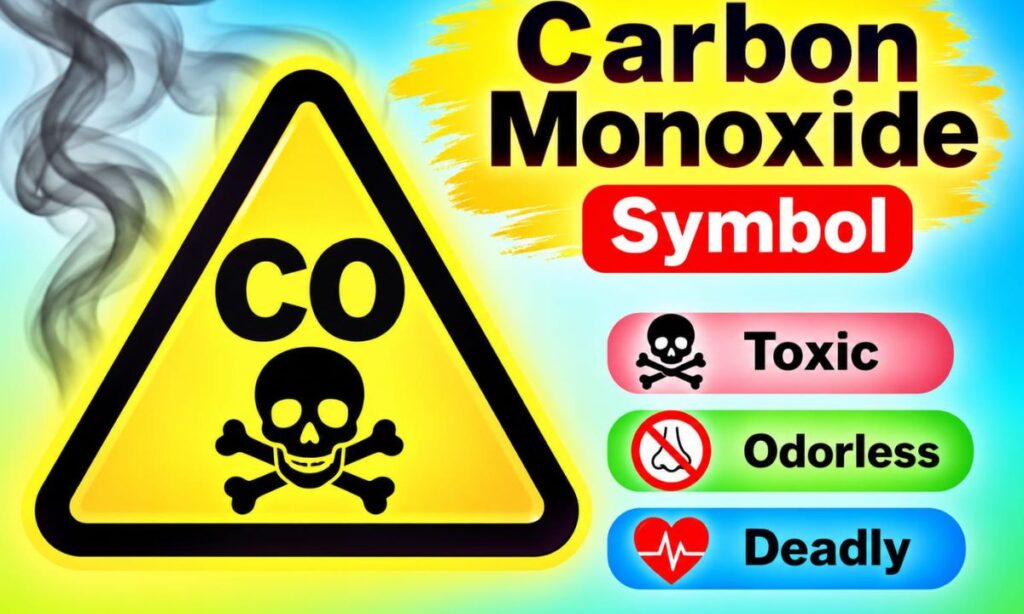
Carbon monoxide is one of those substances everyone has heard of but few people can explain clearly. You’ve seen its symbol on alarms, safety signs, chemistry worksheets, and product packaging but what does it actually mean, and where does it come from?
This guide breaks down the carbon monoxide symbol from every angle: its chemistry, its formula, its appearance on detectors, and even copy paste versions you can use in text or design work. Whether you’re a student studying for a chemistry exam or a homeowner trying to understand what your alarm is telling you, you’ll find the answer here.
What Is the Carbon Monoxide Symbol?
The chemical symbol for carbon monoxide is CO: a capital “C” followed by a capital “O.” This isn’t a single element symbol; it’s a molecular formula representing a compound made of one carbon atom bonded to one oxygen atom.
A quick but important distinction: CO (carbon monoxide) is not the same as Co (cobalt). The capitalization matters. In chemical notation, only the first letter of a symbol is capitalized when it stands for a single element so “Co” with a lowercase “o” refers to the element cobalt, while “CO” in all capitals refers to the compound carbon monoxide.
| Carbon Monoxide Symbol | Meaning | Type |
|---|---|---|
| CO | Carbon monoxide | Chemical compound |
| Co | Cobalt | Chemical element |
| CO₂ | Carbon dioxide | Chemical compound |
Read Also This Blog: Incredible Carcinogen Symbols
Carbon Monoxide Symbol Meaning
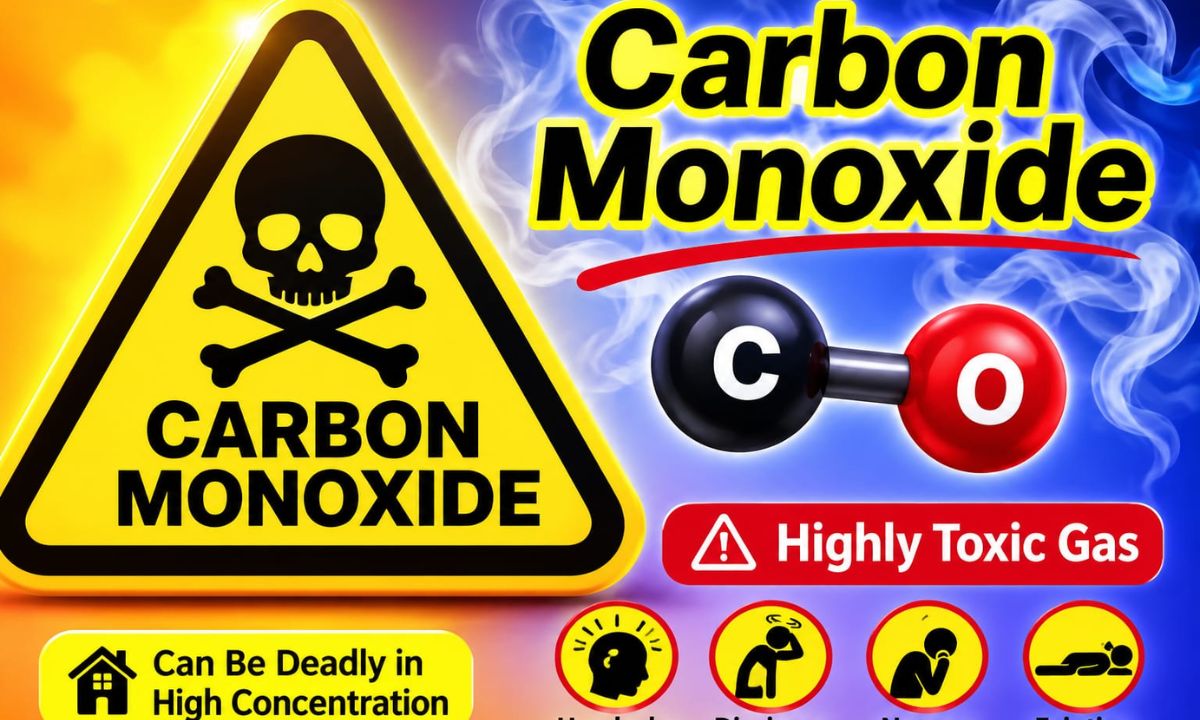
The letters in the CO symbol aren’t arbitrary each one tells you exactly what the molecule contains:
- C stands for one atom of carbon
- O stands for one atom of oxygen
Together, they form a diatomic molecule connected by a strong triple bond. This bond is one of the reasons carbon monoxide is so dangerous: it’s stable enough to bind tightly to hemoglobin in the human bloodstream, blocking oxygen from being carried through the body.
Carbon monoxide forms when carbon based fuels like gasoline, wood, propane, coal, or natural gas burn without enough oxygen for complete combustion. This is called incomplete combustion, and it’s the reason cars, furnaces, generators, and gas stoves can all produce this gas if they’re not functioning or ventilated properly.
Carbon Monoxide Symbol Copy and Paste
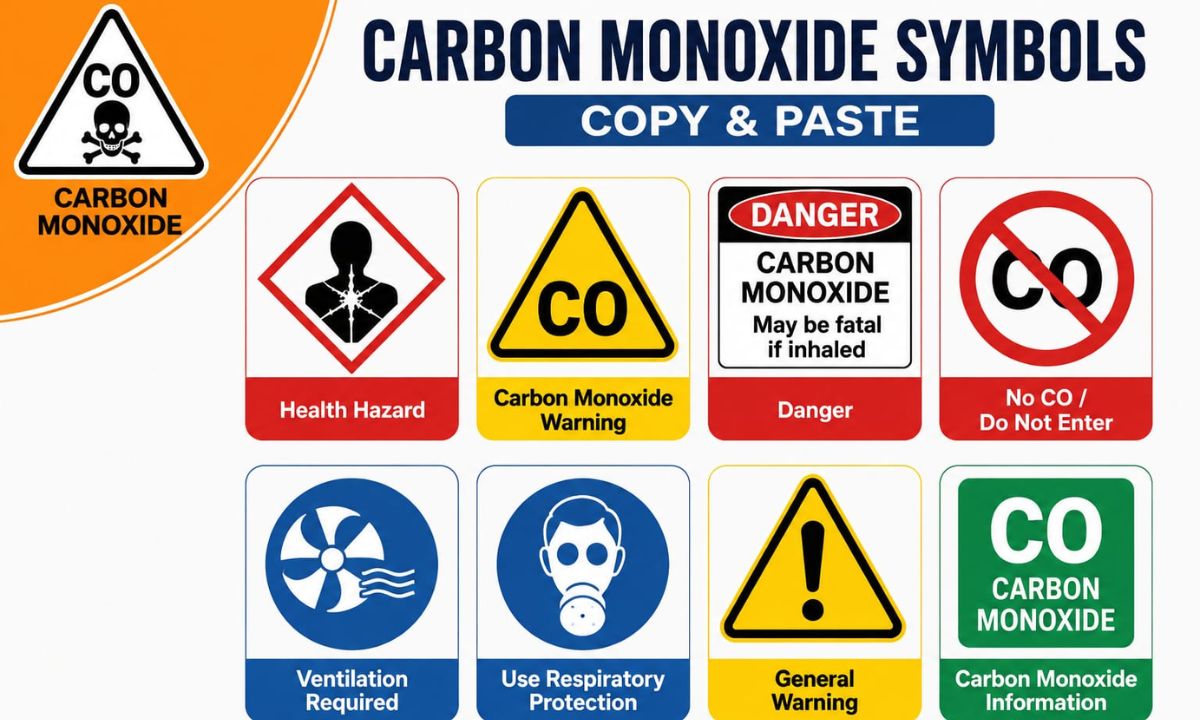
If you need the carbon monoxide symbol for a document, presentation, safety poster, or social post, here are ready to use versions you can copy directly:
- CO Standard chemical formula (plain text).
- CO₂ (Style subscript) Not applicable to CO since it has only one atom of each element, unlike CO₂.
- ☠️ Skull and crossbones, often used to represent toxic gas danger.
- ⚠️ General warning symbol used on CO alarms and signage.
- 🚨 Alert/alarm symbol, often paired with CO warnings in emoji form.
- 🔥 Combustion symbol, sometimes used alongside CO to represent its fuel burning origin.
There is no official Unicode emoji specifically for “carbon monoxide” the way there is for fire or skulls, so most people combine the plain-text formula CO with a warning emoji when they want a quick, recognizable visual online.
List of 5 Carbon Monoxide Symbol Variations
- CO: The standard scientific/chemical symbol.
- CO (in a red circle): Used on hazard labels and safety signage.
- CO (on a detector display): Appears as a digital readout when gas is detected.
- Skull & crossbones with “CO”: Common on industrial warning placards.
- Molecular diagram (C≡O): Used in chemistry textbooks to show the triple bond.
Carbon Monoxide Symbol Emoji
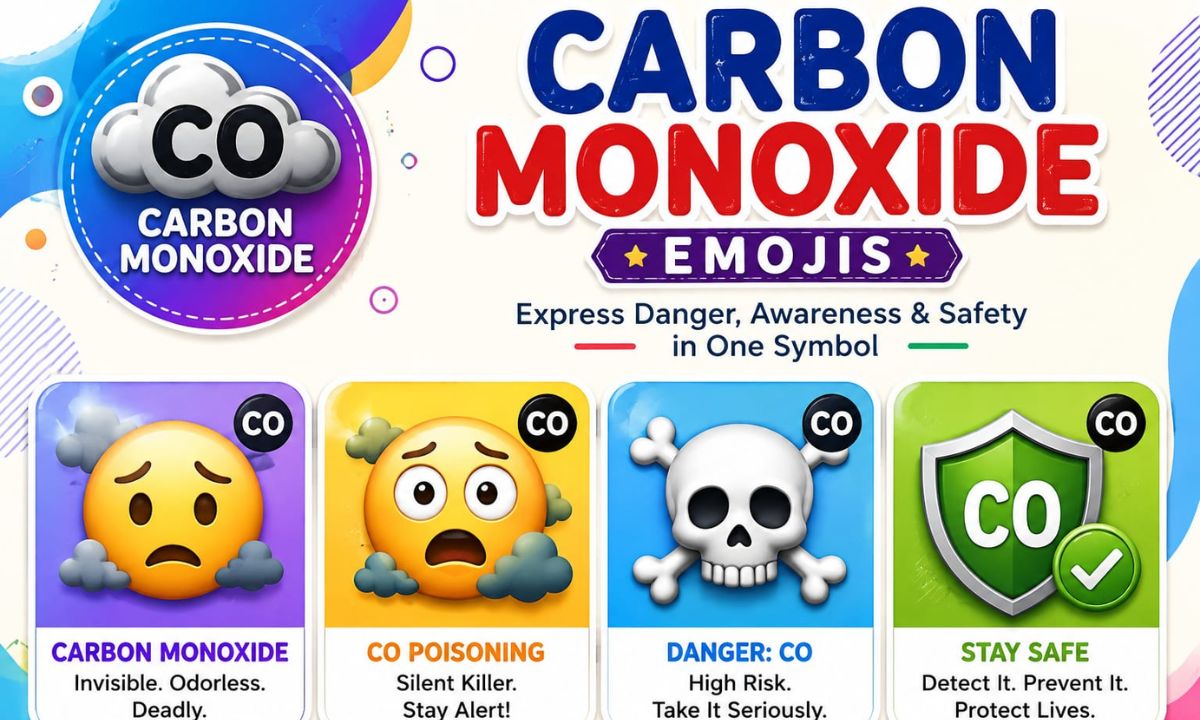
There isn’t a dedicated carbon monoxide emoji in the standard Unicode set, which is why people rely on combinations instead. The most common emoji pairings used to represent carbon monoxide online include:
- ⚠️ + CO (warning symbol paired with the text formula).
- ☠️ (skull and crossbones, representing toxicity).
- 🏠 + 💨 (house with gas/smoke, representing indoor exposure).
- 🚗 + 💨 (car with exhaust, representing vehicle-related CO).
These combinations are popular in safety infographics, social media posts, and even text message warnings because they visually communicate danger even without a dedicated emoji.
Carbon Monoxide Structure
Structurally, carbon monoxide is one of the simplest molecules in chemistry, yet also one of the most studied. It consists of:
- One carbon atom
- One oxygen atom
- A triple bond connecting them (two shared electron pairs plus one dative/coordinate bond)
This triple bond gives carbon monoxide a very short and strong bond length compared to other diatomic molecules. It’s this same bond strength that allows CO to bind to iron atoms in hemoglobin more tightly than oxygen does roughly 200 times more strongly which is the underlying reason CO poisoning is so dangerous even at low concentrations.
Carbon Monoxide Valency
Understanding valency helps explain why carbon and oxygen combine the way they do:
| Element | Standard Valency | Role in CO |
|---|---|---|
| Carbon (C) | 4 | Forms a triple bond, donating electrons |
| Oxygen (O) | 2 | Forms a triple bond, including one dative bond |
In carbon monoxide, the bonding doesn’t follow the “typical” valency pattern seen in most carbon or oxygen compounds. Instead, carbon effectively forms three bonds with oxygen through a combination of covalent and dative (coordinate) bonding, which is why CO is often used as a textbook example of non-standard bonding behavior.
Carbon Monoxide Equation
Carbon monoxide is most commonly produced through incomplete combustion. The general equation looks like this:
2C + O₂ → 2CO (incomplete combustion of carbon)
Compare that to complete combustion, which produces carbon dioxide instead:
C + O₂ → CO₂ (complete combustion of carbon)
The difference between these two equations is the entire reason carbon monoxide poisoning happens. When appliances, engines, or heaters don’t get enough oxygen to complete the second reaction, they produce the far more dangerous first one.
Carbon Monoxide Compound
Carbon monoxide is classified as an inorganic compound, despite containing carbon, a fact that surprises many chemistry students. Its key properties include:
- Colorless and odorless (making it especially dangerous, since it can’t be detected without a device)
- Slightly less dense than air, so it can spread and rise
- Combustible under the right conditions
- Chemically reactive, especially with iron containing compounds like hemoglobin
Carbon Monoxide Symbol Atomic Number
Since carbon monoxide is a compound, not an element, it doesn’t have a single atomic number of its own. Instead, it’s made from two elements with their own atomic numbers:
| Element | Atomic Number | Atomic Mass (approx.) |
|---|---|---|
| Carbon (C) | 6 | 12.01 |
| Oxygen (O) | 8 | 16.00 |
| Carbon Monoxide (CO) | Not applicable (compound) | ~28.01 |
Carbon Monoxide Detector: Reading the Symbols
Carbon monoxide detectors and alarms use standardized symbols and codes so users can react quickly. Here’s what you’ll typically see:
- “CO” displayed digitally indicates the alarm has detected carbon monoxide.
- Flashing red light usually signals an active alarm or detected gas.
- Green light normal operating status.
- Yellow/amber light , low battery or malfunction warning.
- Test button icon used to manually check the alarm is working.
FireAngel Carbon Monoxide Symbol
FireAngel, a well known UK safety brand, uses a red LED “CO” indicator combined with a loud audible alarm and a distinct beeping pattern when carbon monoxide is detected. Its alarms typically display a steady green light during normal use and switch to flashing red with an audible siren once gas levels become dangerous.
Carbon Monoxide Symbol in Chemistry and on the Periodic Table
A common point of confusion: carbon monoxide symbol does not appear on the periodic table, because the periodic table only lists elements, not compounds. What you’ll find instead are:
- Carbon (C) Atomic number 6
- Oxygen (O) Atomic number 8
The compound symbol “CO” is a chemistry classroom shorthand, not a periodic table entry. This distinction trips up a lot of students, especially since “CO” looks like it could be an element symbol at first glance.
Carbon Monoxide Symbol on Alarms and in the Home
In residential settings, the carbon monoxide symbol shows up in a few key places:
- On the detector itself: Digital display or printed label reading “CO”.
- On appliance manuals: Warning icons near gas stoves, boilers, and water heaters.
- On safety signage: Often a red circle or triangle with “CO” and a skull icon.
- On smart home apps: A small gas cylinder or cloud icon paired with “CO” alerts.
Where to Place a Carbon Monoxide Symbol/Detector at Home?
- Near sleeping areas, since poisoning often happens during sleep
- On every level of the home, including basements
- Near fuel burning appliances like furnaces, water heaters, and fireplaces
- At least 15 feet from cooking appliances to avoid false alarms
Quick Reference Table
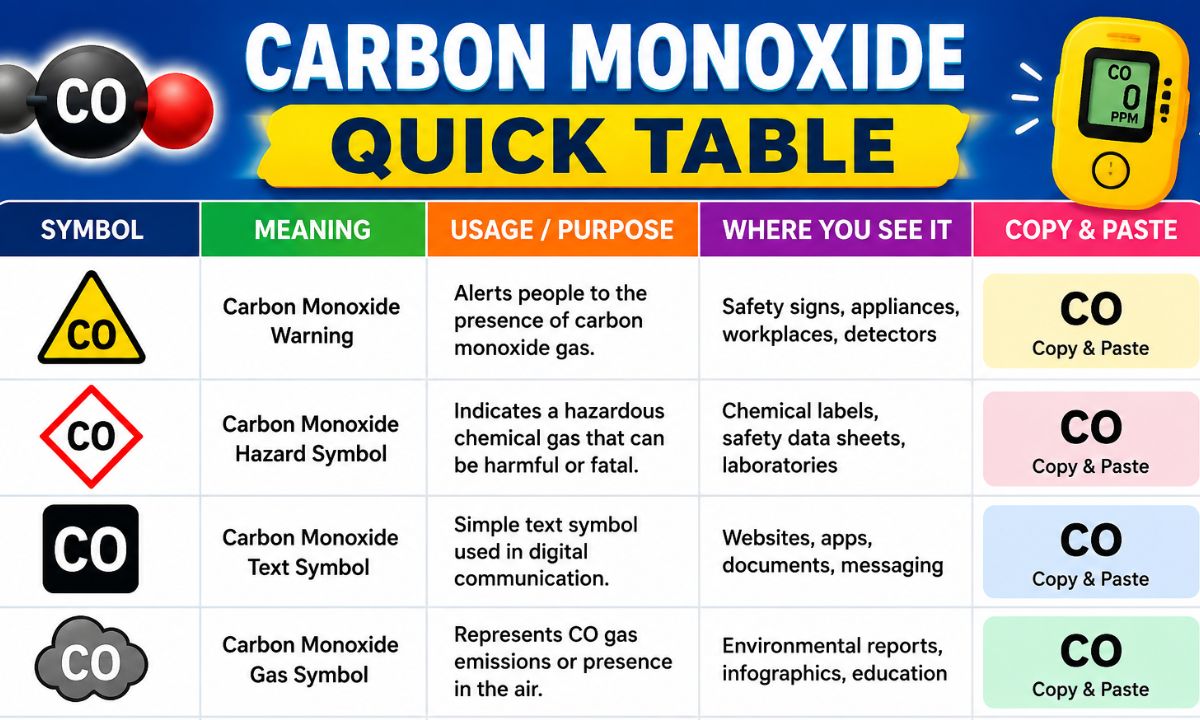
| Term | Carbon Monoxide Symbol / Formula | Category |
|---|---|---|
| Carbon monoxide | CO | Compound |
| Carbon | C | Element |
| Oxygen | O | Element |
| Carbon dioxide | CO₂ | Compound |
| Incomplete combustion equation | 2C + O₂ → 2CO | Chemical reaction |
| Complete combustion equation | C + O₂ → CO₂ | Chemical reaction |
Conclusion
The carbon monoxide symbol CO is simple to write but represents a compound with serious real-world consequences. From its structure and valency to the equations that create it, understanding this symbol helps explain why carbon monoxide detectors exist and why proper home ventilation matters so much. Whether you needed the symbol for a chemistry assignment, a safety poster, or just to understand what your detector is telling you, you now have a complete, accurate picture of what CO means and why it matters.
Frequently Asked Questions
What is the chemical symbol for carbon monoxide?
The chemical symbol is CO, representing one carbon atom bonded to one oxygen atom.
Is CO the same as Co?
No. CO (both capital letters) means carbon monoxide, while Co (capital C, lowercase o) means the element cobalt.
What is the valency of carbon monoxide?
Carbon monoxide involves a triple bond between carbon and oxygen, combining covalent and dative bonding rather than following typical valency rules.
Does carbon monoxide appear on the periodic table?
No, because it’s a compound, not an element. Only carbon and oxygen individually appear on the periodic table.
What is the equation for carbon monoxide formation?
Incomplete combustion is shown as 2C + O₂ → 2CO.
Is there an official carbon monoxide emoji?
No official emoji exists; people typically combine the text “CO” with warning symbols like ⚠️ or ☠️.
What does the CO symbol on my alarm mean?
It means the device has detected carbon monoxide gas and you should leave the area and get fresh air immediately.
