

The hash symbol # is one of the most used characters on the internet, yet most people only know it as the little grid that starts a hashtag. In reality, this tiny symbol carries a long history, dozens of names, and a surprising number of jobs across social media, programming, math, and even phone menus.
In this guide, you will learn what the hash symbol actually means, how to type it on any keyboard, where to copy and paste it instantly, and how it works inside coding languages like JavaScript, Rails, R, and LaTeX. Whether you are a student, a developer, a social media user, or just curious about the octothorpe sitting on your keyboard, this article covers everything you need to know about the hash symbol.
Hash Symbol Meaning
The hash symbol # is a punctuation mark and typographic character that looks like two horizontal lines crossed by two vertical lines, forming a small grid pattern. It is technically classified as Unicode character U+0023.
This symbol goes by many different names depending on where you live and how it is used:
- Hash or hash symbol used in the UK, Australia, and most English speaking countries outside North America 🌍
- Pound sign used commonly in the United States 🇺🇸
- Number sign the formal name used in North America when # means “number,” as in “Room #12” 🔢
- Hashtag used on social media when # comes before a topic or keyword 📱
- Octothorpe a formal and slightly playful name reportedly coined by Bell Labs engineers in the 1960s ☎️
- Crosshatch or grid used informally in design and typography 🔲
Despite the different names, they all refer to the exact same character. The meaning simply shifts depending on the context it appears in, whether that is a text message, a spreadsheet, or a line of code.
Read Also This Blog: Fire Symbol
Hash Symbol Text
If you need it as plain text for documents, chats, or design work, here it is ready to use:#
You can also find similar looking characters that are sometimes confused with the standard hash symbol:
| Symbol | Name | Common Use |
|---|---|---|
| # | Hash or Number Sign | Hashtags, code, numbering |
| # | Fullwidth Hash | Used in Japanese and Chinese typography |
| ♯ | Musical Sharp | Music notation, raises a note by a semitone |
| ⋕ | Increment Symbol | Mathematical notation |
It is worth noting that the musical sharp symbol ♯ looks nearly identical to the hash symbol, but they are technically different characters with slightly different stroke angles. The hash has slanted vertical lines, while the sharp has slanted horizontal lines.
Hash Symbol Copy And Paste
Sometimes typing a symbol is more trouble than it is worth, especially on a device where the shortcut does not work. Below are ready to copy versions of the hash symbol and its close relatives.
- Standard hash symbol: # 📋
- Fullwidth hash symbol: # 📋
- Musical sharp symbol: ♯ 📋
- Hash key emoji: #️⃣ 📋
Simply highlight the character you need and copy it directly into your document, caption, or code editor.
Hash Symbol Use
The hash symbol shows up in more places than most people realize. Here are the most common uses across different fields.
Social Media Hashtags
On platforms like Instagram, X, TikTok, and LinkedIn, the # symbol turns a word or phrase into a clickable, searchable tag. Typing #travel groups your post with every other post using that same tag, making content easier to discover.
Numbering And Ranking
In North America, # is commonly used as shorthand for “number.” For example, “Table #5” or “You are my #1 fan” both use the symbol to represent a numeric position.
Programming And Code Comments
In many programming languages, the hash symbol is used to write comments or denote special syntax. Developers rely on it daily when writing Python, Ruby, R, and shell scripts.
Phone Systems
Automated phone menus often ask callers to “press the hash key” or “press pound,” referring to the # button on a telephone keypad.
Music Notation
In sheet music, a closely related symbol (the sharp ♯) raises a note by a semitone, though this is technically distinct from the standard hash symbol used in text.
Web Development
In HTML and CSS, # plays a functional role. It defines anchor links and ID selectors, which is explained further below.
Hash Symbol On Keyboard
Finding the hash symbol on your keyboard depends on your device and regional layout. Most US keyboards display the # symbol directly above the number 3 key.
| Device | Location |
|---|---|
| US Windows Keyboard | Shift + 3 |
| UK Windows Keyboard | Shift + Backslash or Alt Gr + 3 |
| Mac (US Layout) | Shift + 3 |
| Mac (UK Layout) | Option + 3 |
| iPhone / Android | Tap 123 or #+= on the keyboard |
If pressing Shift + 3 gives you a pound sterling symbol (£) instead of #, your system language is likely set to UK English rather than US English.
Hash Symbol Shortcut
Beyond the standard key combination, there are a few alternative shortcuts to type the hash symbol, especially useful for special formatting or when the direct key does not respond.
- Alt Code (Windows): Hold Alt and type 35 on the numeric keypad, then release Alt ⌨️
- Unicode Input: Type 0023 then press Alt + X in Microsoft Word to convert the code into # 🔤
- Character Map: Open the Character Map app on Windows, search for “number sign,” and copy it directly 🗺️
- HTML Entity: Use
#or#inside HTML code to render the symbol 💻
These shortcuts are especially handy for people working across multiple keyboard layouts or writing code and documents that require precise character input.
Hash Symbol Mac
Typing the symbol on a Mac depends entirely on which keyboard layout is active in macOS settings.
- On a US Mac keyboard, press Shift + 3 to get # 🍎
- On a UK or Irish Mac keyboard, press Option + 3 instead, since Shift + 3 usually produces £ 🇬🇧
- If neither works, open System Settings, check the current keyboard layout, and switch it to match your physical keyboard 🛠️
For quick fixes, copying and pasting the symbol directly is often faster than troubleshooting a shortcut that is not responding.
Star And Hash Symbol
The star (*) and hash (#) symbols are frequently used together, especially on telephone keypads and in interactive voice response systems. Automated phone menus often instruct users with phrases like “press star to repeat this menu” or “press hash to confirm.” Together, these two symbols function as control keys that let users navigate menus without needing a full keyboard.
In texting and casual writing, the star symbol is also used to indicate emphasis (like this), while the hash symbol is reserved almost exclusively for tagging or numbering.
At The Rate And Hash Symbol
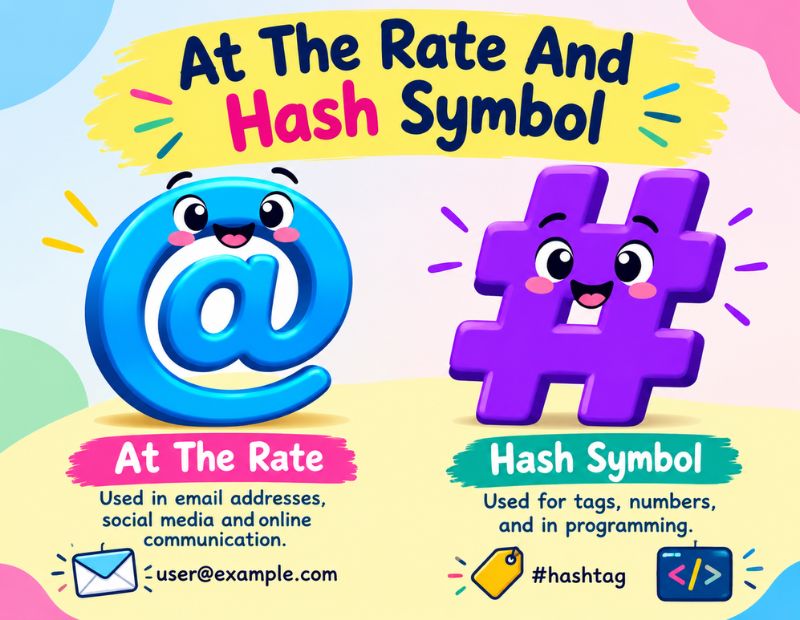
The “at the rate” symbol (@) and the hash symbol (#) are often mentioned together because both are essential building blocks of modern social media.
| Symbol | Common Name | Primary Function |
|---|---|---|
| @ | At symbol or “at the rate” | Tags a specific user or account |
| # | Hash or hashtag | Tags a topic, keyword, or theme |
While @ connects your post to a person, # connects your post to a subject. Using both together, such as “@username #travel,” is one of the most common combinations in modern social posting.
Latex Hash Symbol
In LaTeX, # symbol has a specific technical role rather than being plain text. It is primarily used as a parameter placeholder inside custom command definitions.
For example, when defining a new command that accepts an input value, LaTeX uses #1, #2, and so on to represent the position of each parameter. Because # is a reserved character in LaTeX syntax, typing a literal hash symbol in a LaTeX document requires escaping it with a backslash, written as #, so the compiler does not mistake it for a command parameter.
Hashtag Symbol
The hashtag as a cultural phenomenon is relatively young compared to the symbol itself. In August 2007, designer Chris Messina proposed using the # symbol to group related topics together on Twitter. By 2009, Twitter officially turned hashtags into clickable, searchable links, and other platforms like Instagram, Facebook, TikTok, and LinkedIn quickly followed the trend.
Today, the hashtag symbol transformed from a simple punctuation mark into a global tool for content discovery, marketing campaigns, and online movements. A single hashtag can group millions of posts around one shared topic in seconds.
Markdown Heading Syntax Hash Symbol
In Markdown, one of the most important uses of the hash symbol is creating headings. The number of hash symbols placed before text determines the heading level.
# Heading 1creates the largest, top level heading 📝## Heading 2creates a second level subheading 📝### Heading 3creates a smaller, third level subheading 📝- Additional hash symbols continue creating smaller heading levels down to Heading 6 📝
This simple syntax is why Markdown remains popular for writing documentation, README files, and blog posts without needing complex formatting tools.
Rails 7 Attributes Hash Symbol Keys
In Ruby on Rails, particularly when working with Rails 7, the hash symbol plays an important role in defining symbol keys inside a Ruby hash object. Instead of writing keys as plain strings, developers often write them as symbols using a colon, such as name: rather than "name".
When passing attributes to models or forms, Rails commonly expects hash structures like this: ruby
{ name: "Alex", age: 29, active: true }Here, name, age, and active are symbol keys, which are more memory efficient than string keys and are the standard convention throughout Rails applications, including attribute assignment, strong parameters, and route definitions.
R Comments Hash Symbol
In the R programming language, the hash symbol is used to write comments. Any text following a # on a line is ignored by the R interpreter, making it useful for leaving notes or temporarily disabling a line of code.
Example: r
# This line calculates the average
average <- mean(data)
Unlike some languages that support multi-line comment blocks, R only supports single-line comments, so every commented line must begin with its own #.
ASCII Code
For developers and typists who work with character encoding, the hash symbol has a specific numeric value in both ASCII and Unicode systems.
| Encoding | Code |
|---|---|
| ASCII Decimal | 35 |
| ASCII Hexadecimal | 23 |
| Unicode | U+0023 |
| HTML Entity | # or # |
Knowing the ASCII code is especially useful for typing the symbol using Alt codes or when working with low level programming and encoding tasks.
JavaScript Hash Symbol
In modern JavaScript, it has taken on an important role in class syntax. Since ECMAScript introduced private class fields, developers use # to mark a property or method as private, meaning it cannot be accessed from outside the class.
Example:
javascript
class Example {
  #privateValue = 10;
  getValue() {
    return this.#privateValue;
  }
}
This feature gives developers true encapsulation within JavaScript classes, something that previously required workarounds using naming conventions or closures.
How To Make Dead Links Using The Hash Symbol?
Web developers frequently use the hash symbol to create placeholder or “dead” links during development. Instead of leaving an href attribute empty, developers often write: html
<a href="#">Click Here</a>This creates a clickable looking link that does not navigate anywhere, which is useful for:
- Prototyping a webpage layout before final links are ready 🧩
- Creating buttons that trigger JavaScript functions instead of navigation ⚙️
- Testing design elements without breaking the page structure 🎨
While functional, using a bare # as a placeholder link can sometimes cause the page to jump to the top when clicked, so many developers prefer using href="javascript:void(0);" for a cleaner, non disruptive alternative.
Hash Symbol Punctuation Mark Definition
Formally, the hash symbol is defined as a punctuation mark and typographic symbol represented by two horizontal and two vertical lines intersecting to form a grid pattern. It does not belong to the alphabet or standard numeral system, yet it carries meaning across nearly every digital and written context, from casual texting to advanced programming syntax.
Because its function changes so dramatically depending on where it appears, the hash symbol is considered one of the most versatile punctuation marks in modern written and digital communication.
Hash Symbol Uses At A Glance
| Field | Function of # |
|---|---|
| Social Media | Creates a searchable hashtag |
| Programming (Python, R, Ruby) | Marks a comment line |
| JavaScript | Declares a private class field |
| Markdown | Defines heading levels |
| LaTeX | Represents a command parameter |
| Web Development | Creates anchor links or ID selectors |
| Telephones | Functions as the pound or hash key |
| Music | Closely related to the sharp note symbol |
Conclusion
The hash symbol # may look like a simple grid of four lines, but it carries an impressive range of meanings and functions across everyday life and technology. From starting a trending hashtag on social media to defining a heading in Markdown or securing a private variable in JavaScript, this small character does a lot of heavy lifting.
Whether you needed to know how to type it on your keyboard, copy and paste it instantly, or understand its role inside programming languages like Rails, R, and LaTeX, this guide has walked through every major use case. The next time you see a # symbol, you will know exactly why it is there and what job it is doing.
FAQs
What is the hash symbol called?
It is called a hash, number sign, pound sign, hashtag, or octothorpe, depending on the region and context.
How do I type the hash symbol on a keyboard?
On most US keyboards, press Shift + 3. On UK keyboards, use Alt Gr + 3 or Option + 3 on Mac.
What does the hash symbol mean in programming?
In most languages it marks a comment, while in JavaScript it also denotes a private class field.
Is the hash symbol the same as the sharp symbol in music?
No, they look similar but are different characters with slightly different stroke angles and separate meanings.
How do I copy and paste the hash symbol?
Simply highlight the # character from any text source and use copy and paste like any other text character.
Why does Shift + 3 give me a pound sign instead of a hash symbol?
Your keyboard is likely set to a UK English layout, where Shift + 3 produces £ instead of #.
What is the ASCII code for the hash symbol?
The ASCII decimal code for the hash symbol is 35.
How is the hash symbol used in Markdown?
It creates heading levels, where one # is the largest heading and more hash symbols create smaller subheadings.
