

A smile can travel across the world in less than a second, and that is exactly what a happy sign symbol does every single day. Whether it lands in a text message, a Instagram caption, a birthday card, or a bio on Discord, this small mark carries a big feeling. It says “I am glad” without a single word.
This guide breaks down everything worth knowing about the happy sign symbol. You will find its meaning, ready to use text versions, aesthetic styles, keyboard shortcuts, and even where these symbols show up in art, love, and nature. Every symbol below is copy and paste ready, so you can grab what you like and drop it straight into your next chat, post, or design.
A Short History of the Happy Symbol
Long before smartphones existed, people were already looking for ways to show emotion through plain text. In 1982, a computer scientist at Carnegie Mellon University suggested using 🙂 and 🙁 to separate jokes from serious posts on an online message board. That small suggestion is widely credited as the birth of the modern emoticon.
Japan developed its own parallel tradition around the same era, known as kaomoji, which are read straight on rather than sideways. Faces like (^▽^) and (◕‿◕) grew out of this style and remain popular today, especially among fans of manga, anime, and internet culture.
By the late 2000s, emoji arrived from Japanese mobile phone culture and quickly became a global standard, thanks to Unicode adoption across every major operating system. What started as a simple colon and bracket has grown into a rich, expressive system with thousands of icons, and the happy sign symbol remains one of the most used categories within it.
Read Also This Blog: Bored Sign Symbol
What Is a Happy Sign Symbol?
A happy sign symbol is any character, emoji, or small text based icon used to represent joy, contentment, or positive emotion. It can be as simple as a colon and closing bracket typed together, or as detailed as a fully rendered emoji face with rosy cheeks and closed eyes.
These symbols fall into a few broad families:
- Unicode smiley characters such as ☺ and ☻
- Emoji faces such as 😊, 😄, and 🙂
- Text based emoticons such as 🙂 and ^_^
- Kaomoji (Japanese style faces) such as (^▽^) and ٩(◕‿◕)۶
- Cultural symbols of happiness such as 囍, the Chinese double happiness character
People use the term “happy sign symbol” loosely to cover all of these, because the goal is the same in every case: to show a feeling that plain text alone cannot fully express.
Emoji vs Emoticon vs Kaomoji vs Symbol
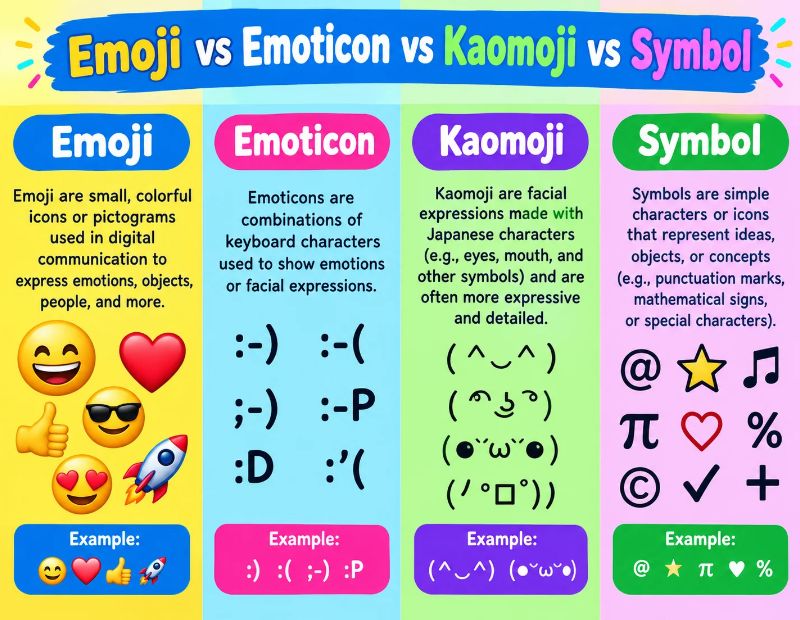
People often use these four terms interchangeably, but each one has a distinct meaning worth understanding before you choose which happy sign symbol fits your message.
| Term | Definition | Example |
|---|---|---|
| Emoji | A small digital image or icon rendered by the device or app | 😊 😄 🥰 |
| Emoticon | A face built from standard keyboard punctuation, read sideways | 🙂 😀 |
| Kaomoji | A Japanese style face built from a wider character set, read straight on | (^▽^) |
| Symbol | A single Unicode character representing an idea or object | ☺ 囍 ✿ |
Knowing the difference helps you pick the right option for the right platform. A minimalist Unicode symbol like ☺ works well in usernames and bios where emoji rendering can be inconsistent, while a full color emoji like 😊 is better suited for casual chats and social captions where visual detail matters more.
Happy Sign Symbol Meaning
At its core, a happy sign symbol represents joy, satisfaction, warmth, or good news. But the exact meaning can shift slightly depending on the version used.
| Symbol Type | Common Meaning | Typical Use |
|---|---|---|
| ☺ / ☻ | Classic contentment, calm happiness | Casual chat, retro or minimal designs |
| 😊 | Warm, gentle happiness with a hint of shyness | Friendly messages, thank you notes |
| 😄 / 😁 | Big, open joy or excitement | Celebrations, good news |
| 🙂 / 🙂 | Simple friendliness or agreement | Texting, forums, emails |
| (^▽^) | Cheerful, animated happiness | Anime fan chats, kaomoji lovers |
| 囍 | Doubled joy, shared happiness | Weddings, Chinese New Year |
A smiley face is never just decoration. Studies on digital communication point out that emotional symbols like these help reduce the ambiguity of plain text, since tone is hard to read from words alone. A happy sign symbol fills that gap by signaling friendliness, humor, sincerity, or excitement in a way a sentence sometimes cannot.
Why People Use Happy Sign Symbols So Often?
- They add emotional context instantly.
- They soften a message that might otherwise sound blunt.
- They make replies feel warmer and more personal.
- They are quick to type and universally recognized.
- They work across almost every platform and device.
Happy Sign Symbol Text
Text based happy symbols are the oldest form of digital emotion, going back to the early days of internet forums and instant messaging, long before colorful emoji existed. These are built entirely from keyboard characters, which makes them light, fast, and compatible with almost any app.
Here are some popular happy sign symbol text versions:
- 🙂
- 🙂
- 😀
- ^_^
- ^-^
- =)
- (:
- :]
- xD
- ☺
- ☻
Kaomoji Style Happy Text Faces
Kaomoji are a Japanese style of emoticon that use a wider range of characters to build more expressive faces. Unlike Western emoticons, which are read sideways, kaomoji are read straight on.
- (^▽^)
- (◕‿◕)
- ٩(◕‿◕)۶
- (。◕‿◕。)
- ヽ(^◇^)ノ
- (⌒‿⌒)
- ᕙ(⇀‸↼‶)ᕗ
- (๑˃ᴗ˂)ﻭ
- ヽ(´▽`)/
- (づ。◕‿‿◕。)づ
These text faces are especially popular because they do not rely on emoji fonts. They render the same way on any device that can display basic Unicode text, which is why they remain popular for usernames, bios, and minimalist designs.
Happy Sign Symbol Copy And Paste
Below is a ready to use collection you can copy and paste directly. No downloads or apps needed, just click, copy, and paste into your chat, caption, or document.
Classic Smiley Symbols
☺ ☻ ㋡ ヅ ヽ(´▽`)/ ٩(◕‿◕)۶
Emoji Style Happy Faces
😀 😃 😄 😁 😊 🙂 🙃 😉 😆 🥰
Text Emoticons
🙂 🙂 😀 ^_^ =) (: xD
Kaomoji Happy Faces
(^▽^) (◕‿◕) (。◕‿◕。) (⌒‿⌒) (づ。◕‿‿◕。)づ ᕙ(⇀‸↼‶)ᕗ
Cultural And Decorative Symbols
囍 (Double Happiness) ⚘ ❀ ✿ ✨
Quick Copy Table
| Category | Ready to Copy Symbols |
|---|---|
| Minimal Unicode | ☺ ☻ ㋡ ヅ |
| Emoji Faces | 😀 😊 😄 🥰 🙂 |
| Text Emoticons | 🙂 😀 ^_^ =) |
| Kaomoji | (^▽^) (◕‿◕) ٩(◕‿◕)۶ |
| Cultural Symbol | 囍 |
Tip: On most phones and computers, tapping or clicking a symbol from a webpage automatically copies it, so you can paste it straight into your keyboard app, notes, or social media caption.
Happy Sign Symbol Aesthetic
Aesthetic happy symbols are used to match a particular vibe, whether that is soft and pastel, minimalist, retro internet, or cottagecore. These are popular for Instagram bios, Pinterest boards, journaling, and digital planners.
Some aesthetic happy sign symbol ideas include:
- ⋆。°✩ paired with soft smiley faces
- ˚ · . happy vibes only . · ˚
- pastel style kaomoji such as (。•́‿•̀。)
- minimal line style faces like ᵔ ᴗ ᵔ
- combinations with hearts, stars, and flowers, such as ♡ ⋆。°✩ ☺
Popular Aesthetic Combos
| Aesthetic Style | Example Combo |
|---|---|
| Soft Pastel | ⋆。°✩ (◕‿◕) ✩°。⋆ |
| Y2K Retro | ☆: .。. o(≧▽≦)o .。.:☆ |
| Minimalist | ᵔ ᴗ ᵔ |
| Cottagecore | ❀ (。•̀ᴗ-)✧ ❀ |
| Cute Kawaii | ૮ ˶ᵔ ᵕ ᵔ˶ ა |
These aesthetic symbols work well in bios, captions, journal spreads, and even in digital scrapbooking, since they add personality without needing an actual image file.
Happy Sign Symbol PNG
Sometimes a text symbol is not enough, especially for design work, presentations, YouTube thumbnails, or printed materials. That is where PNG versions of happy sign symbols come in handy, since they support transparent backgrounds and can be resized without losing quality.
Where to Find Happy Sign Symbol PNGs?
- Icon libraries that offer free vector and PNG downloads
- Emoji resource sites that provide official platform designs as image files
- Design tools that let you export a smiley icon as a transparent PNG
- Stock graphic sites offering hand drawn or flat design happy icons
Tips for Using a Happy Symbol PNG
- Choose a transparent background version so it blends into any design
- Match the icon style, flat, 3D, or line art, to the rest of your project
- Keep the resolution high enough that it does not blur when resized
- Check the license before using it commercially
PNG happy symbols are especially useful for presentations, posters, greeting cards, and social media graphics where a plain text character will not display consistently across devices.
Happy Sign Symbol Emoji On Social Media
Social media is where the happy sign symbol truly thrives. Each platform has its own culture around how these symbols get used.
| Platform | Common Happy Symbol Usage |
|---|---|
| Captions, bios, story stickers, comment replies | |
| Twitter / X | Quick reactions, quote tweets, thread endings |
| TikTok | Comment sections, captions expressing excitement |
| Discord | Custom emoji reactions, status messages |
| Casual chat, confirming plans, greetings | |
| Reactions, comments, event replies |
Why Emoji Boost Engagement?
Marketers and social media managers often note that posts including a well placed happy emoji or symbol tend to feel more approachable and get more replies than plain text posts. A single 😊 or ✨ at the end of a caption can soften a call to action, making it feel like a suggestion rather than a demand.
Best Practices for Using Happy Symbols on Social Media
- Use one or two symbols per post rather than overloading a caption.
- Match the symbol to your brand tone, playful, elegant, or minimal.
- Pair a happy sign symbol with a genuine, benefit driven caption.
- Avoid stacking too many similar emoji, since it can look spammy.
Happy Sign Symbol In Art
Happy symbols have a long history in visual art, long before emoji existed. Artists and designers have used simplified joyful faces and shapes for centuries.
- Ancient pottery and murals sometimes featured stylized smiling faces representing gods of joy or festivity.
- Folk art traditions across many cultures used sun faces, flowers, and animals as symbols of happiness and good fortune.
- Modern pop art frequently reimagines the smiley face, turning it into a bold cultural icon.
- Street art and graffiti often use exaggerated happy faces to bring warmth to urban spaces.
- Digital illustration and character design rely heavily on simplified happy expressions to make characters instantly likable.
The smiley face itself became a design icon in the 1960s, when a simple circle with two dots and a curved line turned into one of the most recognized symbols on the planet. That same basic shape is the direct ancestor of the emoji faces used today.
Happy Sign Symbol And Love
Happiness and love are closely linked, which is why happy sign symbols often appear alongside heart symbols in messages, cards, and posts.
Common pairings include:
- 😊❤️ for warm affection.
- (◕‿◕)♡ for a cute, playful love note.
- ☺ ✨ for gentle, content love.
- 🥰 for happy, loving excitement.
- 囍 for celebratory love, especially in weddings.
Where Love and Happy Symbols Meet?
- Wedding invitations, especially featuring 囍, the Chinese double happiness symbol.
- Anniversary messages combining smiley faces with hearts.
- Valentine’s Day captions using both joyful and romantic icons.
- Friendship messages using softer happy symbols to express warmth without romantic intent.
These combinations help separate platonic warmth from romantic love, since the choice of symbol shapes how a message is read emotionally.
Happy Sign Symbol And Nature
Nature has always been tied to feelings of happiness, calm, and renewal, and this connection shows up clearly in symbol culture.
| Nature Symbol | Happiness Association |
|---|---|
| ☀️ Sun | Warmth, energy, positivity |
| 🌸 Blossom | Renewal, gentle joy |
| 🌈 Rainbow | Hope, cheerful surprise |
| 🍀 Clover | Luck and good fortune |
| 🌻 Sunflower | Bright, open happiness |
Many cultures historically linked specific plants, animals, and weather patterns to joy long before digital symbols existed. The sun, in particular, appears again and again as a universal marker of positive feeling, which is why so many happy emoji designs are built around a simple round, glowing shape.
Nature inspired happy sign symbols are especially popular in aesthetic content, journaling, and eco friendly branding, where a soft, organic symbol feels more genuine than a bold digital emoji.
How To Type A Happy Sign Symbol On The Keyboard?
You do not always need to copy and paste. Most devices let you type happy sign symbols directly using shortcuts or built in keyboards.
On Windows
- Open the Emoji Panel by pressing Windows key + period (.)
- Search for “happy” or “smile” in the search bar
- Click the symbol to insert it directly into your text field
On Mac
- Press Control + Command + Spacebar to open the emoji viewer
- Type “happy” or “smile” into the search box
- Double click the symbol to insert it
On iPhone or iPad
- Go to Settings > General > Keyboard > Keyboards
- Tap Add New Keyboard and select Emoji
- While typing, tap the globe icon to switch to the emoji keyboard
- Search or scroll to find a happy face and tap to insert it
On Android
- Open your keyboard while typing in any app
- Tap the smiley face icon on the keyboard toolbar
- Browse or search for a happy emoji and tap to add it
Using Unicode Shortcodes
Some apps and platforms support typing a code that automatically converts into an emoji, such as typing 🙂 or :blush:, which then renders as the matching happy face icon.
Quick Reference Table
| Device | Shortcut |
|---|---|
| Windows | Windows key + . |
| Mac | Control + Command + Space |
| iPhone / iPad | Emoji keyboard via globe icon |
| Android | Smiley icon on keyboard toolbar |
Common Mistakes to Avoid When Using Happy Sign Symbols
Even a small symbol can be misused. Keep these tips in mind so your happy sign symbol always lands the way you intend.
- Overloading a message with too many symbols, which can make a caption feel cluttered or insincere.
- Using a symbol that clashes with the tone of the message, such as a playful kaomoji in a formal apology.
- Ignoring platform rendering differences, since the same emoji code point can look slightly different on iOS, Android, and Windows.
- Copying low quality symbols from unreliable sites, which sometimes insert hidden characters or broken formatting.
- Forgetting accessibility, since screen readers announce emoji names aloud, so stacking many icons together can create a confusing listening experience.
A Simple Checklist Before You Post
- Does the symbol match the emotional tone of the message.
- Is it appropriate for the platform and audience.
- Have you avoided repeating the same symbol too many times.
- Does it render properly on both mobile and desktop.
- Would the message still make sense without it.
Final Thoughts
A happy sign symbol is a small piece of digital language that carries a very human message: joy is worth sharing. From the earliest text emoticons to today’s colorful emoji and aesthetic kaomoji, these symbols have grown into a shared visual vocabulary that crosses borders and languages.
Whether you want a simple ☺, a warm 😊, a playful (^▽^), or a culturally rich 囍, there is a happy sign symbol suited to almost every mood, message, and platform. Keep this guide handy the next time you want to copy, paste, or type a little extra happiness into your day.
Frequently Asked Questions
What does the happy sign symbol mean?
It represents joy, warmth, or contentment, used to add emotional tone to a message that plain text cannot express on its own.
Is ☺ the same as 😊?
Both represent happiness, but ☺ is a simple Unicode character while 😊 is a full colored emoji with more visual detail.
Can I copy and paste happy sign symbols on any device?
Yes, most happy sign symbols are Unicode based, so they work across phones, tablets, and computers without any special app.
What is the Chinese symbol for happiness?
It is 囍, known as the double happiness symbol, commonly used during weddings and festive celebrations.
How do I quickly type a smiley face on my phone?
Tap the emoji or globe icon on your keyboard, then search for “happy” or “smile” to find a suitable symbol instantly.
Are kaomoji and emoji the same thing?
No, kaomoji are built from keyboard text characters, while emoji are actual image based icons rendered by the device or platform.
Can I use happy sign symbols in professional messages?
Yes, in moderation. A simple 😊 or 🙂 can make a professional message feel more approachable without seeming unprofessional.
