

A red cylinder on a wall. A small icon on a floor plan. A tiny picture on an emoji keyboard. All of these are called the fire extinguisher symbol, and each one does a different job.
In this guide you will learn what the symbol means, where it is used and how the class symbols (A, B, C, D and K) work. You will also get copy and paste characters, steps for Word, Excel and AutoCAD, tips for evacuation plans, and safety facts that can help you pick the right extinguisher.
Quick answer: the fire extinguisher emoji is 🧯 (Unicode U+1F9EF). On safety signs, the standard fire extinguisher symbol is a white extinguisher pictogram on a red square, and class symbols on the label tell you which fires the unit can fight.
What Is a Fire Extinguisher Symbol?
A fire extinguisher symbol is a picture, shape or character that stands for a fire extinguisher or for the type of fire it can put out. It is designed to be understood at a glance, without reading any words.
There are three main families of symbols:
- Location symbols: show where an extinguisher is. You see them on signs, floor plans and evacuation maps.
- Class symbols: show what type of fire the extinguisher can handle. You see them on the label of the unit itself.
- Digital symbols: the emoji 🧯 and icon files such as PNG, SVG and DWG, used in messages, documents and drawings.
Keep these three apart in your mind. Mixing them up is the most common mistake people make, and it can lead to using the wrong extinguisher on the wrong fire.
Read Also This Blog: Fax Machine Symbol
Purpose of the Fire Extinguisher Symbol
The main purpose is speed. In an emergency, nobody has time to read a manual. A clear symbol tells you where to run and what to grab.
Here are the key purposes:
- Show people where the nearest extinguisher is located.
- Tell users which fire classes the extinguisher is safe to use on.
- Warn users when an extinguisher could make a fire worse.
- Support evacuation plans, fire drills and safety audits.
- Help inspectors and building managers keep records and layouts consistent.
- Remove language barriers, since pictograms work across countries.
Extinguishers are labelled with either letter shaped or picture based symbols that show the types of fires they are meant for. Most units are rated for more than one class, and the label should carry a symbol for each hazard.
15+ Powerful Meanings and Uses of the Fire Extinguisher Symbol
The symbol carries different messages depending on where you meet it. Here are 16 meanings and uses.
- Extinguisher location: marks the spot where the unit hangs.
- Fire safety: a general sign of protection and preparedness.
- Class A suitability: the unit works on ordinary combustibles.
- Class B suitability: the unit works on flammable liquids and gases.
- Class C suitability: the unit is safe for energized electrical equipment.
- Class D suitability: the unit is made for combustible metals.
- Class K suitability: the unit is made for cooking oils and fats.
- Danger warning: a red slash across a symbol means the extinguisher should not be used on that fire.
- Evacuation planning: marks equipment on exit maps.
- Floor plan layout: shows planned placement in architectural drawings.
- Inspection tracking: appears on checklists and tags.
- Workplace compliance: signals that the site meets safety rules.
- Emergency preparedness: used on posters, drills and training slides.
- Problem solving in chat: the emoji 🧯 can mean calming down a heated situation.
- Crisis management: teams use it as a joke or a status marker when fixing an urgent issue.
- Brand and design element: used in infographics, apps and safety campaigns.
Characteristics of a Fire Extinguisher Symbol
A strong fire extinguisher symbol follows a few simple design rules. If you create one or buy one, check for these traits.
- High contrast: white on red is common for location signs, so it stands out in smoke or low light.
- Simple shape: a cylinder body, a handle, a hose or nozzle and a pin.
- Standard colours: red for fire equipment, with class symbols using set shapes and colours.
- Scalable: it stays clear on a tiny label and on a large wall sign.
- Consistent style: all icons in one drawing should match.
- Readable without text: people from different countries should understand it.
Class Symbol Shapes and Colours (US Letter Style)
The older letter style symbols use a shape and colour for each class. Many sites still have extinguishers labelled this way.
| Class | Shape | Colour | Letter |
|---|---|---|---|
| Class A | Triangle | Green | A |
| Class B | Square | Red | B |
| Class C | Circle | Blue | C |
| Class D | Five point star | Yellow | D |
| Class K | Hexagon | Black | K |
Newer labels use pictograms, such as a burning trash can and wood for Class A, a flammable liquid can for Class B and an electrical plug for Class C. Pictograms are easier to read under stress, which is why they are now widely used.
Fire Extinguisher Symbol Text
Sometimes you need the symbol as plain text. There is no single text character that draws an extinguisher, so people use these options:
- The emoji: 🧯 works as a text character you can paste anywhere.
- Abbreviations: FE is a common label for a fire extinguisher on plans, and FEC is often used for a fire extinguisher cabinet.
- Bracket labels: [Fire Extinguisher] or (FE) for plain text notes.
- Related symbols: 🔥 for fire, 🚨 for an alarm, ⚠ for a warning and 🚪 for an exit.
Use the full words in important notices. A symbol alone should never be the only message in a safety document.
Fire Extinguisher Symbol Emoji
The fire extinguisher emoji is 🧯. It was added in Unicode 11.0 in 2018, and its official name is fire extinguisher. It shows a red cylinder with a nozzle and a handle.
What it means: fire safety, emergency preparedness and putting out fires. In casual chat it often means stopping a problem before it grows, such as calming an argument.
Where it works: messages, social posts, captions, newsletters, slides and web copy.
A note on design: Apple, Google, Samsung and Windows each draw the emoji in their own style, so it may look slightly different on another phone.
Example: Fire drill at 3 PM today 🚨🧯 Please check the evacuation plan.
Technical Codes for 🧯
| Format | Code |
|---|---|
| Unicode | U+1F9EF |
| HTML decimal | 🧯 |
| HTML hex | 🧯 |
| CSS | \1F9EF |
| JavaScript | \u{1F9EF} |
| Python | \U0001F9EF |
Fire Extinguisher Symbol Copy and Paste
The quickest way is to copy it from here. Highlight the symbol, copy it and paste it into your message or document.
Fire extinguisher symbol:
🧯
Related fire safety symbols:
🔥 🚒 🚨 ⚠ 🚪 🧯 ⛔
Ready to use examples:
- 🧯 Fire extinguisher located near the exit
- 🧯 Inspection due: first Monday of the month
- ⚠ Class K extinguisher for kitchen use only
How to Copy and Paste?
- Select the symbol with your mouse or finger.
- Press Ctrl + C on Windows or Command + C on Mac. On a phone, tap Copy.
- Click where you want it and press Ctrl + V or Command + V. On a phone, tap Paste.
Type It Without Copying
- Windows 10 and 11: press the Windows key and the period key, then search for fire extinguisher.
- Mac: press Control, Command and Space, then search for extinguisher.
- Phones: open the emoji keyboard and type fire in the search bar.
- Word: type 1F9EF and press Alt + X.
Fire Extinguisher Symbol in Plan
On building plans, an extinguisher is shown with a small, simple icon. It is often drawn as a small rectangle or a simplified extinguisher shape, usually in red. The goal is to be clear enough that anyone reading the drawing can find it.
Common plan symbols sit beside other fire equipment icons:
| Item | Typical Plan Symbol |
|---|---|
| Fire extinguisher | Red extinguisher icon or small rectangle |
| Fire hose | Coiled hose symbol |
| Fire alarm pull station | Box with a hand or button |
| Fire blanket | Small square with a blanket icon |
| Exit sign | Green or red running figure with an arrow |
Standards such as ISO 7010 for safety signs and NFPA 170 for fire safety symbols help keep drawings consistent. Always check your local code, since rules differ by region.
Placement Tips for Plans
- Place symbols at every location where an extinguisher is actually mounted.
- Keep symbols the same size across all floors.
- Add a legend that explains every icon.
- Mark extinguishers near exits, corridors and special hazards.
- OSHA lists a travel distance of 75 feet for Class A and 50 feet for Class B in workplaces.
Fire Extinguisher Symbol for Evacuation Plan
An evacuation plan is the map that people follow when they must leave a building. The extinguisher symbol on it should be easy to spot and easy to understand.
Best practices:
- Use red for fire equipment and green for exits, which is the common colour logic for safety signs.
- Add a YOU ARE HERE marker so readers can find their position.
- Show every route to every exit.
- Include a legend with the extinguisher icon and its meaning.
- Display the plan at eye level near stairs and elevators.
- Update the plan whenever you move equipment.
One airport guideline even recommends that fire equipment and alarm device symbols be red on evacuation signs. That matches what most safety teams already do.
Fire Extinguisher Symbol PNG
A PNG file is a flat image with a transparent background. It is popular for slides, websites, posters and Word documents.
Tips for choosing a good PNG:
- Pick a transparent background so it blends into any design.
- Use a high resolution file, such as 512 pixels or larger, so it does not blur.
- Choose SVG when you need to scale it very large, since SVG stays sharp at any size.
- Check the licence before you use it commercially.
- For official signs, use a symbol that follows ISO 7010 or your local standard.
- Add alt text on websites, such as fire extinguisher location sign.
Fire Extinguisher Symbol in AutoCAD
In AutoCAD, the extinguisher is usually a block. A block is a group of lines saved as one object so you can reuse it again and again.
How to add one:
- Type INSERT in the command line and press Enter.
- Browse to your extinguisher block or choose it from the block list.
- Pick the insertion point on the plan.
- Set the scale and rotation, then click OK.
- Place it on a dedicated layer, such as FIRE_EXT, so you can switch it on or off.
How to make your own:
- Draw the symbol with simple lines and shapes.
- Type BLOCK, name it and select the objects.
- Pick a base point, usually the centre.
- Click OK to save it in the drawing.
Fire Extinguisher Symbol CAD Block
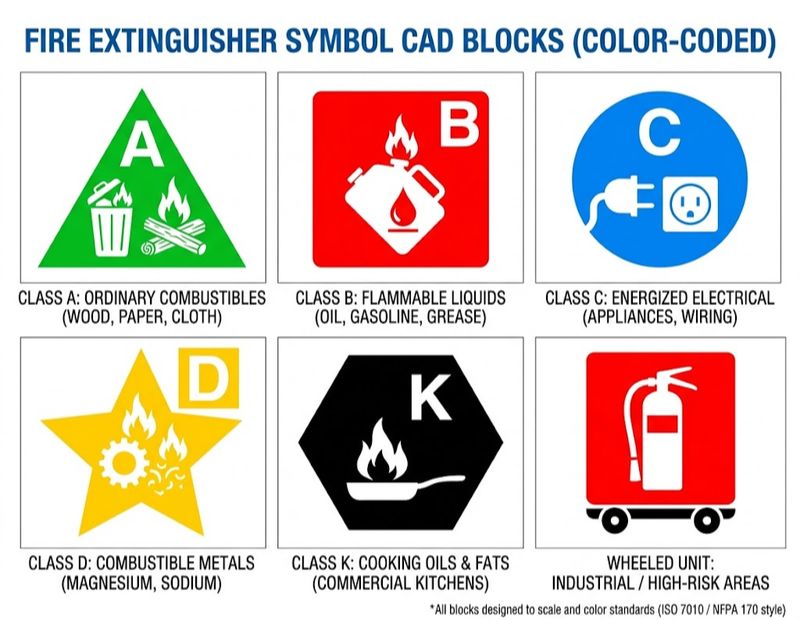
A CAD block saves time and keeps your drawings consistent. Instead of redrawing the icon, you insert the same block each time. If you edit the block, every copy updates.
Benefits of using a CAD block:
- Faster drawing and fewer errors.
- A uniform look across all sheets.
- Smaller file size than many separate objects.
- Easy to attach data, such as extinguisher type or inspection date.
Blocks can be dynamic, which means they can stretch, flip or switch between versions. You can use one dynamic block to show different extinguisher types.
Fire Extinguisher Symbol DWG
DWG is the native file format of AutoCAD. A DWG file of a fire extinguisher symbol is a ready made block that you can open or insert into your own drawing.
How to use a DWG symbol:
- Download the file from a trusted CAD library.
- Open it in AutoCAD, or use INSERT to bring it into your plan.
- Check the units so the size matches your drawing.
- Purge unused layers and objects to keep the file clean.
- Save it to your own block library for future projects.
To turn your own block into a DWG, use the WBLOCK command, which writes the block out as a separate file.
Tip: Always check the source and licence of a free DWG file, and compare the symbol to your local standard before using it on an official drawing.
Fire Extinguisher Symbol in Excel
Excel is useful for extinguisher inspection logs and asset lists. You can add the symbol in a few ways.
Method 1: Copy and paste. Copy 🧯 from this page and paste it into any cell.
Method 2: Emoji keyboard. Click a cell, press the Windows key and the period key, then search for fire extinguisher.
Method 3: UNICHAR formula. Type =UNICHAR(129519) in a cell. Excel returns 🧯 on modern versions.
Method 4: Insert Symbol. Go to Insert, then Symbol, and look for the emoji in a supporting font.
Method 5: Icons. In Microsoft 365, go to Insert, then Icons, and search for fire extinguisher to add a scalable graphic.
Handy Excel Idea
Use the symbol in an inspection tracker. For example, type =IF(C2=”Due”,UNICHAR(129519),””) to show the icon whenever an extinguisher is due for service. This makes your list easy to scan.
Portable Fire Extinguisher Symbol
A portable extinguisher is a unit you can carry by hand. It is the most common type in homes, offices and shops. Its symbol is the classic red cylinder with a hose and handle.
The label on a portable unit shows:
- Class symbols for the fires it can fight.
- A numeric rating, such as 4A or 40B, that shows relative strength.
- Operating instructions, often shown as the PASS method.
- Inspection and servicing tags.
PASS stands for Pull, Aim, Squeeze and Sweep. Pull the pin, aim at the base of the fire, squeeze the lever and sweep from side to side.
A rating of 4A means roughly twice the fire fighting capacity of a 2A unit. A higher number means a bigger fire can be handled.
Comparison of Fire Classes and Their Symbols
| Class | Fuel | Examples | Typical Pictogram |
|---|---|---|---|
| A | Ordinary combustibles | Wood, paper, cloth, many plastics | Burning trash can and wood |
| B | Flammable liquids and gases | Gasoline, oil, grease, solvents | Burning liquid can |
| C | Energized electrical equipment | Appliances, wiring, panels | Plug or electrical symbol |
| D | Combustible metals | Magnesium, titanium, sodium | Burning metal gear or shavings |
| K | Cooking oils and fats | Kitchen fryers, grease | Burning pan |
Class A Fire Extinguisher Symbol
The Class A symbol is a green triangle with the letter A, or a pictogram of a burning trash can and wood pile. It means the extinguisher is suitable for ordinary combustibles.
These are fires in wood, paper, cloth, rubber and many plastics. Water extinguishers work by cooling the fuel, and they carry the Class A rating alone. Never use a water unit on electrical or grease fires.
Class B Fire Extinguisher Symbol
The Class B symbol is a red square with the letter B, or a pictogram of a burning liquid can. It is for flammable liquids and gases, such as gasoline, oil, grease, tar and solvents.
Dry chemical and CO2 units can be rated for Class B. They work by smothering the fuel surface or by interrupting the fire reaction. Keep spraying after the flames die down to stop re ignition.
If the only thing burning is leaking gas, the safest step is usually to shut off the gas supply first.
Class C Fire Extinguisher Symbol
The Class C symbol is a blue circle with the letter C, or a pictogram of a plug and socket. It means the agent will not conduct electricity, so it is safer on energized equipment.
A Class C rating never stands alone in the US. It always comes with a Class A or Class B rating. Once the power is cut off, the fire is treated as a Class A or B fire.
Note: in Europe, Class C refers to flammable gases, and electrical hazards are shown by a separate symbol. Always read the label used in your own country.
Class D Fire Extinguisher Symbol
The Class D symbol is a yellow star with the letter D, or a pictogram of burning metal. It is for combustible metals such as magnesium, titanium and sodium.
Common agents can react with burning metal and make the fire worse. These fires are usually handled with a dry powder made for that metal, or by covering with a dry material such as sand. The nameplate lists the exact metals the unit can handle.
Class K Fire Extinguisher Symbol
The Class K symbol is a black hexagon with the letter K, or a pictogram of a pan with flames. It is made for fires in cooking oils, fats and grease.
These units usually use a wet chemical agent. They are standard in restaurants and commercial kitchens, where deep fryers can reach very high temperatures. Europe uses Class F for the same type of fire.
CO2 Fire Extinguisher Symbol
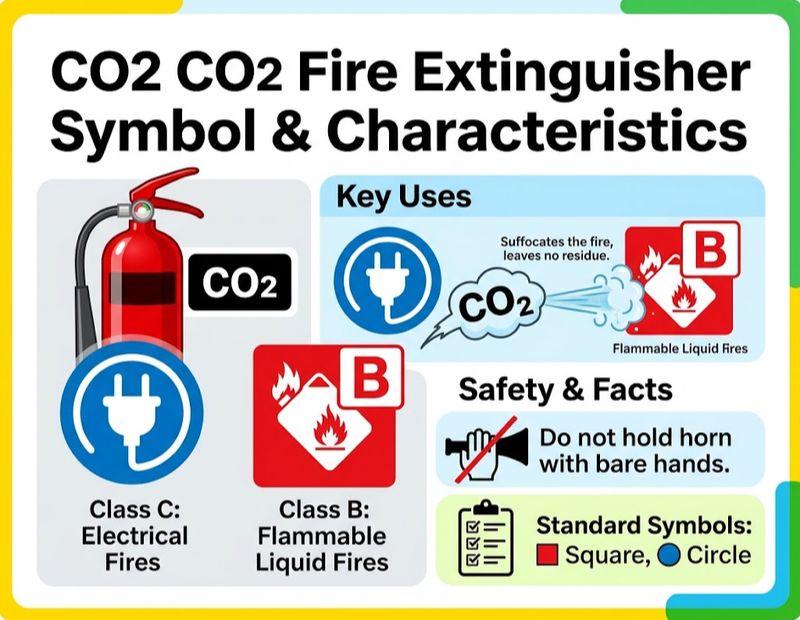
A CO2 extinguisher uses carbon dioxide gas. It is normally rated for Class B and Class C fires, so its label shows the B and C symbols.
Key facts:
- It leaves no residue, which makes it popular for server rooms and labs.
- It has a short range, only a few feet.
- It works by pushing away oxygen and by cooling.
- The horn gets extremely cold, so do not hold it with bare hands.
- It is not the best choice for ordinary combustibles that can smoulder.
In Europe, CO2 units are often marked with a black band or label area.
Wheeled Fire Extinguisher Symbol
A wheeled extinguisher is a large unit mounted on a cart. It holds much more agent than a portable one, so it can fight bigger fires.
You see them at airports, fuel stations, factories and warehouses. The symbol is often the same red extinguisher icon, sometimes drawn with wheels. The label still shows the class symbols for the agent inside, which may be dry chemical, CO2 or foam.
Because of their weight, wheeled units need clear, wide access paths. Never block them with stock or equipment.
Foam Fire Extinguisher Symbol
A foam extinguisher sprays a layer of foam over the fuel. It is usually rated for Class A and Class B, so its label shows both symbols.
The foam cools the fire and seals the surface so vapours cannot rise. It is useful on petrol and paint fires and on solid materials such as wood and paper. Because foam contains water, it is not suited for energized electrical equipment.
Extinguisher Types at a Glance
| Extinguisher Type | Fire Classes | Best For | Avoid On |
|---|---|---|---|
| Water | A | Paper, wood, cloth | Electrical, grease |
| Foam | A, B | Liquids and solids | Energized electrical |
| Dry chemical ABC | A, B, C | Homes, offices, vehicles | Sensitive electronics (residue) |
| CO2 | B, C | Electrical rooms, labs | Large Class A fires |
| Wet chemical | K, A | Commercial kitchens | Electrical |
| Dry powder | D | Metal fires | General use |
Safety Facts Worth Knowing
- In the US, the body colour of an extinguisher has no fixed meaning. You identify the type from the label symbols.
- Always read every symbol on the label, since most units are rated for several classes.
- A red slash across a symbol warns that using the unit on that fire could be dangerous.
- If no symbol is shown for a class, the unit is simply not recommended for that fire.
- Extinguishers should be mounted so the top is not more than 5 feet above the floor for units up to 40 pounds, and the bottom is at least 4 inches off the floor.
- Check extinguishers visually every month and have them serviced yearly.
- If a fire is big, spreading or full of smoke, leave and call the fire service instead.
Common Mistakes to Avoid
- Using a water extinguisher on an electrical or grease fire.
- Ignoring the class symbols and grabbing the nearest unit.
- Hiding extinguishers behind boxes or furniture.
- Forgetting to update the plan when equipment moves.
- Using an unclear or non standard symbol on official drawings.
- Skipping monthly checks and yearly service.
Conclusion
The fire extinguisher symbol is far more than a small red icon. It tells you where equipment is, which fires it can fight and when it can be dangerous. It also helps designers, engineers and inspectors keep plans clear and consistent.
For digital use, copy 🧯 or use the Unicode code U+1F9EF. For drawings, build a CAD block and save it as a DWG. For real emergencies, read the class symbols on the label before you act, and when in doubt, get out and call for help.
Frequently Asked Questions
What is the fire extinguisher symbol?
Fire extinguisher symbol is a pictogram of a fire extinguisher, usually white on a red square, or the emoji 🧯. It marks location or the fire class the unit can fight.
What is the fire extinguisher emoji?
The emoji is 🧯, Unicode U+1F9EF, added in Unicode 11.0 in 2018. It means fire safety or stopping a problem.
How do I copy and paste the fire extinguisher symbol?
Highlight 🧯, press Ctrl + C or Command + C, then paste it with Ctrl + V or Command + V.
How do I insert the fire extinguisher symbol in Word?
Type 1F9EF and press Alt + X, or open the emoji panel with Windows key and period and search fire extinguisher.
How do I add the fire extinguisher symbol in Excel?
Paste 🧯 into a cell, or type =UNICHAR(129519). You can also insert an icon from the Insert menu.
What do the fire extinguisher class symbols mean?
A is ordinary combustibles, B is flammable liquids and gases, C is electrical, D is metals and K is cooking oils.
What are the colours of the class symbols?
In the older US letter style, A is a green triangle, B a red square, C a blue circle, D a yellow star and K a black hexagon.
What does a red slash on an extinguisher symbol mean?
It means the extinguisher should not be used on that type of fire because it could be dangerous.
Which extinguisher is used for a kitchen fire?
A Class K wet chemical extinguisher is made for cooking oil and grease fires in commercial kitchens.
Can I use a CO2 extinguisher on an electrical fire?
Yes. CO2 does not conduct electricity and is rated for Class B and Class C fires.
What is a CAD block of a fire extinguisher symbol?
It is a reusable drawing symbol saved as one object, so you can insert the same extinguisher icon into many plans.
What is a DWG fire extinguisher symbol?
It is a fire extinguisher symbol saved in AutoCAD’s native DWG format, ready to insert into a drawing.
What is a wheeled fire extinguisher?
It is a large extinguisher on a cart, used in industrial sites and airports for bigger fire risks.
Where should the symbol go on an evacuation plan?
Place it at the exact spot of each extinguisher, in red, and include it in the legend.
