

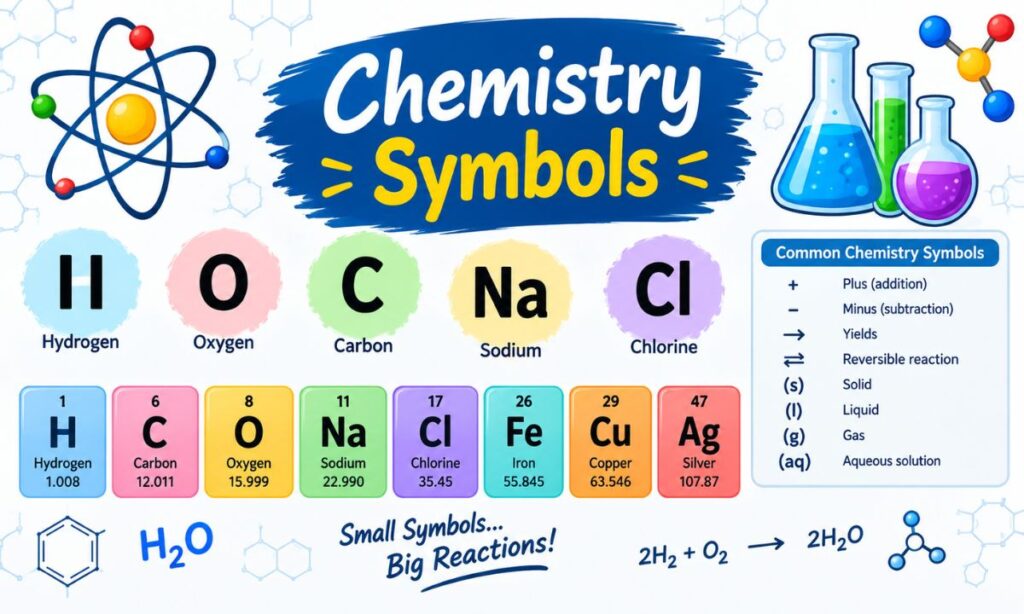
If you’ve ever looked at a periodic table and wondered why gold is “Au” instead of “G,” or why a lab door has a skull-and-crossbones sticker on it, you’ve already bumped into the world of chemistry symbols. These short letters, numbers, and pictograms are the alphabet that every chemist, student, and lab technician uses to communicate no matter what language they speak.
In this guide, you’ll get a complete, easy-to-scan breakdown of chemistry symbols: what they mean, where they came from, how to type them, and how they’re used across organic, physical, and nuclear chemistry. Whether you’re a student prepping for an exam or just curious about that hazard sticker on a cleaning bottle, this article covers it all in one place.
What Do Chemistry Symbols Mean?
A chemistry symbol (also called a chemical symbol or element symbol) is a short abbreviation usually one or two letters that stands for a chemical element. The first letter is always capitalized, and the second letter, if there is one, is always lowercase.
For example:
- H stands for hydrogen
- O stands for oxygen
- Na stands for sodium
- Fe stands for iron
These symbols aren’t random. Most are derived directly from the element’s English name, while others come from Latin, Greek, or German roots. This is why some symbols look nothing like the element’s modern name sodium’s symbol “Na” comes from “natrium,” and iron’s symbol “Fe” comes from “ferrum.”
Chemistry symbols exist so that scientists anywhere in the world regardless of the language they speak can read the same chemical formula and understand it identically. A formula written in Tokyo means exactly the same thing in Toronto.
Read Also This Blog: Semicolon Symbol
A Short History of Chemistry Symbols
Chemistry symbols weren’t always neat one- or two-letter abbreviations. Their history goes through three major phases:
- Alchemical Symbols (Ancient times – 1700s): Early alchemists used pictorial symbols circles, crosses, crescents to represent metals and substances like gold, mercury, and sulfur. These symbols were often tied to astrology, linking metals to planets.
- Dalton’s System (Early 1800s): English chemist John Dalton introduced circular symbols with internal marks to represent atoms, an early attempt at standardization.
- Berzelius’s Letter System (1813 onward): Swedish chemist Jöns Jacob Berzelius proposed using the first letter (or first two letters) of an element’s Latin name. This system was simpler, easier to print, and eventually became the universal standard we still use today.
Modern chemical symbols are now regulated by the International Union of Pure and Applied Chemistry (IUPAC), which approves the name and symbol for every newly discovered element.
Complete Chemistry Symbols List (Common Elements)
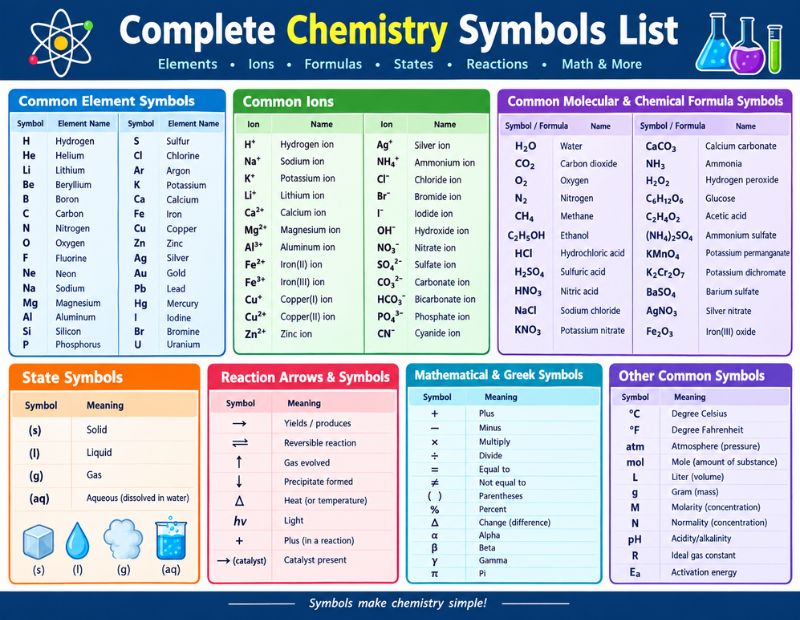
Here is a quick-reference table of the most commonly used chemical symbols, their atomic numbers, and where their names come from.
| Element | Symbol | Atomic Number | Origin of Symbol |
|---|---|---|---|
| Hydrogen | H | 1 | Greek: “hydro” + “genes” (water-forming) |
| Helium | He | 2 | Greek: “helios” (sun) |
| Carbon | C | 6 | Latin: “carbo” (coal) |
| Nitrogen | N | 7 | Greek: “nitron” + “genes” |
| Oxygen | O | 8 | Greek: “oxys” + “genes” |
| Sodium | Na | 11 | Latin: “natrium” |
| Magnesium | Mg | 12 | Named after Magnesia, Greece |
| Aluminium | Al | 13 | Latin: “alumen” |
| Silicon | Si | 14 | Latin: “silex” (flint) |
| Phosphorus | P | 15 | Greek: “light-bearer” |
| Sulfur | S | 16 | Latin: “sulphurium” |
| Chlorine | Cl | 17 | Greek: “chloros” (pale green) |
| Potassium | K | 19 | Latin: “kalium” |
| Calcium | Ca | 20 | Latin: “calx” (lime) |
| Iron | Fe | 26 | Latin: “ferrum” |
| Copper | Cu | 29 | Latin: “cuprum” |
| Zinc | Zn | 30 | German: “zink” |
| Silver | Ag | 47 | Latin: “argentum” |
| Tin | Sn | 50 | Latin: “stannum” |
| Iodine | I | 53 | Greek: “iodes” (violet) |
| Gold | Au | 79 | Latin: “aurum” |
| Mercury | Hg | 80 | Latin: “hydrargyrum” |
| Lead | Pb | 82 | Latin: “plumbum” |
| Uranium | U | 92 | Named after planet Uranus |
There are 118 confirmed elements on the periodic table today, each with its own unique symbol. This table covers the ones most frequently used in school chemistry, everyday science, and general knowledge.
Chemistry Symbol Chart by Category
Elements are also grouped into families that share similar chemical behavior. Here’s a simplified chart showing category, example elements, and their symbols:
| Category | Example Elements | Symbols |
|---|---|---|
| Alkali Metals | Lithium, Sodium, Potassium | Li, Na, K |
| Alkaline Earth Metals | Magnesium, Calcium, Barium | Mg, Ca, Ba |
| Transition Metals | Iron, Copper, Zinc, Silver | Fe, Cu, Zn, Ag |
| Halogens | Fluorine, Chlorine, Iodine | F, Cl, I |
| Noble Gases | Helium, Neon, Argon | He, Ne, Ar |
| Metalloids | Silicon, Boron, Arsenic | Si, B, As |
| Nonmetals | Carbon, Nitrogen, Oxygen | C, N, O |
This chart is a handy way to remember symbols in groups rather than memorizing them one by one — elements in the same family often behave similarly, which makes recall easier.
Chemistry Symbols and the Periodic Table
The periodic table arranges all known elements by increasing atomic number (the number of protons in the nucleus). Each box on the table typically displays:
- The element’s symbol (large, centered letters)
- The atomic number (top corner)
- The element name (below the symbol)
- The atomic mass (bottom of the box)
Reading the periodic table becomes much easier once you’re familiar with the symbols, since rows (periods) and columns (groups) reveal patterns in reactivity, atomic size, and electron configuration. Students preparing for exams often find it useful to print a periodic table and quiz themselves by covering the element name and recalling the symbol instead.
Chemistry Symbols Copy and Paste
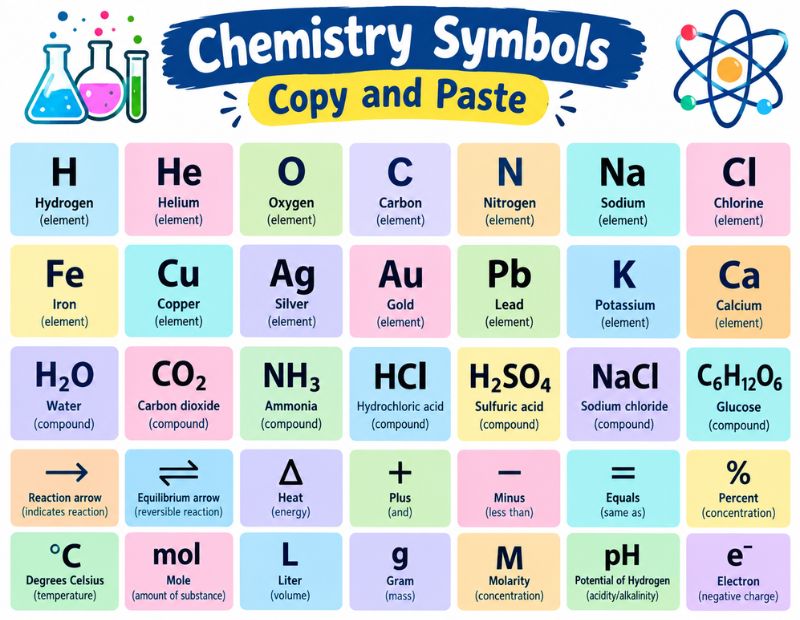
Typing scientific notation like subscripts, superscripts, or special characters (Δ, →, °, ±) can be tricky on a regular keyboard. Below are some commonly copied chemistry symbols you can paste directly into documents, slides, or messages:
→ ⇌ ± ° Δ ∝ ≈ ≠ ≤ ≥ ∞ √ ∴ ∵ ⁰ ¹ ² ³ ⁴ ⁵ ⁶ ⁷ ⁸ ⁹ ₀ ₁ ₂ ₃ ₄ ₅ ₆ ₇ ₈ ₉Common uses:
- → shows the direction of a chemical reaction (reactants to products)
- ⇌ represents a reversible/equilibrium reaction
- Δ (delta) indicates heat is applied to a reaction, or a change in a quantity
- ° is used for degrees (temperature) and for standard state notation
- Subscript numbers show how many atoms are in a molecule (H₂O)
- Superscript numbers show ionic charge or isotope mass number
Chemistry Symbols and Formulas
Chemical symbols combine to form chemical formulas, which describe the exact composition of a compound.
- H₂O – two hydrogen atoms bonded to one oxygen atom (water)
- CO₂ – one carbon atom bonded to two oxygen atoms (carbon dioxide)
- NaCl – one sodium atom bonded to one chlorine atom (table salt)
- C₆H₁₂O₆ – glucose, a simple sugar
There are three common types of chemical formulas:
- Empirical formula – shows the simplest whole-number ratio of atoms (e.g., CH₂O for glucose).
- Molecular formula – shows the actual number of atoms in a molecule (e.g., C₆H₁₂O₆).
- Structural formula – shows how atoms are arranged and bonded within the molecule.
Organic Chemistry Symbols
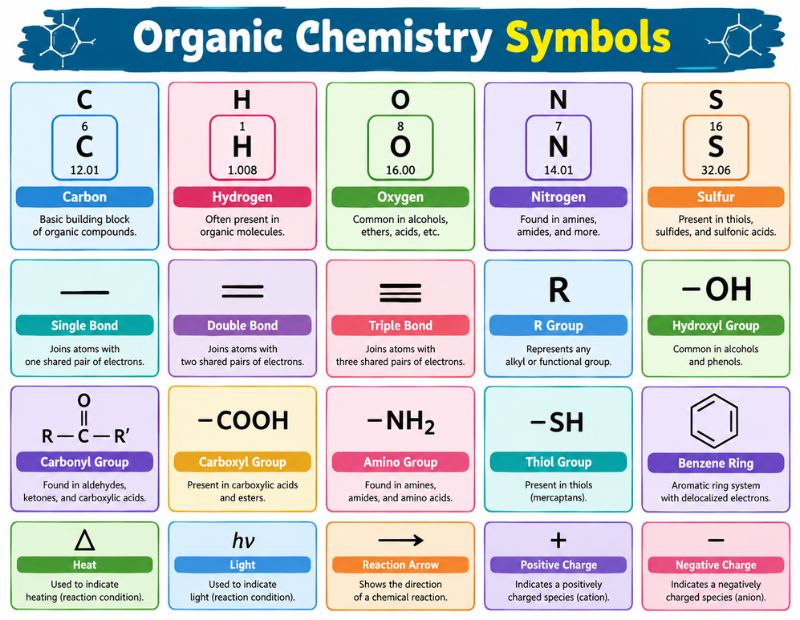
Organic chemistry, the study of carbon-based compounds — has its own shorthand for functional groups and structures. Here are some frequently used organic chemistry symbols:
| Symbol/Notation | Meaning |
|---|---|
| R | A generic alkyl group (placeholder for a carbon chain) |
| Ar | Aryl group (aromatic ring substituent) |
| X | Generic halogen (F, Cl, Br, or I) |
| -OH | Hydroxyl group (alcohols) |
| -COOH | Carboxylic acid group |
| -NH₂ | Amine group |
| -CHO | Aldehyde group |
| C=O | Carbonyl group (ketones, aldehydes) |
| Δ | Heat applied over a reaction arrow |
| hv | Light energy applied to a reaction |
Organic chemists also rely heavily on line-angle (skeletal) structures, where each corner and endpoint represents a carbon atom, and hydrogens are left out for simplicity.
How to Type a Chemistry Symbol in Word?
You can insert chemistry symbols in Microsoft Word using a few simple methods:
- Go to the Insert tab and click Symbol > More Symbols to browse special characters like Δ, °, and →.
- Use the Equation Editor (Insert > Equation) for subscripts, superscripts, and structural notations.
- Type a Unicode code (like 2192 for →) and press Alt+X to convert it instantly.
- For subscripts/superscripts, select the number and press Ctrl+= (subscript) or Ctrl+Shift+= (superscript).
Physical Chemistry Symbols
Physical chemistry deals with energy, thermodynamics, and reaction rates, and it uses a distinct set of symbols and Greek letters:
| Symbol | Meaning |
|---|---|
| ΔH | Enthalpy change |
| ΔG | Gibbs free energy change |
| ΔS | Entropy change |
| K | Equilibrium constant |
| k | Rate constant |
| T | Temperature (Kelvin) |
| P | Pressure |
| V | Volume |
| n | Number of moles |
| R | Universal gas constant |
These symbols appear constantly in equations like the ideal gas law (PV = nRT) and Gibbs free energy equation (ΔG = ΔH − TΔS).
Nuclear Chemistry Symbols
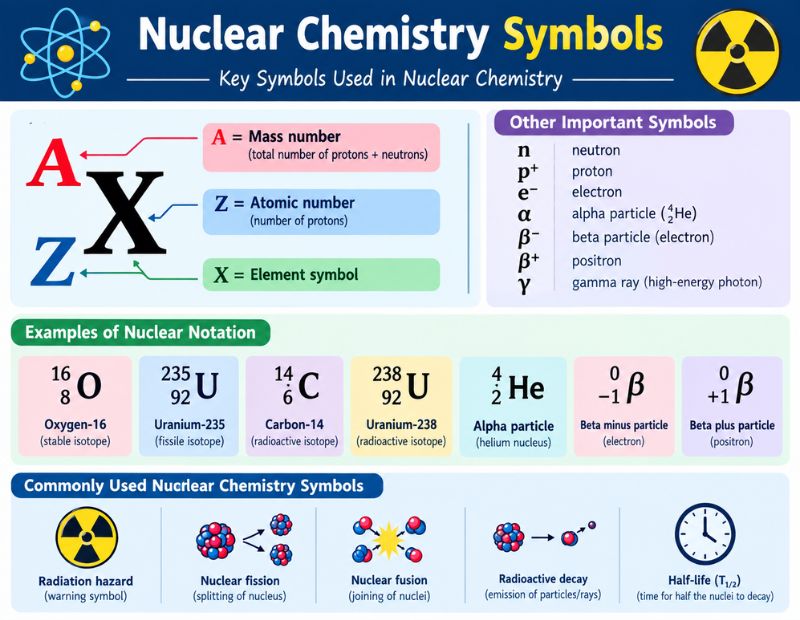
Nuclear chemistry describes changes happening inside the atomic nucleus, such as radioactive decay. Key symbols include:
| Symbol | Meaning |
|---|---|
| α (alpha) | Alpha particle (helium nucleus) emission |
| β (beta) | Beta particle (electron or positron) emission |
| γ (gamma) | Gamma ray emission (high-energy photon) |
| n | Neutron |
| p | Proton |
| ᴬZX | General isotope notation (A = mass number, Z = atomic number) |
| t½ | Half-life of a radioactive isotope |
Nuclear equations must always balance both mass number and atomic number on both sides — a rule that makes these symbols essential for predicting decay products.
Greek Chemistry Symbols
Greek letters show up throughout chemistry to represent constants, changes, and specific concepts. Some of the most common are:
| Greek Letter | Symbol | Common Use in Chemistry |
|---|---|---|
| Alpha | α | Alpha particles, alpha carbon |
| Beta | β | Beta particles, beta carbon |
| Gamma | γ | Gamma rays, surface tension |
| Delta | Δ / δ | Change in a value, partial charge |
| Lambda | λ | Wavelength |
| Mu | μ | Micro- prefix, dipole moment |
| Pi | π | Pi bond |
| Sigma | σ | Sigma bond |
| Omega | ω | Angular velocity |
Common Chemical Symbols You Should Know
Beyond individual elements, chemistry uses a set of general-purpose symbols in equations and lab notation:
- + – combines with, or separates reactants/products
- → – yields / produces (reaction direction)
- ⇌ – reversible reaction / equilibrium
- (s), (l), (g), (aq) – state symbols (explained below)
- ∆H – heat of reaction
- M – molarity (moles per liter)
- % – percent composition or yield
Hazard, Safety, Warning, and Lab Chemistry Symbols
Anyone working in a lab needs to recognize hazard pictograms at a glance. Under the Globally Harmonized System (GHS), hazard symbols appear as diamond-shaped icons with a black symbol on a white background inside a red border. Common examples include:
| Hazard Symbol Meaning | What It Indicates |
|---|---|
| Flame | Flammable substances |
| Skull and Crossbones | Acute toxicity (can be fatal) |
| Corrosion | Corrosive to skin, eyes, or metal |
| Exclamation Mark | Irritant, harmful, or causes allergic reaction |
| Gas Cylinder | Gases under pressure |
| Exploding Bomb | Explosive materials |
| Health Hazard | Carcinogen, respiratory sensitizer |
| Environment | Toxic to aquatic life |
| Flame Over Circle | Oxidizing substances |
General lab safety symbols you’ll also see on equipment or in manuals include eye protection required, wear gloves, biohazard, radioactive material, and no open flame. These pictograms are designed to be understood instantly, even without reading any text — which is exactly why they use simple black-and-white icons instead of long warnings.
LaTeX Chemistry Symbols
For anyone writing scientific papers or lab reports in LaTeX, the mhchem package makes typing chemical formulas and reactions far easier. A few examples:
\ce{H2O}                  → H2O
\ce{CO2 + H2O -> H2CO3}   → reaction with arrow
\ce{Na+ + Cl- -> NaCl}    → ionic reaction
\ce{^{14}_6C}             → isotope notation
Simply load the package with \usepackage[version=4]{mhchem} at the top of your document, and every formula inside \ce{} will format automatically with correct subscripts and bonds.
State Chemistry Symbols
State symbols show the physical state of a substance in a chemical equation. They’re written in brackets right after the chemical formula.
| State Symbol | Meaning |
|---|---|
| (s) | Solid |
| (l) | Liquid |
| (g) | Gas |
| (aq) | Aqueous (dissolved in water) |
Example: NaCl(s) + H₂O(l) → Na⁺(aq) + Cl⁻(aq)
This tells you that solid sodium chloride dissolves in liquid water to form aqueous sodium and chloride ions.
How to Insert Chemistry Symbols in Google Docs?
Google Docs makes it simple to add special chemistry characters:
- Click Insert > Special characters.
- Type a keyword like “arrow” or “delta” in the search box, or draw the symbol by hand in the drawing pad.
- Click the symbol to insert it directly into your document.
- For subscripts/superscripts, highlight the text and use Format > Text > Subscript (Ctrl+,) or Superscript (Ctrl+.).
- Alternatively, install an add-on like “Equation Editor++” for more advanced chemical notation.
Why Chemistry Symbols Matter?
Chemistry symbols aren’t just academic shorthand, they’re the foundation of how science communicates globally. A few reasons they matter:
- They make chemical equations shorter and easier to write.
- They create a universal language understood across countries and languages.
- They allow quick recognition of hazards, states, and reaction types.
- They form the backbone of formulas used in medicine, engineering, agriculture, and manufacturing.
Without a standardized symbol system, every textbook, lab report, and safety label would need lengthy explanations instead of a quick glance at “Fe,” “→,” or a hazard pictogram.
Conclusion
Chemistry symbols may look like a random jumble of letters and icons at first glance, but each one carries precise meaning built up over centuries of scientific standardization from ancient alchemical drawings to today’s IUPAC-approved element list. Once you understand how these symbols are structured, whether it’s an element abbreviation, a Greek letter in a physics-heavy equation, or a hazard pictogram on a chemical bottle, the entire language of chemistry becomes much easier to read.
Bookmark this guide as a quick-reference chart the next time you’re balancing an equation, labeling a lab sample, or just trying to remember what “Au” stands for.
Frequently Asked Questions
What is the chemical symbol for water?
Water’s chemical formula is H₂O, made of two hydrogen atoms and one oxygen atom.
Who introduced modern chemical symbols?
Swedish chemist Jöns Jacob Berzelius introduced the current letter-based symbol system in 1813.
How many chemical elements exist today?
There are 118 confirmed chemical elements, each with a unique one- or two-letter symbol.
What does the arrow symbol (→) mean in a chemical equation?
It means “yields” or “produces,” showing the direction from reactants to products.
What is the difference between (s), (l), (g), and (aq)?
They represent solid, liquid, gas, and aqueous (dissolved in water) states of a substance.
Can two elements share the same chemical symbol?
No, every element has a unique symbol assigned and regulated by IUPAC.
What does Δ mean in chemistry?
Δ (delta) usually means “change in” a value, or indicates heat applied over a reaction arrow.
How do I type subscripts for chemical formulas?
In Word or Google Docs, select the number and use the subscript shortcut (Ctrl+= in Word, Ctrl+, in Docs).
What do chemistry hazard symbols look like?
They are red-bordered diamond icons with black pictograms showing risks like flammability, toxicity, or corrosion.
Why is iron’s symbol “Fe” instead of “I”?
“Fe” comes from the Latin word for iron, “ferrum,” rather than its modern English name.
