
Semicolon Symbol is incredible. The semicolon ( ; ) is one of the most misunderstood punctuation marks in the English language and also one of the most meaningful, thanks to its role as a symbol of mental health awareness. Whether you’re here to finally understand how to use it correctly in a sentence, need to copy and paste it quickly, or want to know why it’s become a tattoo people wear to represent survival, this guide covers it all in one place.
Below, you’ll find the grammar rules, keyboard shortcuts, real examples, and the powerful story behind the semicolon as a symbol explained simply, without the jargon.
What Is a Semicolon?
A semicolon is a punctuation mark that looks like a period sitting on top of a comma ( ; ). It creates a pause that’s stronger than a comma but weaker than a period, which is why it’s sometimes called a “super comma.”
In grammar, a semicolon is mainly used to:
- Connect two closely related independent clauses without a conjunction
- Separate items in a complex list that already contains commas
- Join clauses linked by words like however, therefore, or moreover
Its core purpose is to show that two ideas are closely connected — related enough to stay in the same sentence, but distinct enough to need more separation than a comma provides.
Read Also This Blog: Rainbow Symbol
How to Use a Semicolon in a Sentence?
There are three main rules for using a semicolon correctly. Here’s a simple breakdown:
1. Joining Two Independent Clauses
Use a semicolon to connect two complete sentences that are closely related in meaning, without using “and,” “but,” or “or.”
- Example: She finished the report early; her manager was impressed.
2. Using It With Conjunctive Adverbs
When you connect two independent clauses using words like however, therefore, meanwhile, consequently, or nevertheless, a semicolon goes before the adverb and a comma follows it.
- Example: The flight was delayed; however, the passengers stayed calm.
3. Separating Items in a Complex List
If a list already uses commas within its items, use semicolons to separate the items clearly.
- Example: The team includes John, the manager; Sara, the designer; and Alex, the developer.
Common Semicolon Mistakes to Avoid
- Don’t use a semicolon before a coordinating conjunction (and, but, or) — a comma is correct there instead.
- Don’t use a semicolon to introduce a list — that’s a colon’s job.
- Don’t join a dependent clause to an independent one with a semicolon; a comma usually works better there.
Semicolon vs. Colon vs. Comma: Key Differences
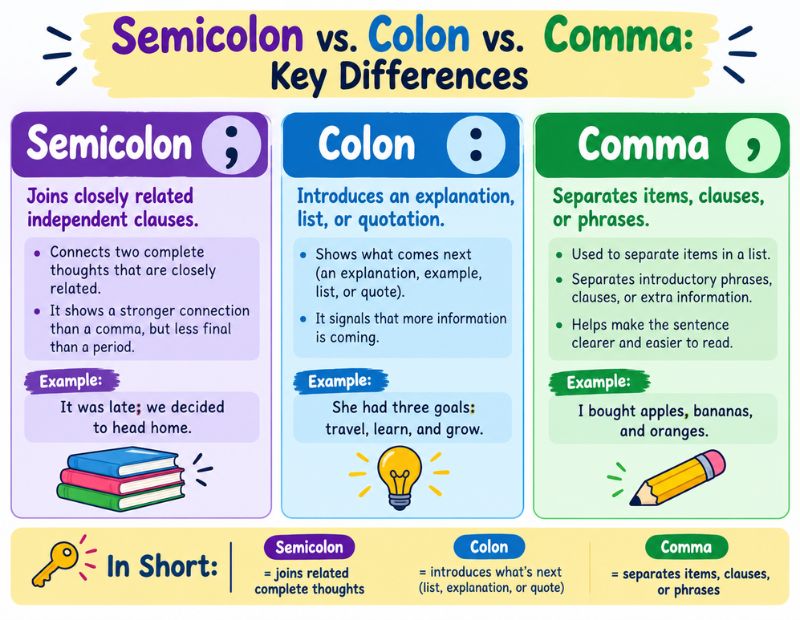
People frequently confuse the semicolon with the colon and the comma. Here’s a quick comparison table to clear that up.
| Punctuation | Main Use | Example |
|---|---|---|
| Comma (,) | Separates short items, clauses, or phrases | I bought apples, bread, and milk. |
| Semicolon (;) | Links two related independent clauses or separates complex list items | I love reading; my sister prefers movies. |
| Colon (:) | Introduces a list, explanation, or example | She had one goal: to win. |
Quick rule of thumb: A colon introduces something (like a list or explanation), while a semicolon connects two equally important, complete ideas.
How to Type a Semicolon on Your Keyboard?
Typing a semicolon is simple on almost every device.
| Device | How to Type It |
|---|---|
| Windows/Mac Keyboard | Press the key to the right of “L” (no shift needed) |
| Mobile (iOS/Android) | Open the symbols/punctuation keyboard, tap “;” |
| HTML Code | ; or ; |
| Unicode | U+003B |
| Alt Code (Windows) | Alt + 59 |
If your keyboard layout doesn’t have a dedicated semicolon key (common on some non-English layouts), you can always copy and paste it directly.
Copy and Paste Semicolon Symbols
Here are semicolon symbols and related variations ready to copy and paste directly into your document, chat, or design project:
Standard Semicolon: ;
Double Semicolon: ;;
Arabic Semicolon: ؛
Reversed/Mirrored Semicolon (used in some Semitic scripts): ⁏
Fullwidth Semicolon (used in East Asian typography): ;
What Is a Double Semicolon Used For?
A double semicolon ( ;; ) isn’t standard in English grammar, but it does show up in specific contexts:
- Programming languages, where some syntaxes use
;;to end a statement block or separate case entries (such as in shell scripting) - Stylized or decorative text, where people use it for emphasis or as a design element
- Typos or emphasis, where writers repeat punctuation informally in casual digital communication
Outside of coding contexts, a double semicolon has no formal grammatical function in English.
The Semicolon as a Symbol: Project Semicolon and Mental Health Awareness
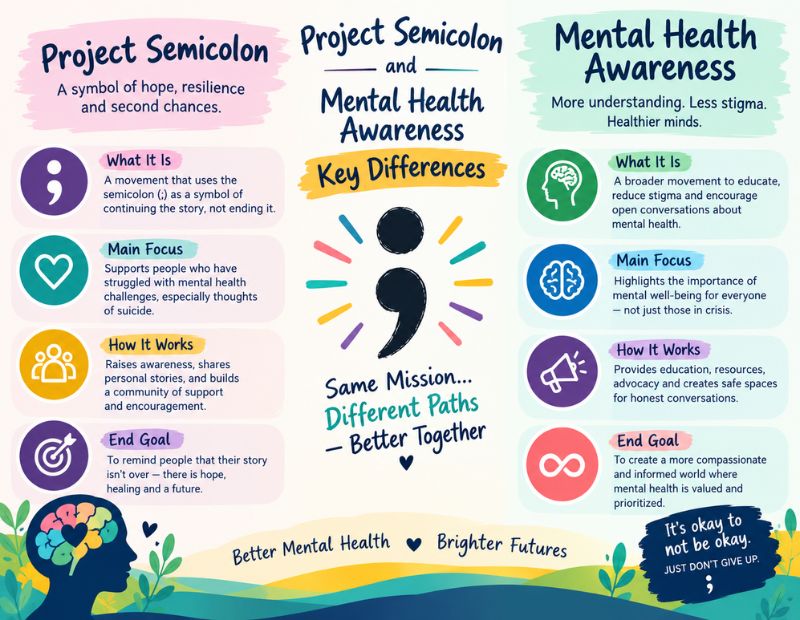
Beyond grammar, the semicolon has taken on a second, deeply personal meaning as a symbol of mental health awareness and suicide prevention.
The Origin of Project Semicolon
In 2013, mental health advocate Amy Bleuel founded Project Semicolon after getting a semicolon tattoo in memory of her father, who died by suicide. The tattoo became a powerful symbol of strength and survival, with the semicolon representing a pause rather than an end. The idea spread quickly online, growing into an international movement for mental health awareness and suicide prevention.
Why a Semicolon Symbol?
The symbolism connects directly to its grammatical purpose. A writer uses a semicolon when a sentence could have ended, but they chose to continue it instead. Applied to a person’s life, the meaning becomes: your story could have ended, but you chose to keep going.
The semicolon tattoo has since become one of the most recognizable symbols of mental health awareness worldwide, appearing in tattoo studios, support groups, and recovery communities.
What Does the “Official” Semicolon Symbol Represent?
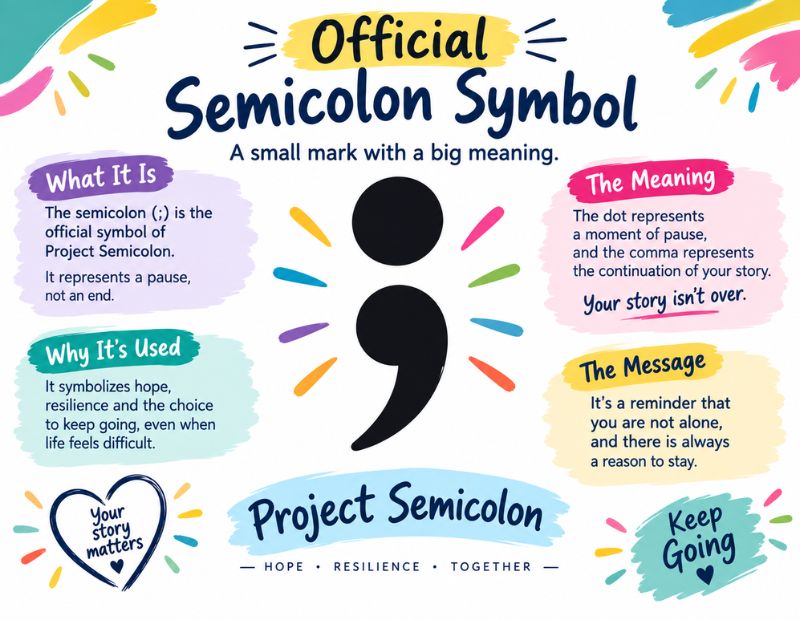
There isn’t a separate “official” version of the symbol — it’s the same standard punctuation mark ( ; ), but worn or shared specifically to represent:
- Survival after suicidal thoughts or a suicide attempt
- Solidarity with people affected by depression, anxiety, or addiction
- Hope, resilience, and continuing one’s personal story
- Remembrance for loved ones lost to suicide
Common Semicolon Tattoo Variations
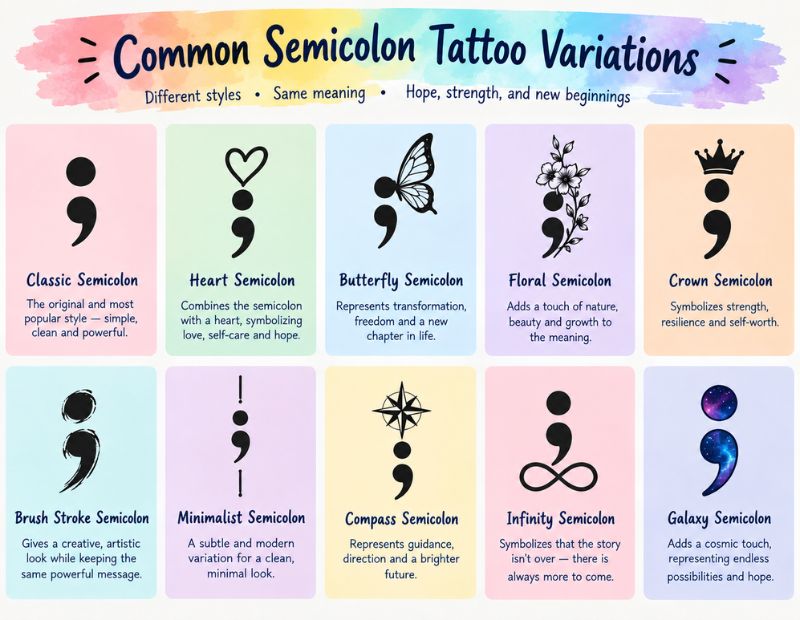
| Design | Symbolic Meaning |
|---|---|
| Simple standalone semicolon | Classic representation of survival and continuation |
| Semicolon with a heart | Emphasis on self-love and healing |
| Semicolon with a butterfly | Symbolizes transformation and growth |
| Semicolon with flowers | Represents renewal and beauty after struggle |
| Colored or watercolor semicolon | Personalized emotional expression |
Semicolon Symbol Examples in Everyday Writing
Here are a few more natural examples showing correct semicolon use across different contexts:
- Business writing: The proposal was approved; funding will begin next quarter.
- Academic writing: The results were inconclusive; further research is recommended.
- Creative writing: The rain kept falling; she didn’t move from the window.
- Lists with detail: Attendees came from Paris, France; Tokyo, Japan; and Lagos, Nigeria.
Frequently Asked Questions About the Semicolon Symbol
What does a Semicolon Symbol mean?
Grammatically, it links two related independent clauses; symbolically, it represents survival and continuing on despite hardship.
How do I type a Semicolon Symbol on my keyboard?
Press the key directly to the right of the “L” key — no shift key needed on most keyboards.
What is the difference between a Semicolon symbol and a colon?
A semicolon connects two related, complete sentences, while a colon introduces a list, explanation, or example.
Why do people get Semicolon tattoos?
They represent mental health awareness and suicide prevention, popularized by Project Semicolon in 2013.
Is a double Semicolon Symbol ( ;; ) grammatically correct?
No, not in standard English grammar; it mainly appears in programming syntax or informal stylized text.
Can I use a Semicolon Symbol instead of “and”?
Yes, a semicolon can replace “and” when joining two closely related independent clauses.
Where can I copy and paste a Semicolon Symbol?
You can copy it directly from this article, or type it using Alt + 59 on Windows or the standard keyboard key.
Final Thoughts
The Semicolon Symbol is more than just a tricky punctuation mark — it’s a tool for building clearer, more connected sentences, and for some, a lasting personal symbol of resilience. Whether you’re using it to tighten up your writing or wearing it as a reminder that your story isn’t over, understanding both sides of the semicolon gives this small mark a lot more meaning.
