

Buddhist symbols carry thousands of years of spiritual meaning, and each one tells a story about enlightenment, compassion, and the path to inner peace. Whether you are researching a tattoo design, looking for the right emoji to copy and paste, or simply curious about what these ancient icons represent, this guide covers every major Buddhist symbol in one place.
From the peaceful lotus flower to the often misunderstood swastika, you will learn the true meaning behind each symbol, how to use them correctly, and where they came from. Let’s dive into the rich visual language of Buddhism.
Buddhist Symbol Meanings: A Quick Overview
Buddhism does not rely on a single logo the way many modern religions do. Instead, it uses a collection of sacred images that each represent a different teaching, virtue, or milestone in the Buddha’s life. Here is a quick reference table before we explore each symbol in depth.
| Symbol | Common Name | Core Meaning |
|---|---|---|
| ☸️ | Dharma Wheel | The Buddha’s teachings and the Noble Eightfold Path |
| 🪷 | Lotus Flower | Purity, awakening, and rising above suffering |
| 🕉️ | Om | The sound of the universe and ultimate reality |
| ⭕ | Enso | Enlightenment, wholeness, and the present moment |
| 卍 | Manji | Good fortune, eternity, and the Buddha’s heart |
| 🐚 | Conch Shell | The spread of Buddhist teaching in every direction |
| ∞ | Endless Knot | Interconnection of all things and eternal wisdom |
| 🌳 | Bodhi Tree | The place and moment of the Buddha’s enlightenment |
| 🏯 | Stupa | The Buddha’s presence, relics, and enlightened mind |
| 👣 | Buddha’s Footprint | The Buddha’s physical presence on Earth |
| 🐟 | Golden Fish | Freedom, fearlessness, and happiness |
| ☂️ | Parasol | Protection from suffering and spiritual authority |
| 🏺 | Treasure Vase | Spiritual and material abundance |
| 🚩 | Victory Banner | Triumph of wisdom over ignorance |
Read Also This Blog: Lead Symbol
Major Buddhist Symbols and Their Deeper Meanings
The Lotus Flower (Buddhist Flower Symbol)
The lotus is one of the most recognized Buddhist symbols worldwide. It grows in muddy water yet blooms perfectly clean above the surface. This journey mirrors the Buddhist belief that enlightenment is possible no matter how difficult a person’s circumstances are.
Different lotus colors carry unique meanings:
- White lotus represents mental and spiritual purity 🤍
- Pink lotus symbolizes the Buddha himself and supreme enlightenment 🌸
- Blue lotus stands for wisdom and knowledge 💙
- Red lotus reflects compassion and the heart ❤️
The Dharma Wheel (Buddhist Wheel Symbol)
Also called the Dharmachakra, the eight spoked wheel is arguably the most iconic symbol of Buddhism itself. Each spoke represents one step of the Noble Eightfold Path, the guide the Buddha gave for ending suffering. The wheel’s constant turning motion also reflects the cycle of samsara, or the ongoing cycle of birth, death, and rebirth.
The Bodhi Tree
The Bodhi tree marks the exact spot where Siddhartha Gautama sat and achieved enlightenment, becoming the Buddha. The word bodhi means awakening in Sanskrit. A descendant of that original tree still stands in Bodh Gaya, India, and remains a major pilgrimage site today.
The Endless Knot
This intricate, looping design has no beginning and no end. It represents the interconnected nature of all existence, the union of wisdom and compassion, and the eternal continuity of the Buddha’s teachings across time.
The Conch Shell
A right spiraling white conch shell symbolizes the far reaching sound of the Dharma. Just as a conch’s call can be heard from a great distance, the Buddha’s teachings were meant to spread across the world and awaken all beings.
The Enso (Buddhist Circle Symbol)
Common in Zen Buddhism, the enso is a hand drawn circle created in a single confident brushstroke. It represents enlightenment, the universe, and the beauty of imperfection, since the circle is often left slightly incomplete on purpose.
The Stupa (Buddhist Temple Symbol)
A stupa is a dome shaped structure that often holds relics of the Buddha or other respected teachers. It is one of the most common Buddhist temple symbols and represents the enlightened mind, as well as the final passing of the Buddha into parinirvana.
Om (OM Buddhist Symbol)
Om, written as 🕉️, is one of the oldest spiritual sounds and symbols, shared across Hinduism, Buddhism, and Jainism. In Tibetan Buddhism especially, Om is the first sound in the famous mantra Om Mani Padme Hum. It is believed to represent the vibration of the entire universe and the essence of ultimate reality.
Symbolic Meanings for Life Themes
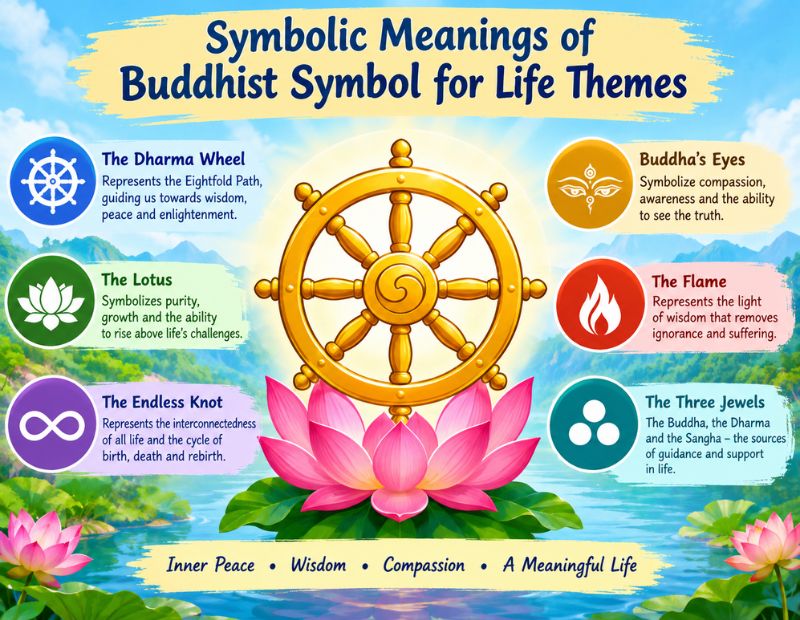
People often search for a specific Buddhist symbol that matches a personal value or life event. Here are the most requested ones.
Buddhist Symbol of Life
The endless knot and the wheel of life are the two symbols most closely tied to life itself. The endless knot shows how every action, relationship, and moment is connected, while the wheel of life illustrates the full cycle of existence, from birth through death and rebirth.
Buddhist Symbol for Love
There is no single “love symbol” in traditional Buddhism, but the lotus flower and the double dorje are commonly associated with loving kindness, known as metta. Many people also use the endless knot to represent a love that has no beginning or end.
Buddhist Symbol for Peace
The lotus flower, the white dove used in some modern Buddhist art, and the peaceful expression of a seated Buddha statue are the most common representations of peace. The word “Om Shanti,” meaning peace, is also frequently paired with Buddhist imagery.
Buddhist Symbol for Universe
The Om symbol and the mandala both represent the universe in Buddhist tradition. A mandala’s intricate, circular geometric pattern is meant to reflect the entire cosmos, while meditators use it as a tool to focus the mind and journey inward.
Buddhist Sun Symbol
While less common than the lotus or wheel, sun imagery appears in Buddhist art to represent wisdom, clarity, and the illumination of ignorance. In some Tibetan thangka paintings, the sun and moon appear together to represent the union of wisdom and compassion.
Buddhist Hand Symbols (Mudras)
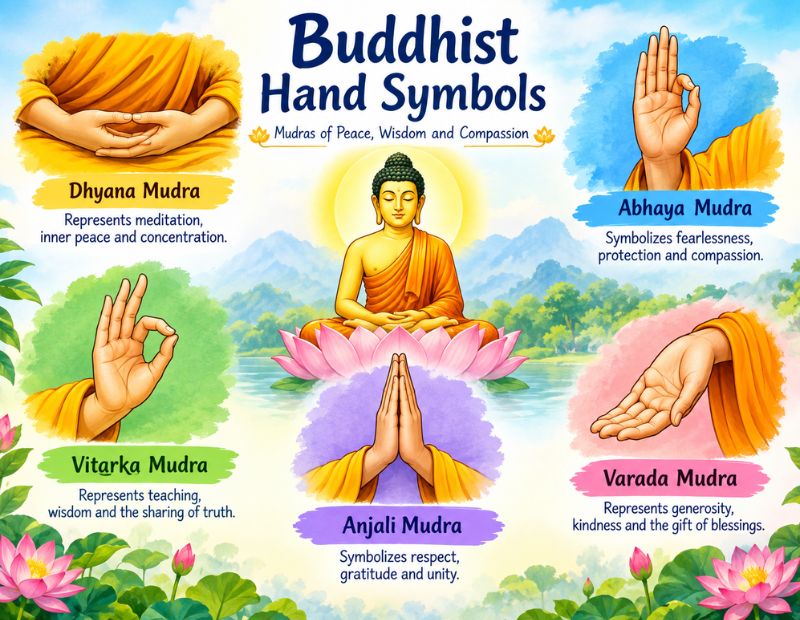
Buddhist hand symbols, known as mudras, are symbolic hand gestures used in meditation and depicted in Buddha statues. Each mudra carries its own specific meaning.
| Mudra Name | Hand Position | Meaning |
|---|---|---|
| Dhyana Mudra | Hands resting in lap, palms up | Meditation and inner focus 🙏 |
| Bhumisparsha Mudra | Right hand touching the earth | Calling the earth to witness enlightenment 🌍 |
| Abhaya Mudra | Right palm raised outward | Fearlessness and protection ✋ |
| Varada Mudra | Left palm facing outward, lowered | Compassion and granting wishes 🤲 |
| Dharmachakra Mudra | Hands at chest, forming a circle | Teaching the Dharma ☸️ |
| Vitarka Mudra | Thumb and index finger touching | Discussion and intellectual debate 💭 |
Buddhist Symbol Text, Emoji, and Copy and Paste Guide
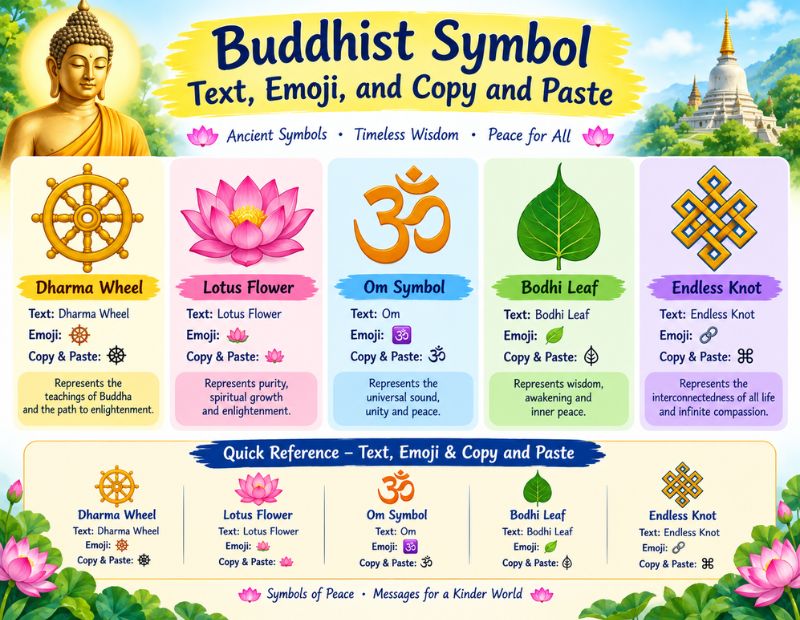
Buddhist Symbol Text
Many Buddhist symbols exist as standard Unicode characters, which means you can type or paste them into any document, caption, or bio without needing an image file.
Buddhist Symbol Emoji
Standard emoji keyboards on phones and computers already include a few Buddhism related icons, such as the wheel of dharma, the lotus, the om symbol, and a person meditating in lotus position.
Copy and Paste Buddhist Symbols
Below is a ready to use table of the most searched Buddhist symbols. Simply copy the character you need.
| Symbol | Name |
|---|---|
| ☸️ | Dharma Wheel |
| 🕉️ | Om |
| 🪷 | Lotus Flower |
| 🧘 | Meditating Person |
| 卍 | Manji |
| ⭕ | Enso Circle |
| 🙏 | Praying Hands / Namaste |
| 🐚 | Conch Shell |
| ∞ | Endless Knot Reference |
| 🛕 | Temple |
Buddhist Symbol Tattoo Ideas
Buddhist symbols are among the most popular spiritual tattoo choices because of their clean lines and deep meaning. Some of the most requested designs include:
- Lotus flower tattoos for personal growth and resilience 🪷
- Dharma wheel tattoos for guidance and life purpose ☸️
- Om symbol tattoos for spiritual grounding 🕉️
- Enso circle tattoos for simplicity and enlightenment ⭕
- Bodhi leaf tattoos for awakening and mindfulness 🍃
- Buddha’s eyes tattoos for wisdom and awareness 👁️
Before getting any sacred symbol tattooed, it is worth researching its cultural context and choosing a design that feels personally meaningful rather than purely decorative.
The Swastika and Manji: Buddhism’s Most Misunderstood Symbol
Buddhist Symbol Swastika
The swastika is one of humanity’s oldest symbols, used for thousands of years before the 20th century across India, Asia, and even parts of Europe and the Americas. In Buddhism, it represents the footprints of the Buddha, eternity, good fortune, and the auspicious nature of his teachings. It often appears on the chest or palms of Buddha statues.
Is the Swastika a Buddhist Symbol?
Yes, the swastika is a genuine and ancient Buddhist symbol of good fortune and the Buddha’s teachings, predating its 20th century misuse by roughly two thousand years.
Buddhist Manji Symbol
In Japan, this same symbol is called the manji. It marks the location of Buddhist temples on official maps and appears throughout Buddhist art and architecture. The manji represents harmony, strength, and the eternal nature of the Buddha’s heart and teachings.
Nazi Symbol vs Buddhist Symbol
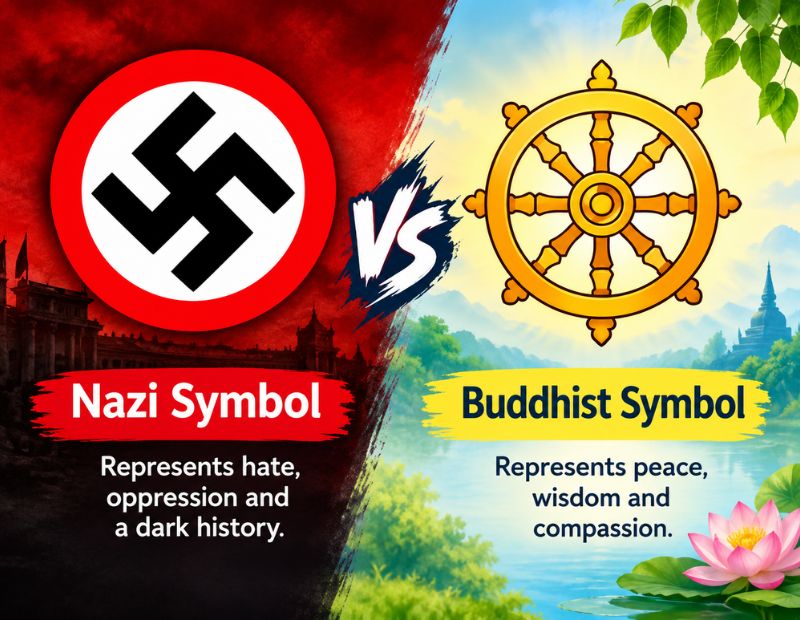
Although both symbols share a similar geometric shape, they are historically and culturally unrelated. The table below highlights the key differences.
| Feature | Buddhist Swastika / Manji | Nazi Symbol (Hakenkreuz) |
|---|---|---|
| Origin | Ancient India, thousands of years old | Adopted by the Nazi Party in 1920 |
| Orientation | Typically rests flat, upright cross style | Usually tilted 45 degrees, diamond style |
| Meaning | Peace, good fortune, eternity, Buddha’s teachings | Political symbol tied to hate and genocide |
| Cultural Use | Buddhist temples, statues, sacred art | German nationalist and white supremacist symbolism |
| Region of Use | India, Japan, China, Tibet, Southeast Asia | Associated with 20th century Germany |
Understanding this history matters because millions of Buddhists and Hindus continue to use the original symbol respectfully in religious contexts today, completely separate from its unrelated 20th century political misuse.
Buddhist Symbol Crossword Clue
Crossword puzzles commonly use short answers for this clue. The most frequent solutions are:
- OM for a three letter clue 🕉️
- LOTUS for a five letter clue 🪷
- WHEEL for references to the dharma wheel ☸️
If you are stuck on a specific puzzle, check the letter count required, since crossword answers vary by publication.
Conclusion
Buddhist symbols are far more than decorative art. Each one, from the peaceful lotus to the misunderstood swastika, carries centuries of meaning tied to enlightenment, compassion, and inner peace. Whether you are choosing a tattoo, searching for the right text symbol to copy and paste, or simply deepening your understanding of Buddhist culture, knowing the true story behind these icons helps you use them with respect and intention.
FAQs
What is the most important symbol in Buddhism?
The Dharma Wheel is widely considered the most important and recognized symbol, representing the Buddha’s core teachings and the Noble Eightfold Path.
What does the lotus flower mean in Buddhism?
The lotus represents purity and spiritual awakening, since it rises clean and beautiful from muddy water.
Is it disrespectful to get a Buddhist symbol tattoo?
It is generally acceptable if done with respect and understanding of the symbol’s meaning, though many people choose to research the cultural context first.
Why is the swastika associated with Buddhism?
The swastika has been a Buddhist symbol of good fortune and the Buddha’s footprints for thousands of years, long before its unrelated use in the 20th century.
What symbol represents peace in Buddhism?
The lotus flower and the calm expression of Buddha statues are the most common representations of peace in Buddhist tradition.
Can I copy and paste Buddhist symbols safely?
Yes, symbols like ☸️, 🕉️, and 🪷 are standard Unicode characters and safe to copy into any text field.
