

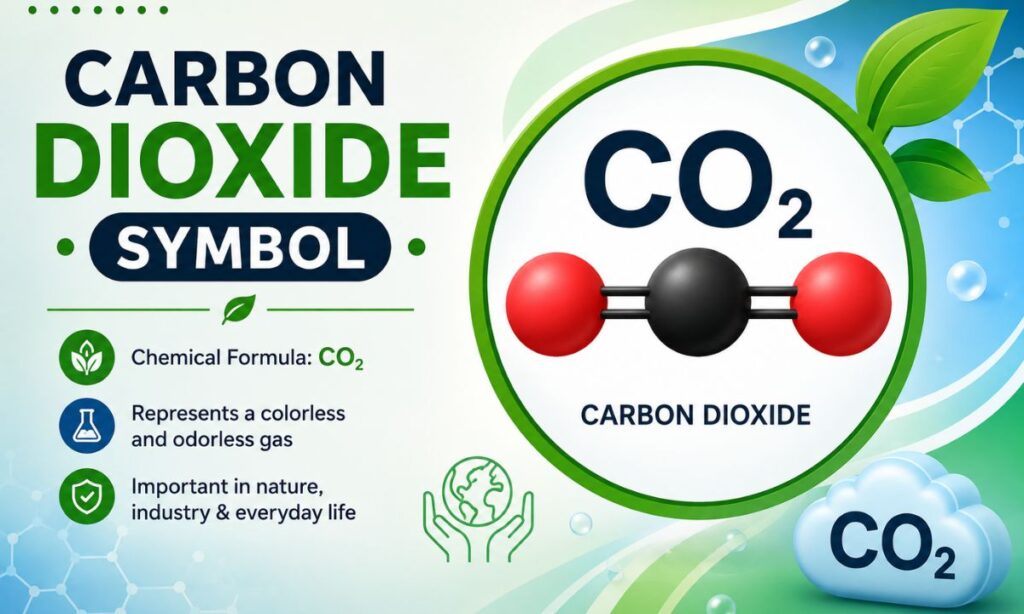
Carbon dioxide is everywhere in the air you breathe out, in your soda can, in the news about climate change. But when it comes to writing its symbol correctly, a surprising number of people get stuck on the subscript, confuse it with carbon monoxide, or aren’t sure how it behaves in its solid and liquid forms.
This guide covers everything about the carbon dioxide symbol: its chemical meaning, how to type and copy it correctly, its structure and formula, real world uses, and where it fits on the periodic table. Whether you’re a student, a writer, or just curious, you’ll find clear, accurate answers below.
What Is the Carbon Dioxide Symbol?
The chemical formula for carbon dioxide is CO₂ one carbon atom bonded to two oxygen atoms. The “2” is written as a subscript because it tells you how many oxygen atoms are in the molecule, not how many molecules of CO you have.
| Element | Carbon Dioxide Symbol | Number of Atoms in CO₂ |
|---|---|---|
| Carbon | C | 1 |
| Oxygen | O | 2 |
It’s worth noting that CO₂ and CO are completely different compounds. CO₂ is carbon dioxide (two oxygen atoms), while CO is carbon monoxide (one oxygen atom), a much more toxic gas. Mixing these up, even by a single character, changes the entire meaning.
Read Also This Blog: Carbon Monoxide Symbol
Carbon Dioxide Symbol Meaning
Breaking down the formula piece by piece:
- C represents one carbon atom
- O represents oxygen
- ₂ (the subscript) means there are two oxygen atoms attached to that single carbon atom
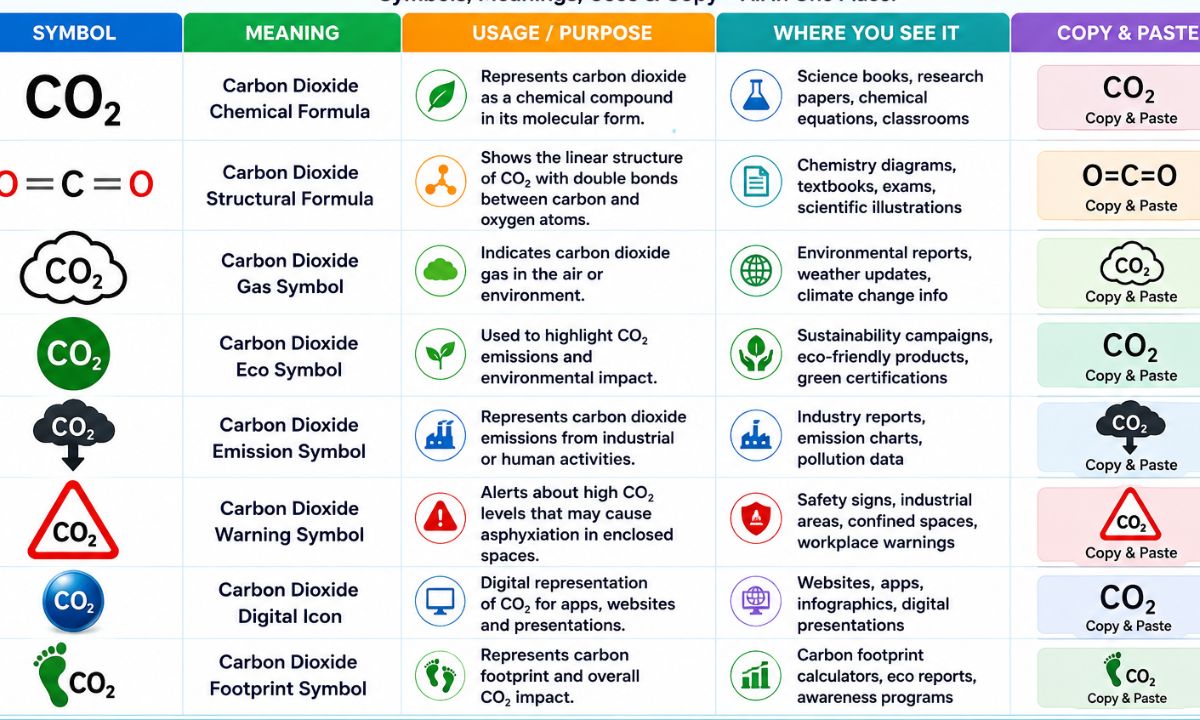
Structurally, this creates a linear molecule where the carbon atom sits in the middle, double-bonded to an oxygen atom on each side. This arrangement is often written out as O=C=O to show the double bonds clearly.
Carbon Dioxide Symbol Copy and Paste
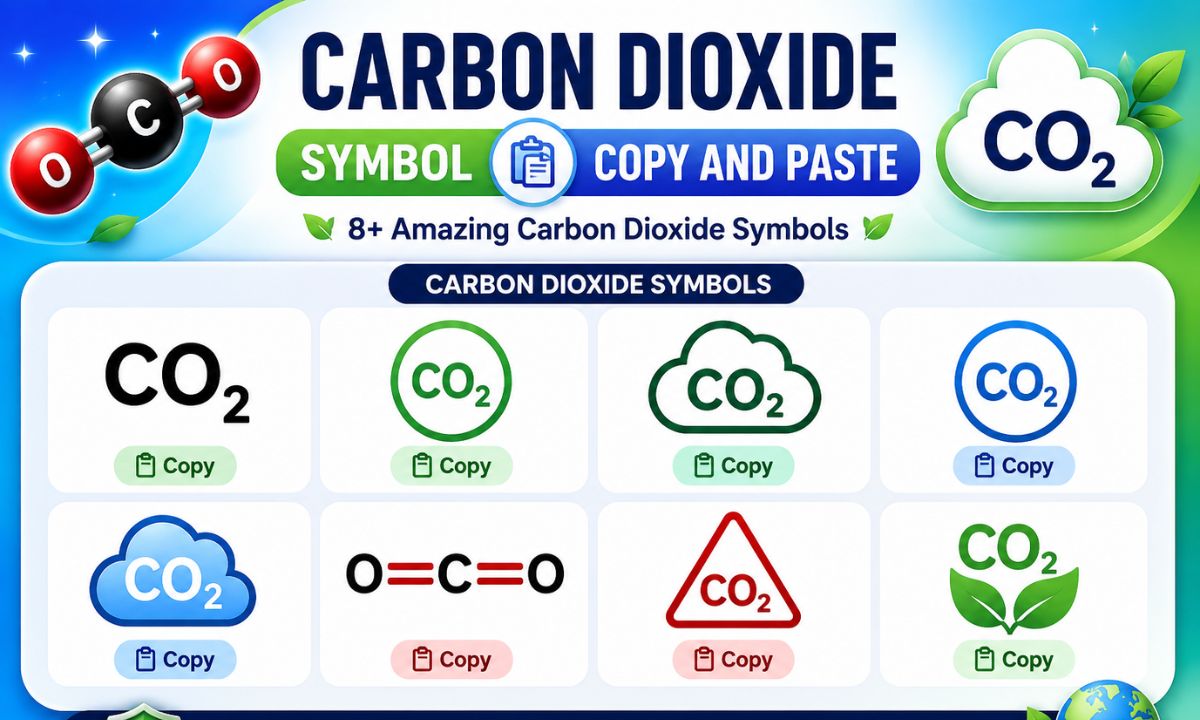
Need to paste the correct symbol into a document, spreadsheet, email, or social post without fighting with subscript formatting? Here are ready-to-use versions:
- CO₂ The correct subscript version (Unicode ₂).
- CO2 Plain text version, widely accepted where subscript isn’t supported.
- CO₂e Used for “carbon dioxide equivalent” in emissions reporting.
- 🌍 Earth symbol, often paired with CO₂ in climate content..
- 💨 Gas/emission symbol.
- 🏭 Factory/industrial emissions symbol.
- ♻️ Recycling symbol, often used alongside carbon footprint discussions.
The subscript “₂” is a genuine Unicode character (U+2082), so copying CO₂ directly from a source like this preserves the correct formatting anywhere Unicode is supported : Word, Google Docs, social media, and most websites.
List of 8 Carbon Dioxide Symbol Variations
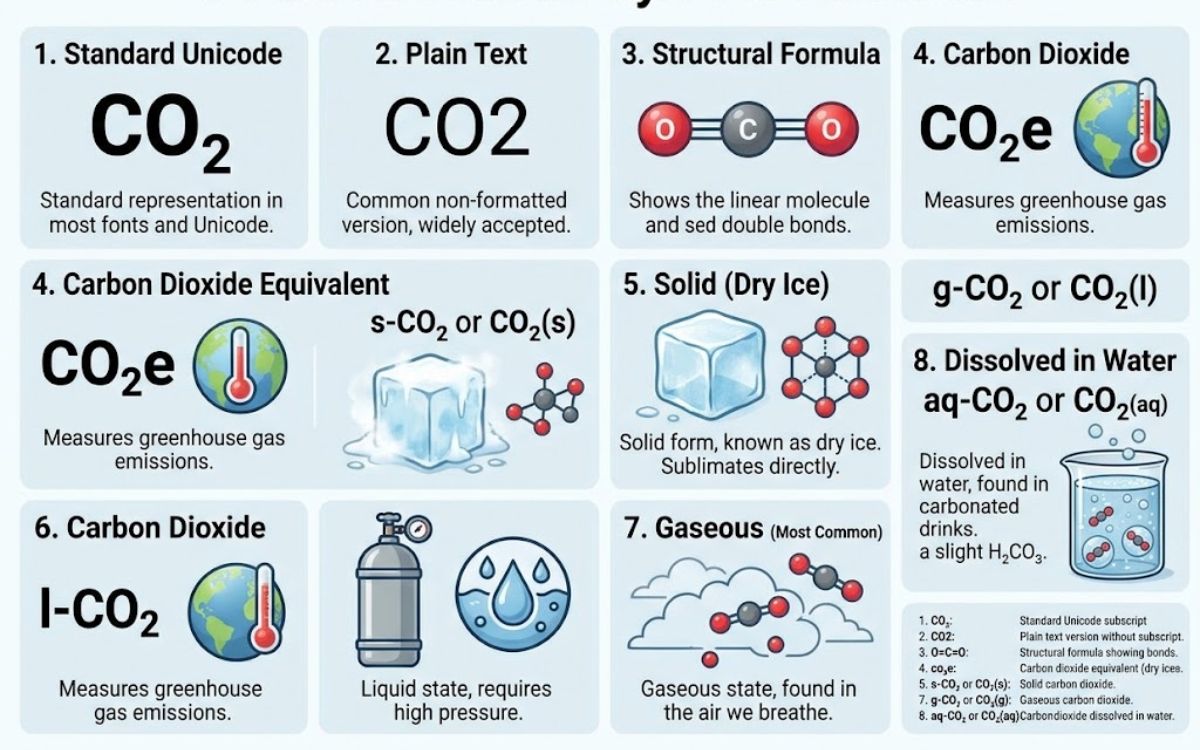
- CO₂: Standard Unicode subscript formula.
- CO2: Plain text version without subscript.
- O=C=O: Structural formula showing double bonds.
- CO₂e: Carbon dioxide equivalent, used in emissions and climate reporting.
- s-CO₂ or CO₂(s): Solid carbon dioxide (dry ice).
- l-CO₂ or CO₂(l): Liquid carbon dioxide.
- g-CO₂ or CO₂(g): Gaseous carbon dioxide, the most common state.
- aq-CO₂ or CO₂(aq): Carbon dioxide dissolved in water.
Carbon Dioxide Symbol Text: How to Type It Correctly?
Getting the subscript “2” right depends on where you’re typing:
| Platform | Method |
|---|---|
| Microsoft Word | Type CO2, select the “2,” press Ctrl + Shift + = (subscript shortcut) |
| Google Docs | Format menu → Text → Subscript, or Ctrl + , |
| Mobile keyboards | Copy the Unicode symbol ₂ directly and paste it after “CO” |
| Websites/HTML | Use the <sub>2</sub> tag around the number |
| Plain text (no formatting) | Use the Unicode character ₂ directly: CO₂ |
How to Type Carbon Dioxide Symbol?
The fastest way is copying the ready-made Unicode version CO₂ and pasting it wherever you need it. This works in almost every modern app without extra formatting steps.
Carbon Dioxide Structure
Carbon dioxide has a simple but very specific molecular geometry:
- Shape: Linear (180-degree bond angle).
- Bonding: Two carbon oxygen double bonds.
- Central atom: Carbon, bonded symmetrically to two oxygen atoms.
- Polarity: Nonpolar overall, because the two polar C=O bonds cancel each other out due to the symmetric, linear shape.
This linear, symmetrical structure is a big reason CO₂ behaves the way it does, it’s stable, doesn’t dissolve into charged ions easily, and passes through cell membranes and the atmosphere with relative ease.
Carbon Dioxide Symbol in Chemistry and on the Periodic Table
A common misconception is that carbon dioxide has its own spot on the periodic table. It doesn’t, the periodic table only contains individual elements, not compounds. What you’ll actually find are:
- Carbon (C) Atomic number 6
- Oxygen (O) Atomic number 8
CO₂ is a molecular compound built from these two elements, and its formula is a chemistry convention rather than a periodic table entry.
Carbon Dioxide Symbol Element
Since CO₂ isn’t an element, it doesn’t have a single atomic number. Its two components do:
| Element | Atomic Number | Atomic Mass |
|---|---|---|
| Carbon | 6 | 12.01 |
| Oxygen | 8 | 16.00 |
| Carbon Dioxide (CO₂) | Not applicable (compound) | ~44.01 |
Carbon Dioxide Symbol Valency
Valency explains how carbon and oxygen combine to form CO₂:
- Carbon has a valency of 4, meaning it can form four bonds.
- Oxygen has a valency of 2, meaning it typically forms two bonds.
In carbon dioxide, carbon uses all four of its bonding “slots” by forming two double bonds, one with each oxygen atom. Each oxygen atom, in turn, satisfies its valency of 2 through that single double bond. This balance is exactly why the formula is CO₂ and not, say, CO or CO₃.
Carbon Dioxide Formula and Equation
The molecular formula, as covered above, is CO₂. It commonly appears in two major chemical reactions:
Complete combustion: C + O₂ → CO₂
Cellular respiration: C₆H₁₂O₆ + 6O₂ → 6CO₂ + 6H₂O + energy
Photosynthesis (the reverse process): 6CO₂ + 6H₂O + light energy → C₆H₁₂O₆ + 6O₂
These equations show why CO₂ sits at the center of both biology and combustion chemistry. It’s produced when we breathe and when fuels burn, and it’s consumed by plants during photosynthesis.
Oxygen and Carbon Dioxide Symbol: How They Relate?
Oxygen (O₂) and carbon dioxide (CO₂) are tightly linked in what’s often called the carbon-oxygen cycle:
| Process | Consumes | Produces |
|---|---|---|
| Respiration (humans, animals) | Oxygen (O₂) | Carbon dioxide (CO₂) |
| Photosynthesis (plants) | Carbon dioxide (CO₂) | Oxygen (O₂) |
| Combustion | Oxygen (O₂) | Carbon dioxide (CO₂) |
This cycle is one of the most fundamental relationships in environmental science, connecting breathing, plant growth, and fuel combustion into a single ongoing exchange.
Carbon Dioxide Examples in Everyday Life
You encounter carbon dioxide far more often than you might realize:
- Carbonated drinks: The fizz in soda and sparkling water comes from dissolved CO₂.
- Fire extinguishers: CO₂ extinguishers smother flames by displacing oxygen.
- Dry ice: Solid CO₂ used for cooling and special effects.
- Human breath: We exhale CO₂ as a natural byproduct of respiration.
- Vehicle exhaust: A major source of atmospheric CO₂ emissions.
- Greenhouses: Supplemented CO₂ levels boost plant growth in controlled environments.
Carbon Dioxide Uses
Beyond being a byproduct of respiration and combustion, CO₂ has genuine industrial and commercial value:
- Food and beverage industry: Carbonating drinks, packaging (modified atmosphere packaging), and decaffeination.
- Fire suppression: Used in extinguishers for electrical and flammable liquid fires.
- Medical applications: Used in some surgical procedures, particularly laparoscopy.
- Agriculture : CO₂ enrichment in greenhouses increases crop yield.
- Refrigeration: Dry ice keeps products cold during shipping without leaving liquid residue.
- Beverage and chemical manufacturing: Used as a solvent in supercritical CO₂ extraction processes, including decaffeinating coffee.
Carbon Dioxide Symbol Drawing (Structural Representation)
When drawn out, carbon dioxide’s structure is typically shown as:
O = C = O
This structural formula makes the double bonds explicit and shows the linear shape at a glance. In Lewis dot structures, each oxygen atom is shown with two lone pairs, while the carbon atom in the middle has no lone pairs, consistent with its four bonds being fully used in the two double bonds.
Solid, Liquid, and Gas: Carbon Dioxide Symbol by State
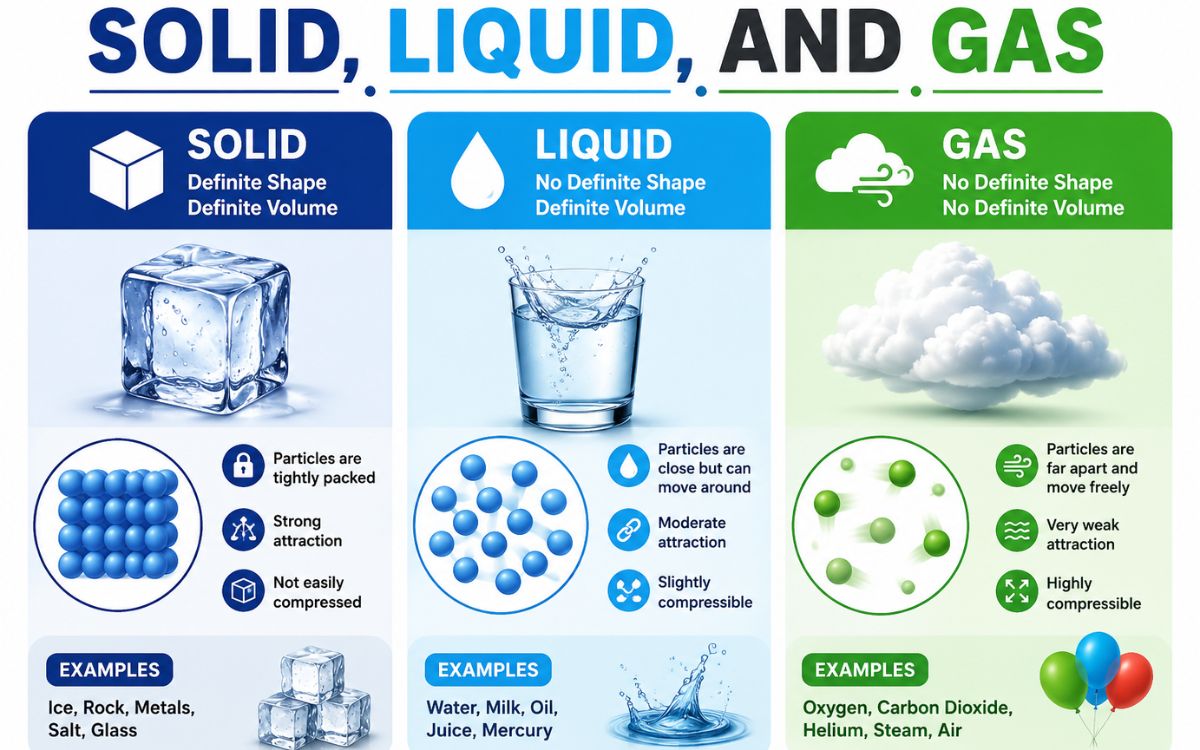
Carbon dioxide’s chemical formula stays the same across all three physical states, but the state is often noted in brackets for clarity in chemical equations.
| State | Symbol Notation | Common Name | Typical Conditions |
|---|---|---|---|
| Gas | CO₂(g) | Carbon dioxide gas | Room temperature and pressure |
| Solid | CO₂(s) | Dry ice | Below −78.5°C (−109.3°F) |
| Liquid | CO₂(l) | Liquid CO₂ | Only exists under high pressure |
| Dissolved | CO₂(aq) | Carbonic acid precursor | Dissolved in water |
Solid Carbon Dioxide Symbol
Solid carbon dioxide, written as CO₂(s), is commonly known as dry ice. It sublimates directly from solid to gas without becoming liquid at normal atmospheric pressure, which is why it produces that distinctive fog effect.
Liquid Carbon Dioxide Symbol
Liquid carbon dioxide, written as CO₂(l), only exists under high pressure. This is why you won’t encounter it in everyday settings, it requires pressurized containers, unlike the solid or gas forms.
Carbon Dioxide in Water
When CO₂ dissolves in water, it partially reacts to form carbonic acid, shown in this equation:
CO₂ + H₂O ⇌ H₂CO₃
This reaction is significant for two major reasons:
- It’s what gives carbonated beverages their slightly acidic, tangy taste
- It’s a key driver of ocean acidification, as rising atmospheric CO₂ levels increase the amount absorbed by seawater
Quick Reference Table
| Term | Carbon Dioxide Symbol/Formula | Category |
|---|---|---|
| Carbon dioxide | CO₂ | Compound |
| Carbon | C | Element |
| Oxygen | O | Element |
| Carbon monoxide | CO | Compound (different from CO₂) |
| Carbonic acid | H₂CO₃ | Compound formed in water |
| Combustion equation | C + O₂ → CO₂ | Chemical reaction |
Conclusion
The carbon dioxide symbol CO₂ is one of the most recognizable chemical formulas in the world, but there’s more depth to it than most people realize. From its linear molecular structure and valency to its role in respiration, combustion, and ocean chemistry, CO₂ touches nearly every corner of science and daily life. Whether you needed the correct way to type it, a deeper understanding of its chemistry, or simply a copy-paste-ready symbol, you now have a complete and accurate reference.
Frequently Asked Questions
What is the chemical symbol for carbon dioxide?
The chemical symbol is CO₂, representing one carbon atom bonded to two oxygen atoms.
Is CO₂ the same as CO?
No. CO₂ is carbon dioxide, while CO is carbon monoxide, a different, more toxic compound with only one oxygen atom.
How do you type the subscript 2 in CO₂?
You can copy the Unicode character ₂ directly, or use your software’s subscript formatting shortcut, such as Ctrl + Shift + = in Word.
Does carbon dioxide appear on the periodic table?
No, because it’s a compound, not an element. Only carbon and oxygen individually appear on the periodic table.
What is the valency involved in forming carbon dioxide?
Carbon has a valency of 4 and oxygen has a valency of 2, allowing carbon to form two double bonds with two oxygen atoms.
What is dry ice?
Dry ice is solid carbon dioxide, written as CO₂(s), which sublimates directly into gas without becoming liquid at normal pressure.
What happens when CO₂ dissolves in water?
It partially forms carbonic acid (H₂CO₃), which contributes to the tangy taste of carbonated drinks and to ocean acidification.
