

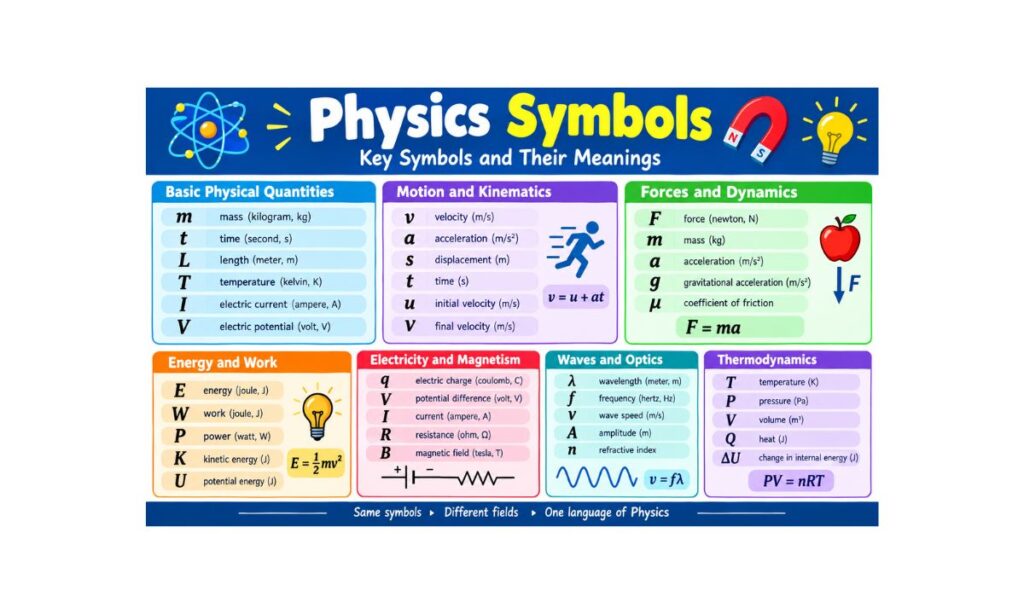
Open any physics textbook and you’ll see a wall of letters like F, v, λ, and μ scattered across equations. These aren’t random, they’re physics symbols, a universal shorthand that lets scientists write complex ideas in a few characters instead of full sentences.
This guide breaks down everything you need to know about physics symbols: their meanings, history, units, and how to actually type them in Word or Google Docs. Whether you’re studying for a school exam, working through mechanics and electricity problems, or just need to copy-paste a Greek letter into your notes, this article has you covered in one place.
What Are Physics Symbols? (Meanings Explained)
A physics symbol is a letter, character, or notation used to represent a physical quantity, unit, or constant in an equation. Instead of writing “velocity” every time, physicists use “v.” Instead of writing “the speed of light in a vacuum,” they write “c.”
These symbols are standardized internationally by the International System of Quantities (ISQ) and the International System of Units (SI), so a formula written by a physicist in Germany means exactly the same thing to a physicist in India or Brazil.
Symbols in physics generally fall into three types:
- Quantity symbols — represent measurable things (F for force, m for mass)
- Unit symbols — represent the unit of measurement (N for newton, kg for kilogram)
- Constant symbols — represent fixed values (c for speed of light, G for gravitational constant)
Some symbols are intuitive (d for distance, t for time), while others come from Latin or Greek and don’t match the English word at all (like c for the speed of light, from the Latin “celeritas,” meaning “swiftness”).
A Brief History of Physics Symbols
Physics notation didn’t appear overnight, it evolved over centuries as science became more mathematical and more global.
- Early Notation (1600s–1700s): Scientists like Isaac Newton and Gottfried Leibniz introduced early mathematical notation for calculus and motion, laying the groundwork for symbolic physics.
- Standardization Efforts (1800s): As physics split into branches like thermodynamics, electricity, and optics, scientists began assigning consistent letters to recurring quantities such as force, energy, and current.
- SI System Adoption (1960 onward): The International System of Units (SI) was formally adopted in 1960, standardizing base units (meter, kilogram, second, ampere, kelvin, mole, candela) and, by extension, the symbols used to represent related quantities.
- Modern ISQ Standard: Today, the International System of Quantities governs which symbol represents which quantity, ensuring consistency across textbooks, research papers, and countries.
This is why, no matter where you study physics in the world, F always means force and v always means velocity.
Read Also This Blog: Chemistry Symbols
Complete Physics Symbols List
Below is a categorized list of the most important and frequently searched physics symbols, along with their meanings and SI units.
Basic Physical Quantities
| Quantity | Symbol | SI Unit |
|---|---|---|
| Distance | d | Meter (m) |
| Displacement | Δx | Meter (m) |
| Time | t | Second (s) |
| Mass | m | Kilogram (kg) |
| Velocity | v | Meter/second (m/s) |
| Acceleration | a | Meter/second² (m/s²) |
| Force | F | Newton (N) |
| Momentum | p | kg·m/s |
| Energy | E | Joule (J) |
| Work | W | Joule (J) |
| Power | P | Watt (W) |
| Density | ρ (rho) | kg/m³ |
| Temperature | T | Kelvin (K) |
| Pressure | P | Pascal (Pa) |
| Frequency | f | Hertz (Hz) |
| Wavelength | λ (lambda) | Meter (m) |
Electricity and Magnetism Physics Symbols
| Quantity | Symbol | SI Unit |
|---|---|---|
| Electric current | I | Ampere (A) |
| Voltage (potential difference) | V | Volt (V) |
| Resistance | R | Ohm (Ω) |
| Charge | Q | Coulomb (C) |
| Capacitance | C | Farad (F) |
| Inductance | L | Henry (H) |
| Electric field | E | N/C |
| Magnetic field | B | Tesla (T) |
| Magnetic flux | Φ (phi) | Weber (Wb) |
| Resistivity | ρ | Ohm-meter (Ω·m) |
| Electromotive force (EMF) | ε | Volt (V) |
| Conductance | G | Siemens (S) |
Physics Symbol Chart by Branch
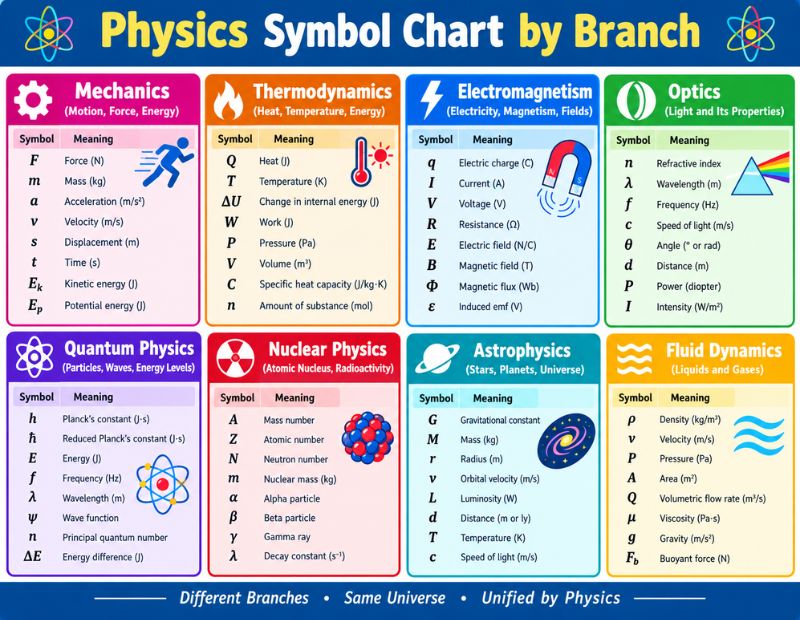
Physics is a huge subject, so symbols are often grouped by the branch they belong to. This chart makes it easier to see where each symbol is typically used:
| Branch | Common Symbols | Focus Area |
|---|---|---|
| Mechanics | F, m, a, v, p, W | Motion, force, energy |
| Electricity & Magnetism | I, V, R, Q, B | Circuits, charge, fields |
| Thermodynamics | T, Q, S, ΔU | Heat, entropy, energy transfer |
| Optics & Waves | λ, f, n, θ | Light, sound, wave behavior |
| Quantum Physics | h, ħ, ψ, ΔE | Subatomic particles, energy levels |
| Modern/Nuclear Physics | N, t½, α, β, γ | Radioactivity, particle decay |
Physics “Periodic Table”: Fundamental Constants
Physics doesn’t have a periodic table the way chemistry does, but it does have a widely used table of fundamental physical constants that plays a similar role — a fixed reference chart every physics student relies on.
| Constant | Symbol | Approximate Value |
|---|---|---|
| Speed of light in vacuum | c | 3 × 10⁸ m/s |
| Planck’s constant | h | 6.626 × 10⁻³⁴ J·s |
| Gravitational constant | G | 6.674 × 10⁻¹¹ N·m²/kg² |
| Elementary charge | e | 1.602 × 10⁻¹⁹ C |
| Boltzmann constant | k or k_B | 1.381 × 10⁻²³ J/K |
| Avogadro’s number | Nₐ | 6.022 × 10²³ /mol |
| Permittivity of free space | ε₀ | 8.854 × 10⁻¹² F/m |
| Permeability of free space | μ₀ | 4π × 10⁻⁷ T·m/A |
Physics Elements 1 to 30 With Symbols
Since physics also covers atomic structure and particle behavior, students often need the first 30 elements and their symbols when studying atomic physics topics like electron configuration.
| Atomic No. | Element | Physics Symbols | Atomic No. | Element | Symbol |
|---|---|---|---|---|---|
| 1 | Hydrogen | H | 16 | Sulfur | S |
| 2 | Helium | He | 17 | Chlorine | Cl |
| 3 | Lithium | Li | 18 | Argon | Ar |
| 4 | Beryllium | Be | 19 | Potassium | K |
| 5 | Boron | B | 20 | Calcium | Ca |
| 6 | Carbon | C | 21 | Scandium | Sc |
| 7 | Nitrogen | N | 22 | Titanium | Ti |
| 8 | Oxygen | O | 23 | Vanadium | V |
| 9 | Fluorine | F | 24 | Chromium | Cr |
| 10 | Neon | Ne | 25 | Manganese | Mn |
| 11 | Sodium | Na | 26 | Iron | Fe |
| 12 | Magnesium | Mg | 27 | Cobalt | Co |
| 13 | Aluminium | Al | 28 | Nickel | Ni |
| 14 | Silicon | Si | 29 | Copper | Cu |
| 15 | Phosphorus | P | 30 | Zinc | Zn |
This list is especially useful for atomic number and mass number calculations in early physics chapters on atomic structure.
Physics Symbols Copy and Paste
Physics involves a lot of special characters that aren’t on a standard keyboard. Here’s a ready-to-use set you can copy directly:
α β γ δ Δ ε θ λ μ π ρ σ τ φ Φ ψ ω Ω
→ ⇌ ± ° √ ∞ ∝ ≈ ≠ ≤ ≥ ∑ ∫ ∂ ×
⁰ ¹ ² ³ ⁴ ⁵ ⁶ ⁷ ⁸ ⁹    ₀ ₁ ₂ ₃ ₄ ₅ ₆ ₇ ₈ ₉
Quick uses:
- Δ – change in a quantity (ΔT, Δv)
- ∝ – “is proportional to”
- ∑ – summation of a series of values
- ∫ – integral, often used in calculus-based physics
- Ω – ohm (unit of resistance) or angular velocity in some contexts
Physics Symbols and Formulas
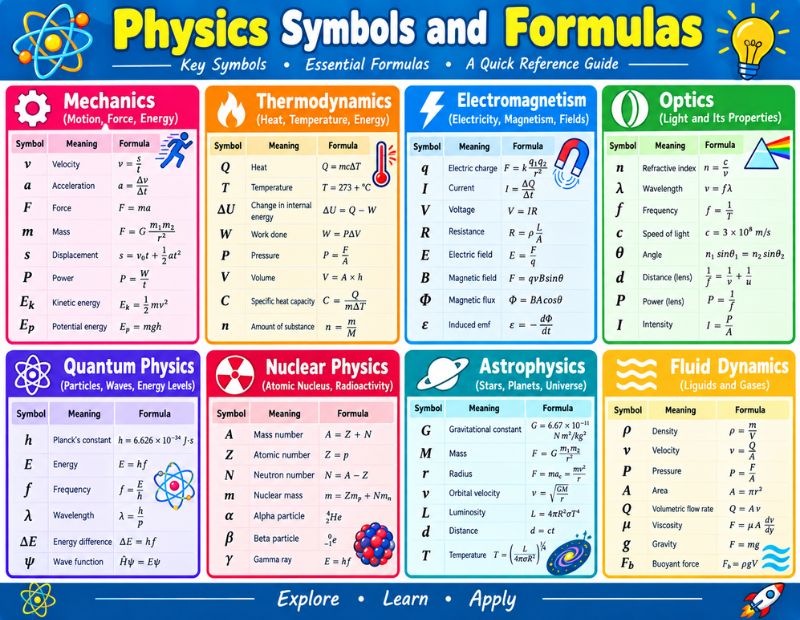
Symbols only make sense once you see them combined into formulas. Here are a few of the most common ones students encounter:
- F = ma — Newton’s Second Law (Force = mass × acceleration)
- v = u + at — final velocity in uniformly accelerated motion
- E = mc² — mass-energy equivalence
- P = IV — electrical power (Power = Current × Voltage)
- PV = nRT — ideal gas law
- λ = v/f — wave speed formula (wavelength = speed ÷ frequency)
Understanding what each letter represents makes memorizing and rearranging these formulas far easier during problem-solving.
How to Type Physics Symbols in Word?
Typing Greek letters, subscripts, or special physics notation in Microsoft Word is simple once you know the shortcuts:
- Go to Insert > Symbol > More Symbols and select the “Greek and Coptic” subset for letters like λ, μ, and Ω.
- Use the Equation Editor (Insert > Equation) for fractions, square roots, and complex notation.
- Type the symbol’s name in AutoCorrect format — for example, type
\lambdainside the equation editor and press space to auto-convert it. - For subscripts, press Ctrl+=; for superscripts, press Ctrl+Shift+=.
- Use the Unicode + Alt+X trick — type a character code (like 03BC for μ) and press Alt+X.
Physics Symbols MU (μ)
The Greek letter mu (μ) is one of the most reused symbols in physics, and its meaning changes depending on context:
| Context | Meaning of μ |
|---|---|
| Mechanics | Coefficient of friction |
| Magnetism | Permeability (μ₀ for free space) |
| Optics | Micro- prefix (as in μm, micrometer) |
| Statistics in Physics | Mean value or population mean |
| Particle Physics | Muon (a subatomic particle) |
Always check the chapter or context to know which meaning of μ applies.
Physics Symbols for Electricity
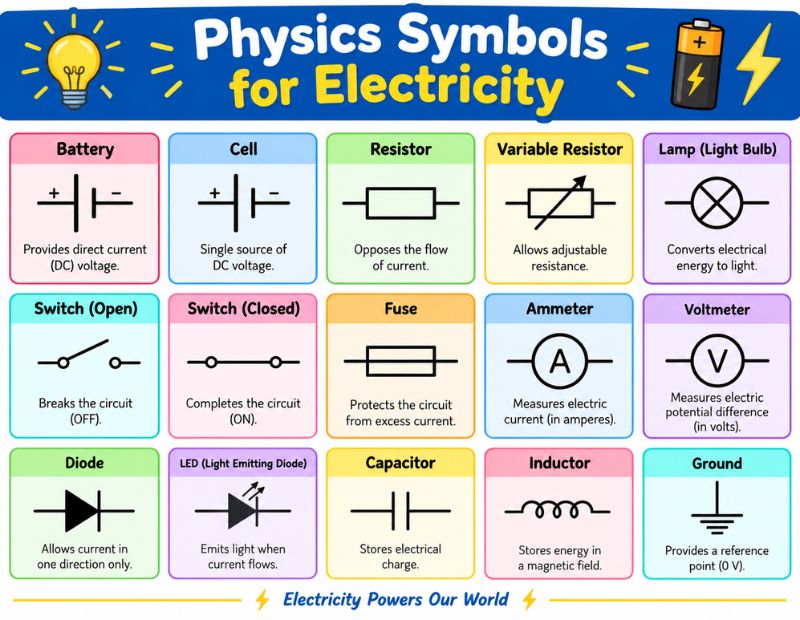
Electric circuits rely on a consistent set of symbols for both quantities and diagram components. Here’s a quick breakdown:
| Physics Symbols | Meaning |
|---|---|
| I | Current |
| V | Voltage |
| R | Resistance |
| Q | Charge |
| P | Power |
| ε | EMF (electromotive force) |
| C | Capacitance |
Physics Circuit Symbols
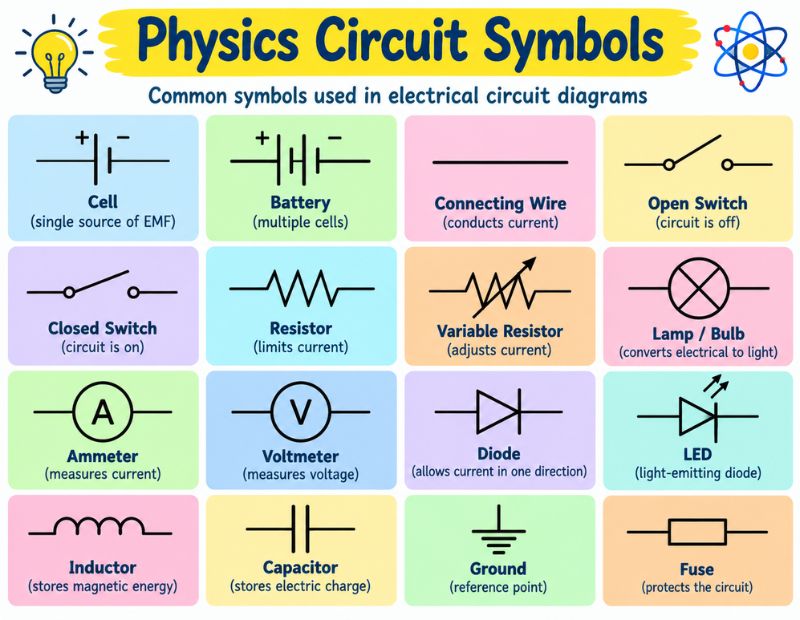
Circuit diagrams use standardized pictorial symbols instead of letters, so anyone reading a schematic — anywhere in the world — understands the components instantly.
| Component | Symbol Description |
|---|---|
| Resistor | Rectangle or zig-zag line |
| Battery/Cell | Long and short parallel lines |
| Switch | Diagonal line with a break in the circuit line |
| Capacitor | Two parallel lines with a gap |
| Bulb/Lamp | Circle with an X or filament inside |
| Ammeter | Circle with letter “A” |
| Voltmeter | Circle with letter “V” |
| Fuse | Rectangle with a wavy line |
| Diode | Triangle pointing to a line |
Physics Symbols and Units
Every physical quantity is paired with a standard SI unit. Here’s a compact cheat sheet:
| Quantity | Physics Symbols | SI Unit | Unit Symbol |
|---|---|---|---|
| Length | l | Meter | m |
| Mass | m | Kilogram | kg |
| Time | t | Second | s |
| Current | I | Ampere | A |
| Temperature | T | Kelvin | K |
| Amount of substance | n | Mole | mol |
| Luminous intensity | Iᵥ | Candela | cd |
These seven base units form the foundation from which every other physics unit (like Newton, Joule, or Watt) is derived.
Quantum Physics Symbols
Quantum mechanics introduces its own advanced set of notations for describing subatomic behavior:
| Physics Symbols | Meaning |
|---|---|
| h | Planck’s constant |
| ħ (h-bar) | Reduced Planck’s constant |
| ψ (psi) | Wave function |
| ΔE | Energy uncertainty/change |
| Δx | Position uncertainty |
| E = hf | Photon energy equation |
| eV | Electron volt (unit of energy) |
The Heisenberg Uncertainty Principle, written as Δx·Δp ≥ ħ/2, is one of the most famous equations built entirely from these symbols.
Greek Physics Symbols
Greek letters appear everywhere in physics because the Latin alphabet simply isn’t large enough to cover every unique quantity. Here are the most common ones:
| Greek Letter | Greek Physics Symbol | Common Use in Physics |
|---|---|---|
| Alpha | α | Angular acceleration, alpha particle |
| Beta | β | Beta particle, velocity ratio (v/c) |
| Gamma | γ | Lorentz factor, gamma ray |
| Delta | Δ / δ | Change in a quantity |
| Theta | θ | Angle |
| Lambda | λ | Wavelength |
| Mu | μ | Friction coefficient, permeability |
| Pi | π | Ratio of circumference to diameter |
| Rho | ρ | Density, resistivity |
| Sigma | σ | Stefan-Boltzmann constant, conductivity |
| Omega | ω / Ω | Angular velocity / resistance unit |
Scientific Physics Symbols You’ll See Often
Beyond quantities and constants, physics uses several general scientific symbols in equations and notation:
- ∝ – proportional to
- ≈ – approximately equal to
- ∞ – infinity
- ∇ – gradient/del operator (used in vector calculus)
- ⊥ – perpendicular
- ∥ – parallel
- ° – degrees (angle or temperature)
Why Physics Symbols Matter?
Physics symbols aren’t just abbreviations for convenience, they’re essential to how science functions globally:
- They allow complex ideas to be written compactly in a single line.
- They create a universal scientific language that transcends spoken language barriers.
- They make formulas easier to manipulate algebraically during problem-solving.
- They standardize units and measurements across research, engineering, and education.
Without this shared symbolic system, physics research from different countries would be far harder to compare, verify, or build upon.
Conclusion
Physics symbols might look intimidating in a dense equation, but they follow logical, standardized rules once you understand where they come from — from Newton’s early notation to today’s SI-regulated system. Whether you’re decoding a circuit diagram, solving for velocity, or trying to remember what μ means in this week’s chapter, this guide gives you a single reference point for meanings, formulas, and units.
Bookmark this page as your quick-access cheat sheet the next time you’re stuck mid-equation or need to copy a Greek letter into your notes.
Frequently Asked Questions
What does the symbol “c” mean in physics?
The symbol “c” represents the speed of light in a vacuum, approximately 3 × 10⁸ meters per second.
What is the SI unit of force?
The SI unit of force is the newton (N), where 1 N equals 1 kg·m/s².
What does λ (lambda) mean in physics?
Lambda represents wavelength, the distance between two successive wave crests, measured in meters.
How many base SI units are there in physics?
There are seven base SI units: meter, kilogram, second, ampere, kelvin, mole, and candela.
What does μ mean in physics?
μ (mu) can mean coefficient of friction, permeability, or the micro- prefix, depending on the context.
What is the difference between mass and weight symbols?
Mass is represented by “m” and measured in kilograms, while weight is a force represented by “W” and measured in newtons.
How do you type Greek letters in Word?
Use Insert > Symbol > Greek and Coptic subset, or type the letter’s name (like \lambda) inside the Equation Editor and press space.
What does Δ mean in a physics formula?
Δ (delta) means “change in,” such as ΔT for change in temperature or Δv for change in velocity.
What is the symbol for electric current?
Electric current is represented by “I” and measured in amperes (A).
Why do physicists use Greek letters?
Greek letters expand the available symbol set beyond the Latin alphabet, avoiding confusion between similar quantities.
