

Tsunamis are among the most feared natural disasters on the planet, capable of leveling coastlines within minutes of an earthquake. Because of that danger, an entire system of symbols, signs, and warnings has developed around the word “tsunami,” from the blue evacuation signs posted along beaches to the emoji people use to describe overwhelming situations online.
This guide walks through every meaningful use of the tsunami symbol you’re likely to encounter, covering official hazard signage, warning colors, emoji, cultural references, and even dream symbolism. Whether you’re researching coastal safety, studying disaster preparedness, or just curious what a tsunami represents beyond the literal wave, this article has you covered.
What Is a Tsunami Symbol?
A tsunami symbol is any icon, sign, or graphic used to represent, warn about, or reference a tsunami. Unlike more decorative weather symbols, most tsunami symbols exist for one urgent reason: to save lives by communicating danger instantly, even across language barriers.
Tsunami symbols generally fall into a few categories:
- Official hazard and evacuation signage used near coastlines
- Warning system icons used by government agencies
- Emoji and text symbols used in casual digital communication
- Cultural and symbolic meanings tied to emotion, dreams, or personal identity
- Branding uses, including logos and nicknames unrelated to the natural disaster itself
Because a tsunami can strike with very little warning, these symbols are designed to be understood instantly, often relying on simple wave shapes, arrows, and running figures rather than text alone.
Read Also This Blog: Heatwave Symbol
Tsunami Symbol Meaning
At its core, the tsunami symbol represents sudden, overwhelming, and unstoppable force. Visually, most official symbols use a stylized wave curling toward the shore, sometimes paired with a human figure running toward higher ground.
This design choice is intentional. Research into hazard signage has found that literal accuracy matters less than instant recognizability, since people need to understand the danger in a split second, not analyze the artwork.
Common visual elements include:
- A large curling wave shape, similar to a cresting ocean wave.
- Horizontal lines suggesting motion or water rushing forward.
- A human figure running away from the wave toward safety.
- Blue and white coloring, consistent with international water hazard signage.
- Arrows pointing toward evacuation routes or higher ground.
What Does a Tsunami Symbolize?
Beyond its literal meaning as a giant wave, a tsunami is widely used as a symbol for sudden, overwhelming change that arrives with little warning. In literature, art, and everyday language, it often represents:
- A sudden emotional or life event that feels impossible to control.
- Overwhelming force that reshapes everything in its path.
- A turning point that separates life clearly into “before” and “after”.
- The unstoppable nature of certain events, no matter how much preparation is done.
This is why the word “tsunami” gets used so often outside of meteorology, describing everything from a tsunami of emotions to a tsunami of information, always carrying that same sense of scale and inevitability.
Tsunami Symbol Text and Copy Paste
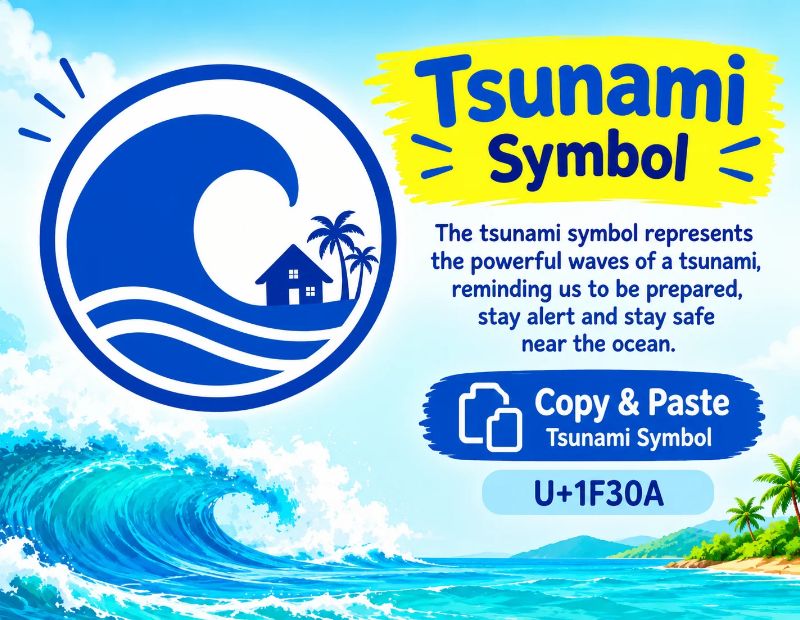
There is no single official tsunami emoji recognized by Unicode, but several related symbols are commonly used together to represent one in text and social media.
| Symbol | Name | Common Use |
|---|---|---|
| 🌊 | Water wave | Most common stand in for tsunami or ocean waves |
| 🌀 | Cyclone | Sometimes used alongside wave emoji for storm related posts |
| ⚠️ | Warning sign | Used to indicate danger or hazard alerts |
| 🏃 | Person running | Often paired with the wave emoji to represent evacuation |
Copy this: 🌊
For developers and designers who need code references instead of the emoji itself:
| Format | Code |
|---|---|
| Unicode | U+1F30A |
| HTML | 🌊 |
| CSS | \1F30A |
| JavaScript | \u{1F30A} |
Since the wave emoji is the closest widely supported symbol, most people simply pair it with warning or running emoji to imply the full concept of a tsunami in casual text.
Tsunami Weather Symbol
Tsunamis are technically not weather events, since they’re caused by underwater earthquakes, volcanic eruptions, or landslides rather than atmospheric conditions. Still, many people search for a “tsunami weather symbol” because tsunami alerts are often displayed alongside weather warnings on news broadcasts and forecasting apps.
On most marine and coastal hazard maps, tsunami risk is shown using:
- Blue shaded zones marking tsunami inundation areas.
- Wave icons placed near coastal regions under alert.
- Color coded severity levels similar to storm warning systems.
Because tsunami detection relies on seismic activity and ocean sensors rather than atmospheric forecasting, agencies like the Pacific Tsunami Warning Center operate separately from standard weather services, even though their alerts are frequently displayed using similar visual formats for public familiarity.
International Tsunami Warning Symbol
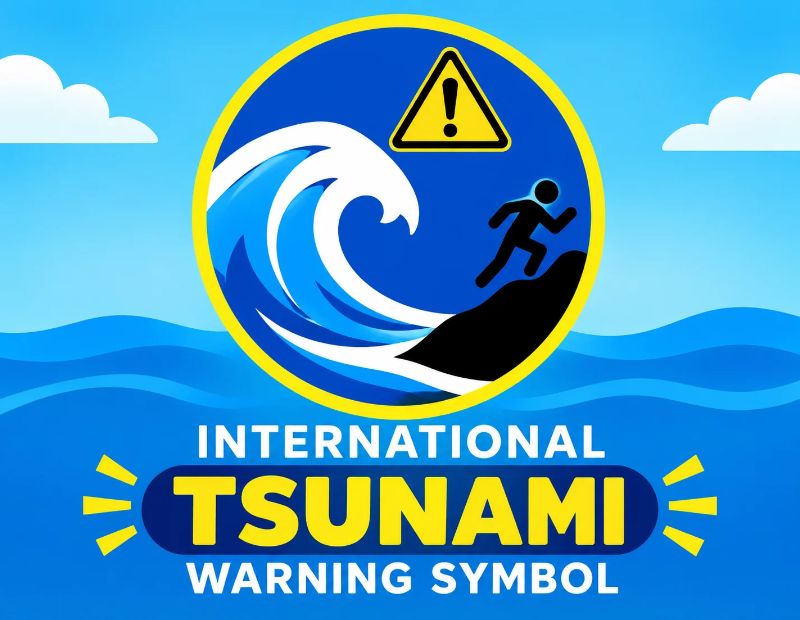
The most widely recognized tsunami symbol worldwide is the tsunami hazard sign, which follows a fairly consistent international design so it can be understood regardless of local language.
Tsunami Signage Design
The standard international tsunami warning sign typically includes:
- A blue rectangular or square background, consistent with international hazard sign color standards.
- A stylized wave graphic curling toward the shore.
- A human figure shown running toward high ground.
- Text such as “Tsunami Hazard Zone” or “Tsunami Evacuation Route,” often translated locally.
This sign can be seen posted along coastlines in countries including the United States, Japan, Indonesia, Thailand, New Zealand, and many Pacific island nations, guiding people toward safe evacuation routes during an emergency.
Interestingly, researchers studying hazard communication have noted that the classic wave depicted on these signs doesn’t always match real tsunami behavior, since many tsunamis are preceded by water rapidly receding from the shore rather than an immediately visible wave. Despite this, the symbol remains widely used because of how quickly it’s recognized.
Tsunami Flag Symbol
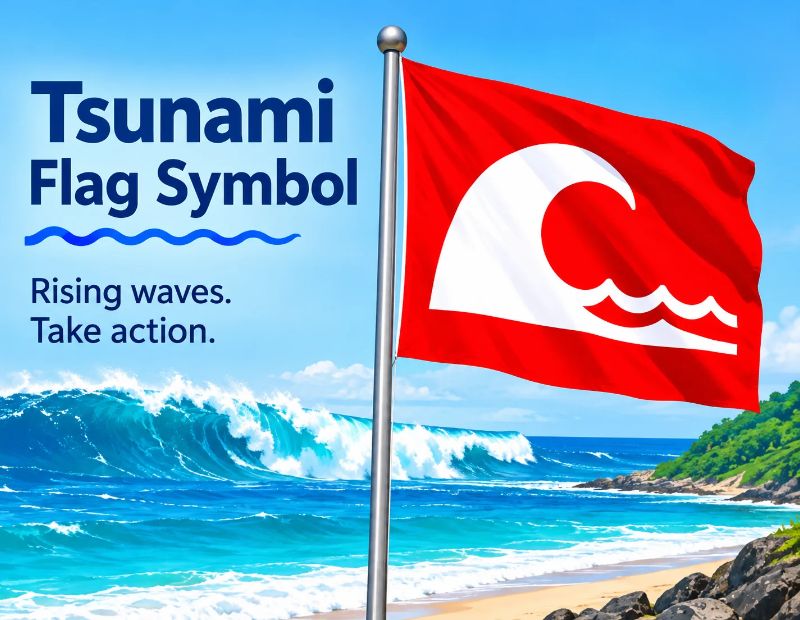
Along some beaches, especially in tsunami prone regions, flag systems are used to indicate evacuation status or hazard levels, similar to the flag systems used for rip currents or surf conditions. While flag color systems vary by country, they generally follow the same logic as other emergency color coding:
| Flag Color | General Meaning |
|---|---|
| Yellow | Caution advised, stay alert |
| Orange | Increased risk, be prepared to evacuate |
| Red | Immediate danger, evacuate now |
These flags are typically used alongside sirens and official alerts rather than as a stand alone warning system.
Tsunami Wave Symbol vs Tsunami Sea Symbol
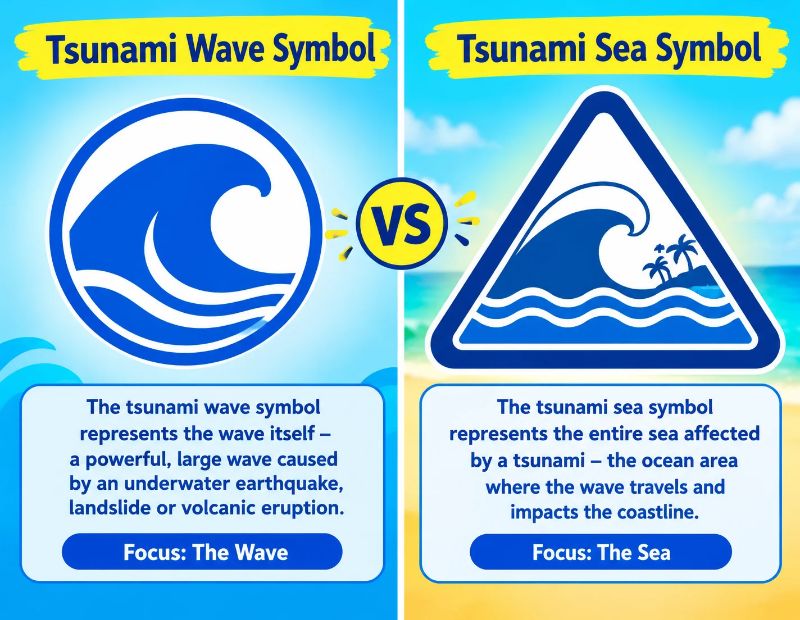
People often search for both “tsunami wave symbol” and “tsunami sea symbol,” assuming they’re different things. In practice, they usually refer to the same visual concept, just described differently.
| Term | What It Usually Refers To |
|---|---|
| Tsunami wave symbol | The curling wave graphic used on hazard signs and icons |
| Tsunami sea symbol | General ocean or water based imagery associated with tsunami danger |
| Tsunami hazard symbol | The full official warning sign, including wave and evacuation figure |
In short, the “wave” is the core visual element, while “sea symbol” is simply a broader way of referring to the same ocean based danger imagery.
Tsunami Warning Symbol Colors and Alert Levels
Tsunami alerts typically follow a tiered system, similar to hurricane or severe storm alerts, with each level represented by different terminology and, in many regions, different colors on maps and broadcasts.
| Alert Level | Meaning | Recommended Action |
|---|---|---|
| Tsunami Watch | A tsunami is possible but not yet confirmed | Stay informed, monitor updates |
| Tsunami Advisory | Strong currents expected, but major flooding unlikely | Stay away from water, avoid beaches and harbors |
| Tsunami Warning | Dangerous waves and flooding are expected | Evacuate immediately to higher ground |
Agencies such as the U.S. National Weather Service and Pacific Tsunami Warning Center use this structure to help the public quickly understand both the certainty and severity of a potential tsunami, mirroring how hurricane and heatwave alerts are communicated.
Tsunami Symbol in Dreams
Reve De Tsunami Symbolique
In French, “rêve de tsunami symbolique” translates to “symbolic tsunami dream,” a topic frequently explored in dream interpretation and psychology discussions. While dream meanings are subjective and not scientifically proven, common interpretations associated with dreaming about a tsunami include:
- Feeling overwhelmed by emotions, responsibilities, or life changes.
- A sense that something in life feels uncontrollable or unpredictable.
- Suppressed feelings that may be building toward a breaking point.
- Major life transitions, such as a new job, relationship, or personal loss.
Dream analysts often note that the size and behavior of the wave in the dream, whether it’s approaching slowly or crashing suddenly, can reflect how a person perceives the intensity of whatever challenge they’re currently facing in waking life.
Tsunami Symbol in Pop Culture
Kehlani Tsunami Symbol
Fans searching for “Kehlani Tsunami symbol” are usually referencing the singer’s personal nickname and fanbase branding rather than a specific song. Kehlani has gone by the nickname “Lani Tsunami” since childhood, and her fanbase became known as the Tsunami Mob, often shortened to TSNMI. This branding reflects her personality and connection with fans rather than any literal reference to natural disasters, and it’s become a recognizable part of her artist identity across album releases and merchandise.
Tsunami Logo Fixie
“Tsunami logo fixie” refers to Tsunami Bicycle, a well known brand in the fixed gear and track bike community. Popular for affordable, durable steel and aluminum frames, models like the Tsunami SNM100 and Tsunami 4130 have built a strong following among fixie riders, particularly in Asia and among budget conscious cyclists worldwide. In this context, the tsunami name and logo are used purely for branding purposes, evoking speed, strength, and momentum rather than any connection to the natural disaster.
Tsunami Symbol Uses at a Glance
To summarize how differently this single word and symbol are used across contexts, here’s a quick comparison.
| Context | What the Tsunami Symbol Represents |
|---|---|
| Coastal safety signage | Real evacuation warning and hazard zone marker |
| Weather and news broadcasts | Alert level indicating wave danger |
| Text and social media | Emoji based shorthand for waves or overwhelming situations |
| Dream interpretation | Emotional overwhelm or major life change |
| Music and fandom branding | Personal identity and community nickname |
| Cycling and product branding | Speed, strength, and durability |
How to Type or Insert Tsunami Symbols?
Adding tsunami related symbols to your messages or documents is simple.
- On a phone: Open your emoji keyboard and search “wave” to find 🌊 instantly.
- On a computer: Use the Windows key plus period, or Control plus Command plus Spacebar on Mac, to open the emoji picker.
- In code or design work: Use the Unicode reference U+1F30A or the HTML entity listed earlier in this article.
- On social media or documents: Copy the wave emoji directly from this article and pair it with warning or running emoji as needed.
Frequently Asked Questions
What does the tsunami symbol mean?
It typically represents sudden, overwhelming danger, most often shown through a curling wave paired with a running figure on official hazard signs.
What does a tsunami symbolize emotionally or symbolically?
It’s widely used to represent sudden, uncontrollable change or overwhelming emotions that arrive with little warning.
Is there an official tsunami emoji?
No single tsunami emoji exists, so the water wave emoji 🌊 is most commonly used to represent one in text.
What color is used on international tsunami warning signs?
Most tsunami hazard signs use a blue background with a white wave graphic and evacuation figure.
What is the difference between a tsunami watch, advisory, and warning?
A watch means a tsunami is possible, an advisory means strong currents are expected, and a warning means dangerous flooding is imminent and evacuation is required.
What does dreaming about a tsunami mean?
It’s often interpreted as a symbol of emotional overwhelm or a major, uncontrollable life change, though dream meanings vary by individual.
Why is Kehlani associated with the word Tsunami?
It comes from her childhood nickname “Lani Tsunami,” which later became the name of her fanbase, known as the Tsunami Mob.
Final Thoughts
The tsunami symbol carries far more weight than a simple wave graphic. It’s a life saving hazard sign posted along vulnerable coastlines, a color coded alert system used by emergency agencies worldwide, a widely used metaphor for overwhelming change, and even a piece of personal branding in music and cycling culture. Understanding these different meanings not only helps with coastal safety awareness but also shows just how powerful a single natural phenomenon can become as a symbol across language, science, and everyday life.
