

Every faith on earth has found a way to speak without words. A cross, a crescent, a star, or a single sacred syllable can carry centuries of belief in one simple image. These religious symbols connect believers to their traditions, guide worship, and often become part of daily life, from jewellery to gravestones.
In this guide, you will discover the meaning and history behind the world’s most recognized religious symbols, learn how different faiths express identity visually, and get quick answers to the most searched questions on this topic.
What Are Religious Symbols?
Religious symbols are images, objects, gestures, or marks that represent the beliefs, values, and teachings of a faith. They act as a visual shorthand for complex spiritual ideas, allowing believers to express devotion and recognize others who share their faith.
A symbol becomes religious when a community of believers gives it sacred meaning through scripture, ritual, or tradition. The same shape can mean different things across faiths, and its meaning can even shift within a single religion depending on region or sect.
Read Also This Blog: Cultural Symbols
Why Religious Symbols Matter?
- They express identity and belonging within a faith community 🙏
- They connect believers to sacred history and scripture 📖
- They are used in worship, prayer, and ceremony 🕯️
- They help preserve teachings across generations 🌿
- They often carry protective or blessing significance 🛡️
Religious Symbols Meaning and History
Most religious symbols were not invented overnight. They developed slowly, often borrowing from nature, astronomy, or earlier belief systems, before being adopted and reshaped by a specific faith.
The table below traces how a few major symbols evolved over time.
| Symbol | Origin Period | Original Meaning | Modern Meaning |
|---|---|---|---|
| Cross | 1st century CE | Instrument of crucifixion | Salvation and sacrifice in Christianity |
| Star of David | Middle Ages | Geometric emblem | Jewish identity and covenant |
| Crescent Moon | Pre Islamic Arabia | Lunar calendar marker | Islamic faith and guidance |
| Om | Ancient Vedic period | Sound of creation | Hindu spiritual unity |
| Ankh | Ancient Egypt | Life symbol | Eternal life in Egyptian religion |
| Khanda | 16th century | Sikh warrior emblem | Sikh faith and justice |
Over centuries, trade routes, migration, and conquest carried these symbols far beyond their place of origin, which is why many of them are now instantly recognizable worldwide.
7 Main Religious Symbols
While there are dozens of sacred symbols worldwide, these seven are the most universally recognized.
- The Cross, representing Christianity ✝️
- The Star of David, representing Judaism ✡️
- The Crescent and Star, representing Islam ☪️
- The Om, representing Hinduism 🕉️
- The Wheel of Dharma, representing Buddhism ☸️
- The Khanda, representing Sikhism 🪯
- The Ankh, representing Ancient Egyptian religion ☥
All Religious Symbols With Name
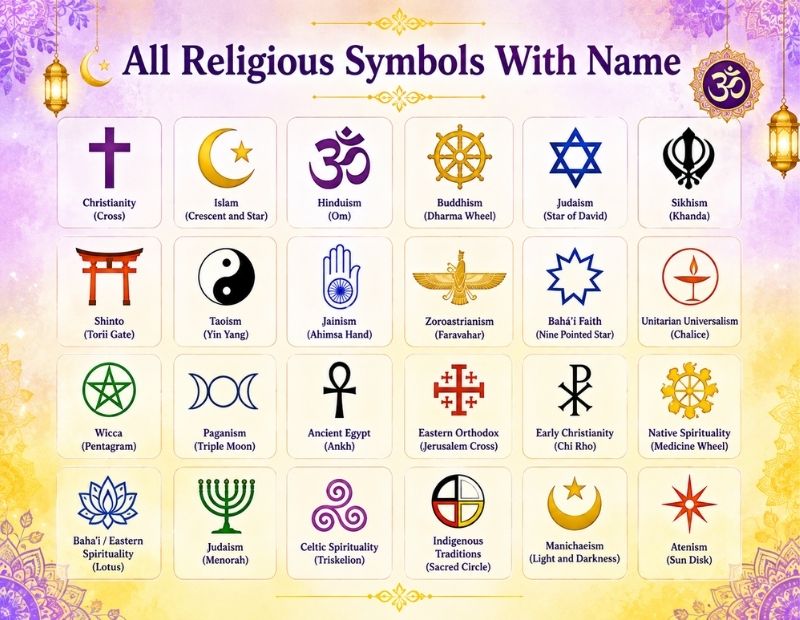
Here is a broader list of sacred symbols recognized across world religions.
- Christian cross ✝️
- Ichthys or fish symbol 🐟
- Star of David ✡️
- Menorah 🕎
- Crescent moon and star ☪️
- Hand of Fatima or Hamsa 🤚
- Om 🕉️
- Swastika, an ancient auspicious Hindu and Buddhist symbol 🌀
- Wheel of Dharma ☸️
- Lotus flower 🪷
- Khanda 🪯
- Ik Onkar 🕉️
- Ankh ☥
- Eye of Horus 👁️
- Yin Yang ☯️
- Torii gate ⛩️
Religious Symbols by Faith
Christian Religious Symbol
The cross is the defining Christian religious symbol, representing the crucifixion and resurrection of Jesus Christ. Other common symbols include the fish, the dove for the Holy Spirit, and the lamb representing sacrifice.
Catholic Religious Symbol
Catholicism shares the cross with other Christian denominations but often features the crucifix, which includes the figure of Christ. The rosary, the Sacred Heart, and Marian symbols are also central to Catholic devotion.
Lutheran Religious Symbol
The Luther Rose is the primary Lutheran religious symbol, combining a black cross, a red heart, a white rose, and a golden ring to represent faith, grace, and eternal joy.
Jewish Religious Symbol
The Star of David is the most recognized Jewish religious symbol, representing identity and covenant with God. The menorah, a seven branched candelabrum, is another central symbol tied to ancient temple worship.
Islamic Religious Symbol
The crescent moon and star are widely associated with Islam, though they are more of a cultural marker than a scripturally mandated symbol. The word Allah in Arabic calligraphy and the star and crescent on national flags are commonly used representations.
Hindu Religious Symbol
Om is the most sacred sound and symbol in Hinduism, representing the essence of the universe. The swastika, unrelated to its 20th century misuse in the West, remains an ancient auspicious symbol in Hindu and Buddhist tradition.
Sikh Religious Symbol
The Khanda is the central Sikh religious symbol, made up of a double edged sword, a circle, and two curved swords, representing spiritual and temporal power. Ik Onkar, meaning one supreme reality, is also widely used.
Religious Japanese Symbol
The torii gate is a widely recognized religious symbol in Japan, marking the entrance to Shinto shrines and the transition from ordinary space to sacred space.
Religious Egyptian Symbol
The ankh, symbolizing eternal life, and the Eye of Horus, symbolizing protection and health, are two of the most enduring religious symbols from ancient Egyptian belief.
Religious Symbols in India
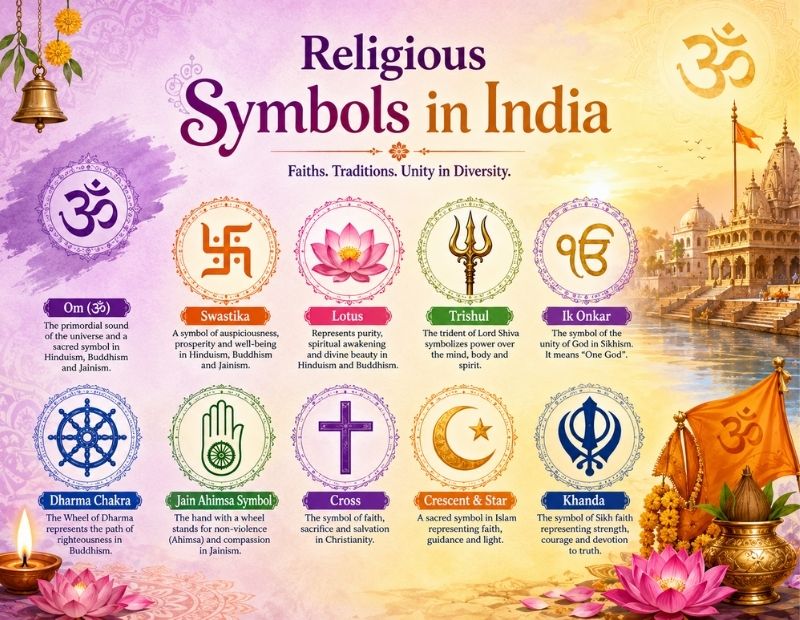
India is home to multiple faiths, each contributing its own sacred imagery to the country’s spiritual landscape.
| Religion | Common Symbol | Meaning |
|---|---|---|
| Hinduism | Om | Universal sound and unity |
| Sikhism | Khanda | Justice and power |
| Buddhism | Wheel of Dharma | Path to enlightenment |
| Jainism | Ahimsa hand symbol | Nonviolence |
| Islam | Crescent and star | Faith and guidance |
| Christianity | Cross | Salvation |
Religious Star Symbol
Stars appear across multiple faiths, though their meaning changes with context.
- The Star of David represents Jewish identity and covenant ✡️
- The Star and Crescent is linked with Islamic nations and communities ☪️
- The Star of Bethlehem represents the guiding light in the Christian nativity story ⭐
- The pentagram has historic ties to several ancient belief systems and modern pagan practice 🔯
Religious Christmas Symbol
Christmas blends religious and cultural symbolism, especially within Christian tradition.
- The nativity scene, representing the birth of Jesus 👶
- The star atop the tree, representing the Star of Bethlehem ⭐
- The candle, representing Christ as the light of the world 🕯️
- The evergreen tree, representing eternal life 🌲
- The dove, representing peace and the Holy Spirit 🕊️
Religious Symbols Tattoo Ideas
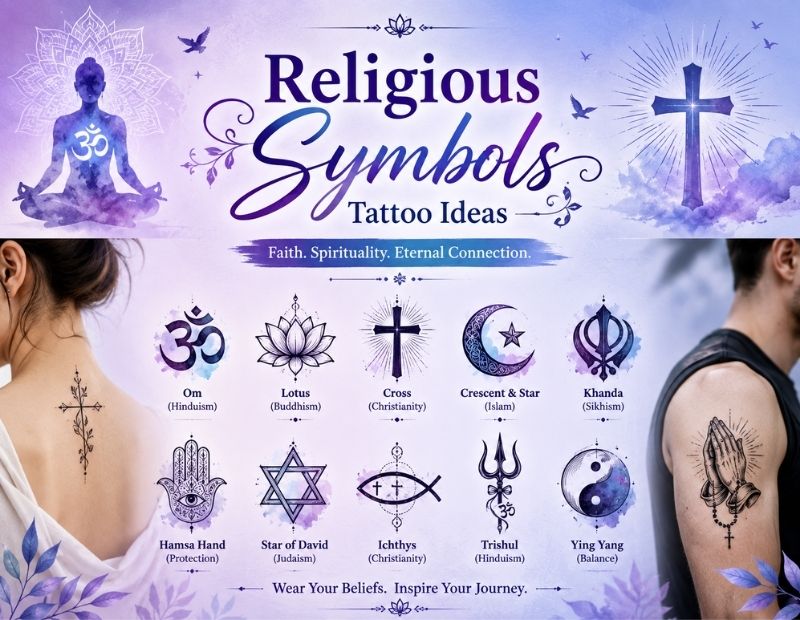
Many people choose religious symbols for tattoos as a personal expression of faith or protection.
- Small cross tattoos for Christian faith ✝️
- Om symbol tattoos for spiritual grounding 🕉️
- Hamsa hand tattoos for protection 🤚
- Lotus flower tattoos for purity and rebirth 🪷
- Ankh tattoos for eternal life ☥
Before getting a religious tattoo, it is respectful to research the symbol’s proper context, since some sacred marks are considered inappropriate for casual or purely decorative use.
Silver Kada With Religious Symbols for Men
A kada is a traditional steel or silver bracelet worn primarily in Sikh culture, often engraved with religious symbols such as the Khanda or Ik Onkar. It represents strength, discipline, and an unbreakable bond with faith, and has also become popular as a spiritual accessory beyond the Sikh community.
Religious Symbols on Gravestones
Gravestones often use religious symbols to reflect the faith of the person who has passed.
- A cross for Christian burials ✝️
- A Star of David for Jewish burials ✡️
- A crescent moon for Muslim burials ☪️
- A lotus flower for Buddhist or Hindu burials 🪷
- An anchor, historically used to represent hope in Christian tradition ⚓
Religious Symbols and Public Policy: The Quebec Example
Religious symbols are not only spiritual, they can also become the center of political and legal debate. A widely discussed case is Quebec’s Bill 21, a secularism law passed in 2019.
The law bars several public sector workers, including teachers, judges, and police officers, from wearing visible religious symbols while at work. Supporters argue the law protects the religious neutrality of the state, while critics say it disproportionately affects religious minorities and limits the right to openly practice one’s faith. The law has faced ongoing court challenges since it was passed.
This example shows how religious symbols can carry legal and political weight far beyond personal devotion, making them a topic of both spiritual and civic importance.
Religious Symbols Copy and Paste
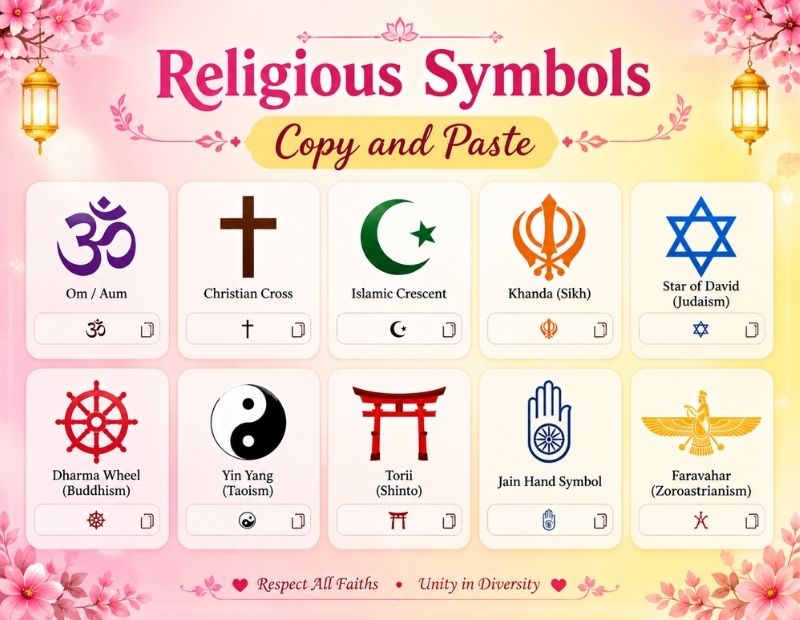
Many of the most common religious symbols are available as text characters for quick use online.
| Symbol | Character |
|---|---|
| Cross | ✝ |
| Star of David | ✡ |
| Crescent and Star | ☪ |
| Om | ॐ |
| Wheel of Dharma | ☸ |
| Yin Yang | ☯ |
| Ankh | ☥ |
Frequently Asked Questions
What are the 7 main religious symbols?
The seven most recognized are the cross, Star of David, crescent and star, Om, Wheel of Dharma, Khanda, and ankh.
What is the main Christian religious symbol?
The cross is the primary Christian symbol, representing the crucifixion and resurrection of Jesus Christ.
What is the Jewish religious symbol called?
The Star of David, also called the Magen David, is the main Jewish religious symbol representing identity and covenant.
What symbol represents Sikhism?
The Khanda is the central Sikh symbol, representing spiritual and temporal power through its sword and circle design.
Why was Bill 21 in Quebec controversial?
Bill 21 banned public workers from wearing visible religious symbols, and it drew criticism for limiting religious expression among minority faith groups.
What is the religious symbol of Japan?
The torii gate is a widely known religious symbol in Japan, marking the entrance to Shinto shrines.
Can I wear a religious symbol tattoo of a faith that is not mine?
It is best to research the symbol’s meaning and cultural context first, since some sacred symbols are considered inappropriate outside their faith community.
What does a kada with religious symbols represent?
A kada engraved with symbols like the Khanda represents strength, discipline, and a lasting connection to Sikh faith.
Conclusion
Religious symbols carry the weight of centuries in a single image. Whether it is the cross on a gravestone, the Khanda on a silver kada, or the Om inked as a tattoo, these symbols allow faith to be seen, worn, and remembered. Understanding their meaning and history offers more than just trivia, it opens a window into how billions of people across the world express belief, identity, and hope.
