

You have probably seen it a thousand times without thinking about it. A small dish tilted toward the sky, sometimes with curved lines beaming out of it. That is the satellite antenna symbol, and it has become one of the most recognized icons for signals, broadcasting, and connection.
This guide explains what the symbol means, where it is used, how to copy and paste the 📡 emoji, what its Unicode details are, where to find free PNG files, and how satellite frequency rates connect to the symbol. If you write content, design interfaces, work in telecom, or simply love emoji trivia, you will find something useful here.
What is a Satellite Antenna Symbol?
A satellite antenna symbol is an icon that represents a dish antenna used to send or receive signals from a satellite. The most common version is the emoji 📡. It shows a mounted parabolic dish with a small arm pointing out from the center.
In technical drawings, a similar symbol appears in block diagrams and site plans. It is usually a half circle or curved dish shape on a stand, often paired with a short feed arm.
Quick Definition for Featured Snippets
The satellite antenna symbol (📡) is a pictogram of a parabolic dish that sends or receives satellite signals. It stands for communication, broadcasting, data transfer, and space technology.
The symbol appears in three main forms:
- The Unicode emoji 📡
- A vector or PNG icon used in apps, websites, and presentations
- A schematic symbol used in engineering and telecom drawings
Read Also This Blog: Diya Lamp Symbol
What is a Satellite Antenna Symbol Used For?
People use the symbol wherever the idea of a signal or remote connection needs to be shown quickly. A picture of a dish is easier to understand than a long phrase.
Common uses include:
- Showing satellite TV, radio, or internet services
- Marking broadcast or live streaming features in apps
- Representing network, signal, or data transmission icons
- Labeling weather, navigation, and space related content
- Decorating tech blogs, podcasts, and news posts
- Marking ground station locations on maps and plans
- Adding a science fiction or alien signal vibe in memes and games
In chats, people often drop 📡 into a message to say “broadcasting now,” “picking up a signal,” or “searching for connection.”
Purpose Of Satellite Antenna Symbol
The main purpose of the symbol is to communicate an invisible idea in a visible way. Signals cannot be seen, but a dish pointing to the sky helps the brain picture them.
Here is what it helps achieve:
- Fast understanding: One icon replaces a full sentence.
- Universal recognition: Dishes look the same across most countries.
- Visual branding: Telecom and media brands use it to look modern and connected.
- Clear navigation: In software, it marks features that depend on signals or remote data.
- Emotional tone: In social posts, it can suggest curiosity, awareness, or being “tuned in.”
7 Powerful Meanings of the Satellite Antenna Symbol
The headline promises seven meanings. Here they are, with plain examples.
- Communication: The dish is a tool for sending and receiving messages across long distances.
- Broadcasting: It stands for TV channels, radio shows, and live streams reaching many people at once.
- Connectivity: It suggests an internet link, especially in remote regions where cables do not reach.
- Signal and reception: It shows that something is being detected, tracked, or received.
- Space technology: The upward angle connects it to satellites, orbits, and exploration.
- Searching and listening: It is used to show someone is “scanning” for news, ideas, or answers.
- Extraterrestrial contact: In pop culture, a dish is linked to listening for alien signals, so the emoji often shows up beside 👽.
Characteristics Of Satellite Antenna Symbol
The symbol looks simple, but it follows a few visual patterns.
| Characteristic | Description |
|---|---|
| Shape | A curved dish, often shown at a slant |
| Direction | Usually points to the upper right |
| Base | A small stand or mount |
| Feed arm | A short arm or horn at the center |
| Extra lines | Some designs add curved signal waves |
| Color | Grey, white, or blue on most platforms, with colored waves in some |
| Style | Flat, outlined, or 3D depending on the device |
Because every company draws its own version, the same emoji can look different on an iPhone, an Android phone, and a Windows computer. The meaning, however, stays the same.
Satellite Antenna Symbol Text
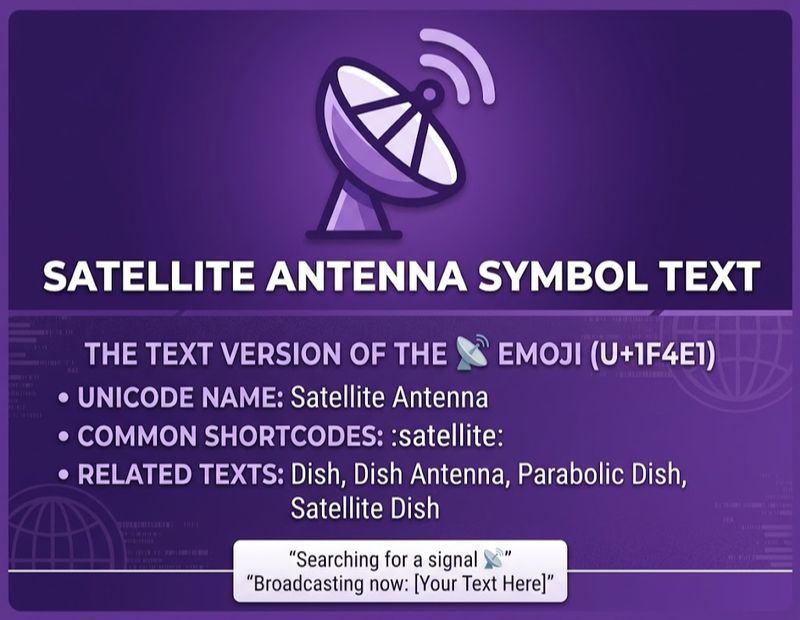
The text version refers to the written name that goes with the icon. The official Unicode name is “satellite antenna.” Some platforms also use the short code :satellite: in places like Discord and GitHub, even though that name can sometimes be confused with the separate satellite emoji 🛰️.
Related words people use in text include:
- Dish antenna
- Parabolic dish
- Satellite dish
- Ground station
- Receiver
- Transmitter
Example captions where the symbol and text work together:
- “Live now 📡 Join the broadcast.”
- “Searching for a signal 📡”
- “New podcast episode, broadcasting from my desk 📡”
Satellite Antenna Symbol Emoji
The emoji looks like this: 📡
It belongs to the Objects category, under the science group. It was approved in Unicode 6.0 in 2010 and became part of the emoji set in 2015. That means it works on almost every modern phone, tablet, and computer.
Emoji Technical Details
| Detail | Information |
|---|---|
| Emoji | 📡 |
| Official name | Satellite antenna |
| Unicode code point | U+1F4E1 |
| Unicode version | 6.0 (2010) |
| Emoji version | 1.0 (2015) |
| Category | Objects |
| Keywords | Antenna, dish, satellite, signal, communication |
| Short code | :satellite: |
Platform Design Differences
- Apple: A clean dish on a stand, with earlier versions showing signal lines.
- Google: A flat, simple dish design.
- Microsoft and X (Twitter): Often include curved radiating lines to show transmission.
- Samsung: Has changed over time, with older versions also showing signal waves.
If you are writing for a global audience, remember that appearance can change from device to device. Always check that the emoji supports your message even if the style looks different.
Satellite Antenna Symbol Copy And Paste
You can copy the symbol right here: 📡
Follow these steps to paste it anywhere:
- Highlight the emoji and copy it with Ctrl + C (Windows), Cmd + C (Mac), or a long press on mobile.
- Open your document, chat, caption box, or website editor.
- Paste it with Ctrl + V, Cmd + V, or a long press and tap Paste.
Prefer typing it? Try these quick methods:
- Windows: Press the Windows key + period, then search “satellite.”
- Mac: Press Control + Command + Space and search “satellite antenna.”
- iPhone and Android: Open the emoji keyboard and type “satellite” or “antenna.”
Code Values for Developers
| Format | Value |
|---|---|
| HTML decimal | 📡 |
| HTML hex | 📡 |
| CSS | \1F4E1 |
| JavaScript | \u{1F4E1} |
| Python | \U0001F4E1 |
| UTF-8 bytes | F0 9F 93 A1 |
| UTF-16 | D83D DCE1 |
If you work with databases, make sure your text encoding supports four byte characters (such as utf8mb4 in MySQL). Otherwise, the emoji may break or turn into question marks.
Satellite Antenna Symbol Unicode
Unicode is the global standard that gives each character and emoji a unique number so every device can show it the same way. The satellite antenna symbol uses U+1F4E1.
A few useful facts:
- It sits in the Miscellaneous Symbols and Pictographs block.
- It was added to the standard in Unicode 6.0 in 2010.
- It is part of the Emoji 1.0 set released in 2015.
- It does not have skin tone options or gender variations.
- It is a single code point emoji, which makes it easy to handle in code.
Do not confuse it with the satellite emoji 🛰️ (U+1F6F0). That one shows an orbiting spacecraft, while 📡 shows the ground based dish that talks to it.
Satellite Antenna Symbol PNG
A PNG file is a popular choice because it supports a transparent background. You can place it on any banner, slide, or thumbnail without a white box around it.
Tips for picking a good PNG:
- Choose at least 1000 pixels in width for print use.
- Make sure the background is truly transparent.
- Pick SVG if you need a logo that scales without losing quality.
- Match the style to your project, such as flat, line art, or 3D.
- Always check the license before using it commercially.
Typical uses of a PNG version:
- Website headers and feature icons
- Telecom or media company presentations
- YouTube and podcast thumbnails
- Infographics about internet or broadcasting
- Technical manuals and brochures
Free Satellite Antenna Symbol
You can find the symbol for free in several ways.
Free Options
- Built in emoji keyboards: The 📡 emoji is free on every phone and computer.
- Open license icon libraries: Many icon sites offer free dish icons in SVG and PNG.
- Design tools: Apps like Canva and Figma include free dish and signal icons.
- Public domain collections: Some archives provide free to use graphics of antennas.
- Create your own: Draw a simple curved dish with a feed arm in any vector editor.
What to Check Before Downloading
| Check | Why It Matters |
|---|---|
| License type | Some are personal use only |
| Attribution rules | Certain icons require credit |
| File format | PNG for quick use, SVG for scaling |
| Resolution | Low quality files look blurry in print |
| Brand use | Never use a logo that belongs to a company |
Free does not always mean free for business use, so read the terms carefully.
Satellite Antenna Symbol Frequency Rate
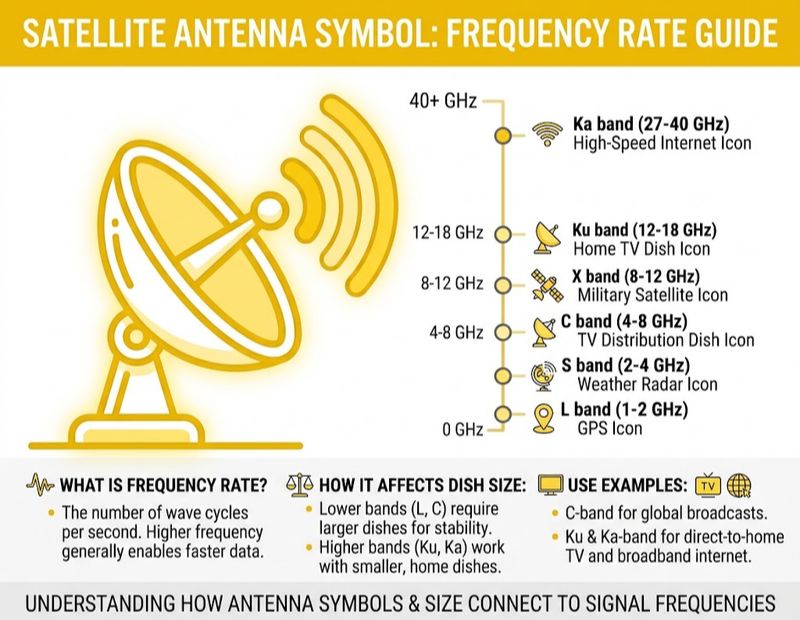
This section covers an angle most pages skip. The emoji itself has no frequency, but the real dish it represents works within specific frequency bands. People searching for “frequency rate” usually want to know how these dishes communicate.
Satellite dishes send and receive radio waves. Different bands suit different jobs, and each one has trade offs.
Common Satellite Frequency Bands
| Band | Approximate Range | Common Use |
|---|---|---|
| L band | 1 to 2 GHz | GPS, mobile satellite services |
| S band | 2 to 4 GHz | Weather radar, some space communication |
| C band | 4 to 8 GHz | TV distribution, large dishes |
| X band | 8 to 12 GHz | Military and government links |
| Ku band | 12 to 18 GHz | Direct to home TV, broadband |
| K band | 18 to 27 GHz | Specialized communication |
| Ka band | 27 to 40 GHz | High speed satellite internet |
Frequency ranges can vary slightly by standard and region, so check local regulations for exact allocations.
How Frequency Affects Dish Size?
A simple rule helps here. Lower frequencies need larger dishes, while higher frequencies allow smaller dishes. That is why a C band dish can be several feet wide, while a Ku band home TV dish is much smaller.
Pros and Cons of Different Bands
- Lower bands (L, S, C): More stable in heavy rain, but need bigger antennas.
- Mid bands (X, Ku): Good balance of size and performance, but rain can weaken the signal.
- Higher bands (Ka): Faster data and smaller dishes, but more sensitive to bad weather.
What Does “Rate” Mean Here?
The word “rate” can mean two things:
- Frequency: How many wave cycles occur per second, measured in hertz (Hz, MHz, GHz).
- Data rate: How much information is sent per second, measured in Mbps or Gbps.
Higher frequency bands often carry more data, which is why modern satellite internet leans on Ku and Ka bands.
How a Satellite Antenna Actually Works?
Understanding the real device makes the symbol more meaningful.
- A satellite in orbit sends a radio signal toward Earth.
- The curved dish collects the weak signal and reflects it to one point.
- A small device at that point, called the feed horn or LNB, receives the signal.
- The signal travels through a cable to a receiver, modem, or decoder.
- The receiver turns it into video, audio, or internet data.
For sending data, the process runs in reverse. The dish focuses the signal and beams it up to the satellite.
Key Parts of a Dish
| Part | Function |
|---|---|
| Reflector (dish) | Collects and focuses signals |
| Feed horn | Captures the focused signal |
| LNB | Amplifies and converts the signal |
| Mount | Holds the dish steady and aimed |
| Cable | Carries the signal indoors |
Fascinating Facts About the Satellite Antenna Symbol
- Many geostationary satellites sit about 35,786 kilometers above the equator, which is why home dishes stay fixed in one direction.
- The 📡 emoji has been around since the early days of emoji, so it works on nearly every device.
- It is often used beside 👽 and 🛸 in memes about alien contact.
- In weather and news content, it often marks live reports.
- Some designs rotate the dish toward the upper right, which became a visual habit across platforms.
- The dish shape is called a paraboloid, and it focuses incoming waves to a single point.
- Ham radio fans and space hobbyists use the symbol as a badge for their community.
Design and Usage Tips
If you plan to use the symbol in content or design, these quick tips help.
- Pair it with the right words. Use it for signals, broadcasts, or connections, not for unrelated topics.
- Do not overuse it. One or two emojis in a post is enough.
- Check contrast. Grey icons on grey backgrounds are hard to see.
- Test on multiple devices. Designs vary, and some older systems may show a blank box.
- Add alt text for accessibility. Describe it as “satellite dish icon” so screen readers can help users.
- Avoid mixing it up with other icons. Use 🛰️ for the satellite itself and 📡 for the dish.
SEO Tips for Using the Symbol on a Website
If you run a blog or product page, the symbol can help your content stand out.
- Use the keyword “satellite antenna symbol” in the title, first paragraph, and one heading.
- Add descriptive alt text to images, such as “satellite antenna symbol PNG on transparent background.”
- Compress PNG files so pages load fast.
- Include related terms like satellite dish icon, signal icon, and 📡 emoji meaning naturally in your content.
- Add an FAQ section to target question style searches.
- Link to related pages about emoji, telecom, and space technology.
Conclusion
The satellite antenna symbol is a small icon with a big job. It turns invisible signals into a picture anyone can read at a glance. From the 📡 emoji in your phone to engineering drawings and website icons, it stands for communication, broadcasting, connectivity, and exploration.
Now you know its Unicode code point (U+1F4E1), how to copy and paste it, where to find free PNG files, and how real satellite frequency bands shape the dishes it represents. Use it with a clear purpose, check your platform designs, and respect licenses, and it will serve your message well.
Frequently Asked Questions (FAQs)
What does the satellite antenna symbol mean?
It represents a dish that sends or receives satellite signals. People use it for communication, broadcasting, connectivity, and space technology.
What is the satellite antenna emoji?
The satellite antenna emoji is 📡, a pictogram of a parabolic dish. It is widely used for signals, TV, internet, and transmission topics.
What is the Unicode for the satellite antenna symbol?
The Unicode code point is U+1F4E1. It was added in Unicode 6.0 in 2010.
How do I copy and paste the satellite antenna symbol?
Select the 📡 emoji, copy it, and paste it where you type. You can also search “satellite” on your emoji keyboard.
What is the HTML code for the satellite antenna symbol?
Use 📡 or 📡 in your HTML. Both display 📡.
Is the satellite antenna emoji the same as the satellite emoji?
No. The 📡 emoji shows a ground dish, while 🛰️ shows a satellite in orbit.
Can I use a satellite antenna symbol PNG for free?
Yes, many sites offer free PNG files. Always read the license to see if commercial use is allowed.
Does the satellite antenna symbol have a frequency?
The emoji itself has none. The real dishes it represents use bands such as C, Ku, and Ka.
Which frequency band is used for satellite internet?
Ku and Ka bands are widely used for modern satellite internet. Ka band generally supports higher data speeds.
Why do some satellite antenna emojis look different?
Each company, like Apple, Google, and Microsoft, designs its own artwork. The Unicode code point and meaning stay the same.
Is the satellite antenna symbol used for Wi-Fi?
People sometimes use it for general signal or wireless topics, though it is more accurate for satellite and broadcast content. For Wi-Fi, a wireless signal icon is usually clearer.
Where is the satellite antenna symbol used in design plans?
It marks dish locations, ground stations, and rooftop equipment in site and network diagrams. A simple curved dish shape on a stand is the standard representation.
