

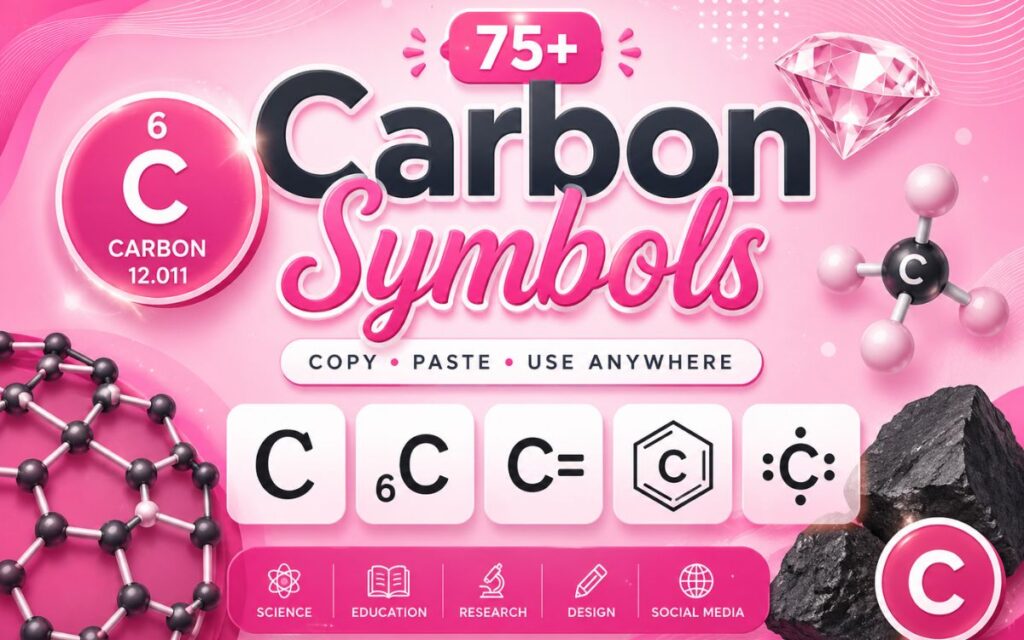
Carbon Symbols is one of the most talked about elements in chemistry class, and for good reason. It is the building block of every living thing on Earth. Yet a surprising number of students still mix up the carbon symbol with its atomic number, mass number, or valency. This guide clears up the confusion in one place, with simple explanations, easy to scan tables, and quick answers you can use for homework, exams, or general revision.
By the end of this article, you’ll know exactly what the carbon symbol represents, how carbon symbol was discovered, where carbon symbol sits on the periodic table, and how carbon symbol is written for isotopes and carbon symbol uses.
What Is Carbon Symbol?
The carbon symbol is “C”, a single capital letter taken directly from the element’s Latin name, carbonium (meaning coal or charcoal). It’s one of the few elements on the periodic table represented by just one letter, a naming shortcut reserved mostly for the earliest-known elements.
Every time you see symbol “C” in a chemical formula CO₂, CH₄, C₆H₁₂O₆ . Symbol stands for one atom of carbon. This single letter carries a huge amount of scientific meaning: Carbon Symbol tells chemists the element’s identity. Carbon Symbol’s position on the periodic table, and how it will likely behave in a reaction.
Quick facts about the carbon symbol:
- Symbol: C
- Derived from: Latin word carbo (coal)
- Element type: Nonmetal
- Group: 14 (carbon group)
- Period: 2
Read Also This Blog: Amazing Letters Symbols
When Were Carbon Symbols Discovered?
Carbon itself has been known since prehistoric times early humans used charcoal and soot without knowing they were handling a pure element. <cite index=”8-1″>Carbon was discovered by the Egyptians and Sumerians around 3750 BCE</cite>, making it one of the oldest known elements, long before the idea of atomic symbols even existed.
The letter based symbol system used today wasn’t invented until much later. Chemist Jones Jacob Berzelius introduced the modern one- and two letter element symbols in the early 1800s, giving carbon its now familiar “C” as carbon symbol. Before that, alchemists and early scientists used various pictorial or descriptive notations for carbon containing substances like coal and diamond.
Timeline at a glance:
| Period | Development |
| ~3750 BCE | Carbon (as charcoal/soot) used and recognized by ancient civilizations |
| Ancient India & China | Diamond and graphite forms of carbon documented |
| 1789 | Antoine Lavoisier lists carbon as a chemical element |
| Early 1800s | Berzelius assigns carbo symbol “C” |
Carbon Symbol For Atomic Number
The atomic number tells you how many protons sit inside an atom’s nucleus and for carbon, that number is 6. <cite index=”9-1″>Carbon is a chemical element of the periodic table with chemical carbon symbol C and atomic number 6</cite>.
Written in isotopic notation, the atomic number appears as a subscript before the symbol:
₆C
This means every carbon atom, no matter which isotope, always has exactly 6 protons. If it had a different number of protons, it simply wouldn’t be carbon anymore it would be a different element entirely. <cite index=”5-1″>In a typical sample of carbon containing material, most carbon atoms also contain 6 neutrons, giving each a mass number of 12</cite>.
Carbon Symbol For Mass Number
The mass number is the total count of protons plus neutrons in an atom’s nucleus. For the most common form of carbon, the mass number is 12.
In nuclear notation, the mass number is written as a superscript before the carbon symbol:
¹²C
Here’s how the numbers break down for carbon’s main isotope:
| Particle | Count |
| Protons | 6 |
| Neutrons | 6 |
| Mass Number | 12 |
Combining both the atomic number and mass number gives the full isotopic symbol: ¹²₆C. This notation instantly tells a chemist three things: the element (carbon), how many protons it has (6), and how many protons plus neutrons it contains (12).
Carbon Symbol For Valency
Valency describes how many bonds an atom can form with other atoms. Carbon has a valency of 4, which is one of the biggest reasons it forms such a huge variety of compounds. <cite index=”9-1″>Carbon is nonmetallic and tetravalent, making four electrons available to form covalent chemical bonds</cite>.
This tetravalency lets carbon:
- Bond with up to four other atoms at once
- Form long chains and rings (a property called catenation)
- Create single, double, and triple bonds
- Combine with hydrogen, oxygen, nitrogen, and other carbon atoms
Why does the valency of carbon matter so much?
Because of its four valence electrons, carbon can build millions of different compounds from simple methane (CH₄) to complex DNA molecules. No other element comes close to matching carbon’s bonding flexibility, which is exactly why an entire branch of chemistry (organic chemistry) is dedicated to studying carbon compounds.
Carbon Symbols in Periodic Table
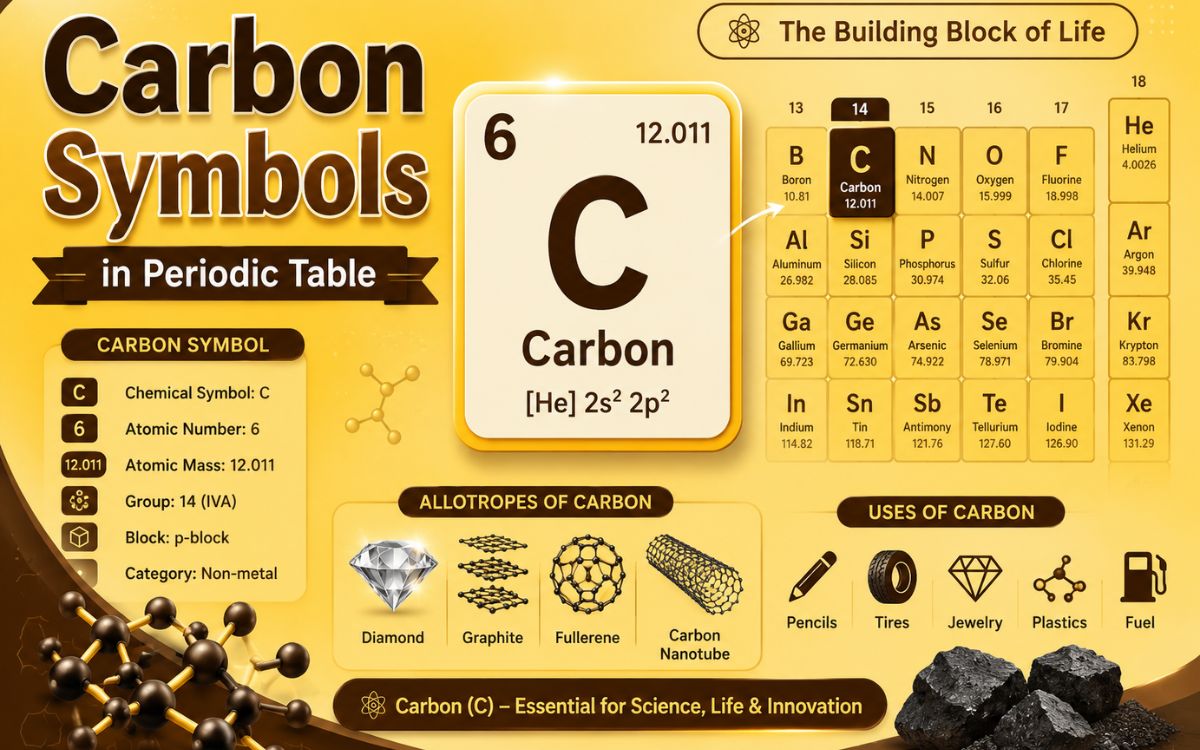
On the periodic table, carbon symbol holds a specific and important address. <cite index=”9-1″> Carbon is classed as a nonmetal and is part of group 14, the carbon group</cite>, and it sits in period 2.
| Property | Value |
| Carbon Symbol | C |
| Atomic Number | 6 |
| Group | 14 |
| Period | 2 |
| Block | p-block |
| Category | Nonmetal |
| Atomic Weight | ~12.011 u |
| Electron Configuration | [He] 2s² 2p² |
Carbon’s position in group 14 places it alongside silicon, germanium, tin, and lead. Elements that also have four valence electrons, though none matches carbon’s unique bonding ability.
Carbon Symbols Uses
The carbon symbol shows up across science, industry, and daily life. Understanding where carbon is used helps explain why this single letter is so significant.
Common uses of carbon include:
- Steel production: Carbon combines with iron to strengthen steel used in construction and manufacturing.
- Fuel sources: Coal, natural gas, and petroleum are all carbon based.
- Organic chemistry: Carbon forms the backbone of proteins, lipids, sugars, and nucleic acids.
- Industrial materials: Graphite (pure carbon) is used in pencils, lubricants, and batteries.
- Gemstones: Diamond, another pure form of carbon, is prized for jewelry and industrial cutting tools.
- Carbon dating: Radioactive carbon isotopes help scientists date ancient organic material.
- Water and air filtration: Activated carbon absorbs impurities in filters.
These uses all trace back to the same core idea: carbon’s four valence electrons let it bond in countless ways, making it one of the most versatile elements known.
Isotopes Of Carbon Symbols
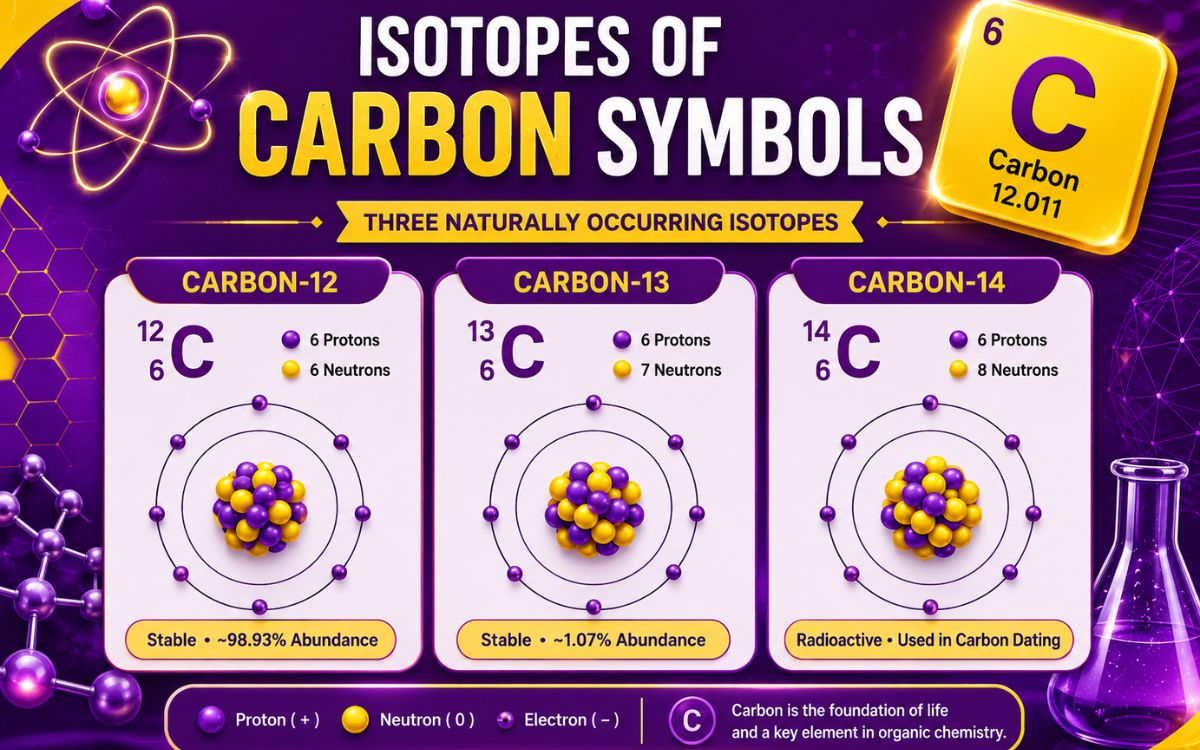
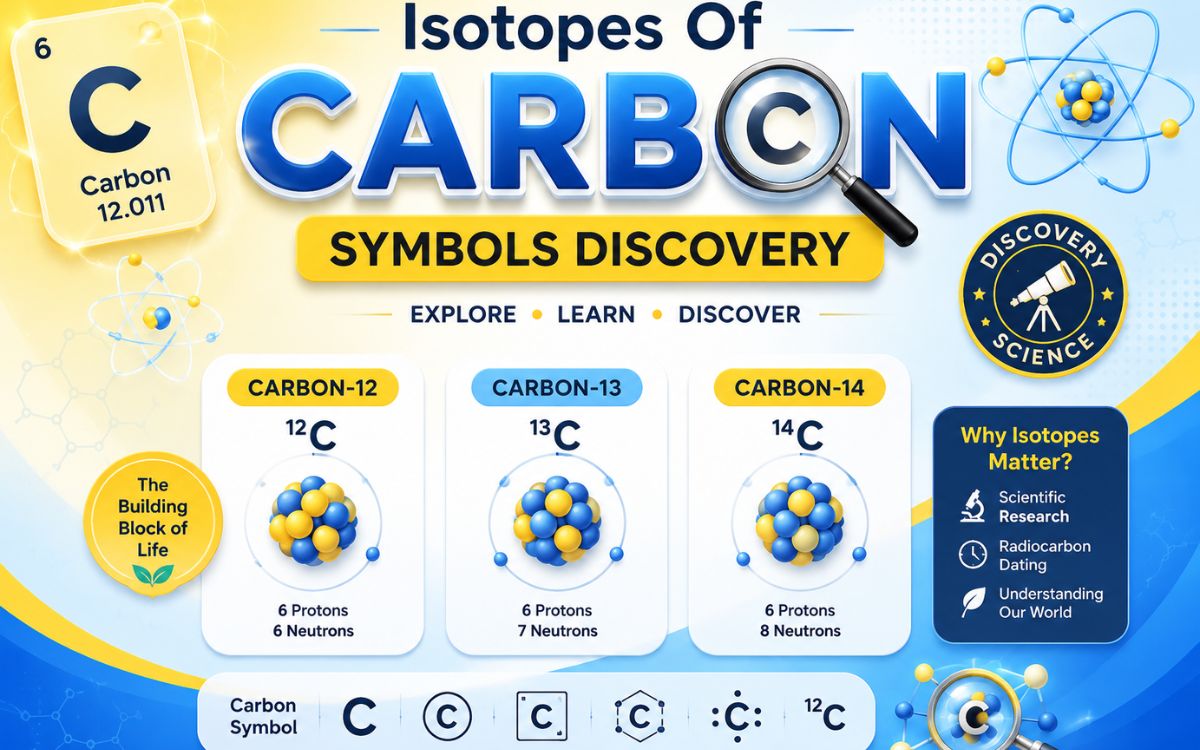
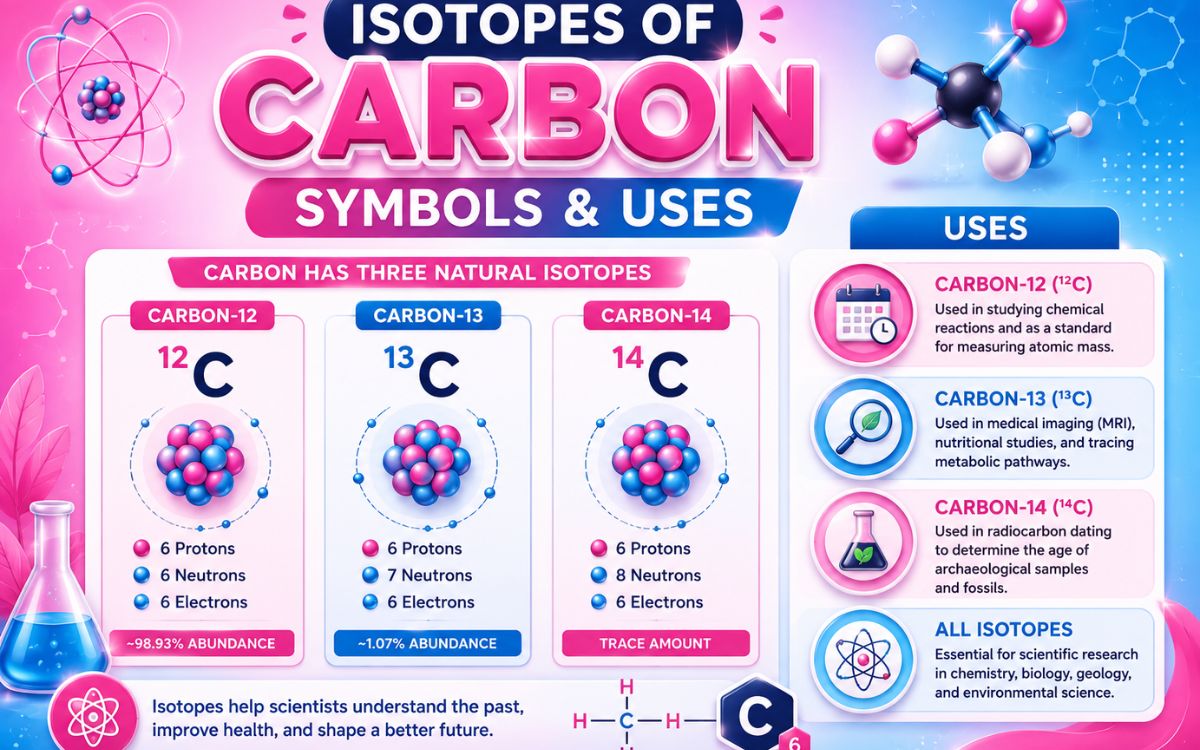
Isotopes are versions of the same element that have the same number of protons but different numbers of neutrons. Carbon has three well known isotopes, each with its own symbol.
| Isotope | Carbon Symbol | Protons | Neutrons | Mass Number | Stability |
| Carbon-12 | ¹²₆C | 6 | 6 | 12 | Stable |
| Carbon-13 | ¹³₆C | 6 | 7 | 13 | Stable |
| Carbon-14 | ¹⁴₆C | 6 | 8 | 14 | Radioactive |
- Carbon-12 is by far the most abundant isotope, making up roughly 98–99% of natural carbon. It’s also the reference standard used to define the atomic mass unit.
- Carbon-13 is a stable isotope that makes up about 1% of natural carbon and is widely used in scientific research, including mass spectrometry.
- <cite index=”16-1″>Carbon-14, often called radiocarbon, is a radioactive isotope with a half-life of approximately 5,700 years</cite>, and it’s the isotope behind the famous carbon dating technique used by archaeologists.
Each isotope is written using the same basic format: the mass number as a superscript, the atomic number as a subscript, followed by the letter “C.”
Conclusion
The carbon symbol “C” might look simple, but carbon symbol packs in an enormous amount of chemistry. Atomic number 6, mass number 12, a valency of 4, and a spot in group 14 of the periodic table. Once you understand how these pieces fit together, reading any carbon related notation, from ¹²₆C to CO₂, becomes second nature. Whether you’re studying for an exam or just curious about the science behind everyday materials like coal, diamond, and steel, carbon symbol is a small letter that tells a very big story.
FAQs
What is the Carbon Symbols?
The carbon symbols is C, taken from the Latin word carbo, meaning coal.
What is the atomic number of carbon?
Carbon’s atomic number is 6, meaning every carbon atom has 6 protons.
What is the mass number of carbon?
The most common isotope of carbon has a mass number of 12 (6 protons + 6 neutrons).
What is the valency of carbon?
Carbon has a valency of 4, allowing it to form four covalent bonds.
How many isotopes does carbon have?
Carbon has three main isotopes: carbon-12, carbon-13, and carbon-14.
Which carbon isotope is radioactive?
Carbon-14 is radioactive and is used in radiocarbon dating.
Which group and period is carbon symbol in?
Carbon is in group 14 and period 2 of the periodic table.
Why is carbon symbol written with just one letter?
Carbon symbol was one of the earliest elements identified, so carbon symbol received a single letter symbol under the Berzelius naming system.
