

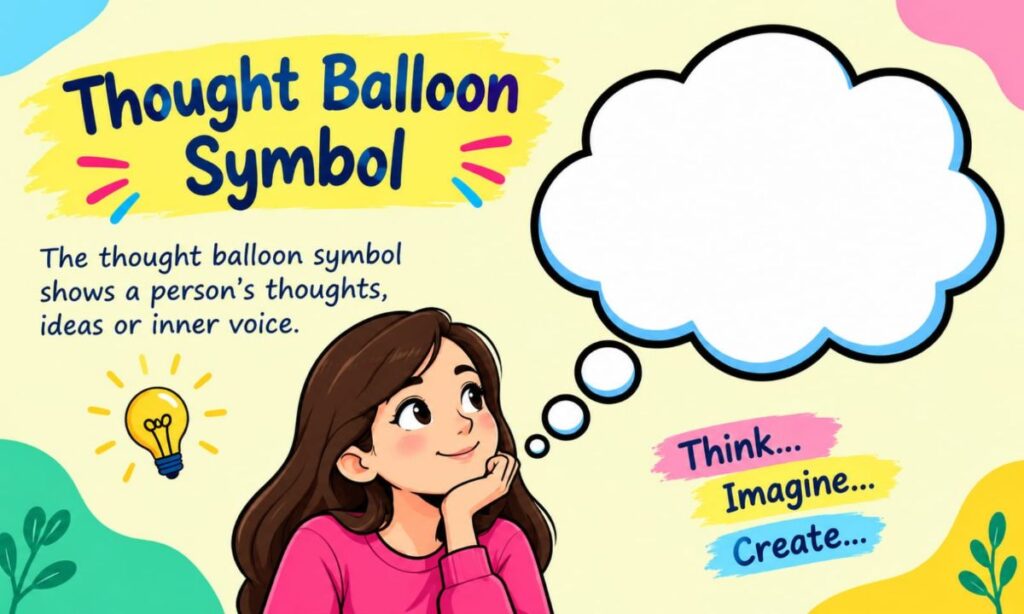
You have probably seen the little cloud 💭 in a caption, a story, or a text from a friend. It looks simple, but it says a lot. The thought balloon symbol shows that someone is thinking, dreaming, wondering, or keeping something unsaid.
This guide covers what the symbol means, where it came from, and how to copy and paste it. It also explains how to type it on any device and how to use it well on social media. If you only need the symbol, here it is:
💭
Select it, copy it, and paste it anywhere. The rest of the article explains how to get the most out of it.
What Is the Thought Balloon Symbol?
The thought balloon symbol is a small emoji shaped like a puffy cloud. Small circles usually trail from one corner, like bubbles drifting away. The design comes from comic books and cartoons, where a cloud over a character’s head shows what that character is thinking but not saying out loud.
Its official Unicode name is “Thought Balloon”. Many people call it the thought bubble, thinking cloud, or daydream emoji. All of these names point to the same character: 💭.
Read Also This Blog: Oval Symbol
Quick Facts at a Glance
| Detail | Information |
|---|---|
| Symbol | 💭 |
| Official name | Thought Balloon |
| Unicode code point | U+1F4AD |
| HTML decimal code | 💭 |
| HTML hex code | 💭 |
| CSS code | \1F4AD |
| Shortcode | :thought_balloon: |
| Category | Smileys & Emotion |
| Unicode version | 6.0 (2010) |
| Emoji version | 1.0 (2015) |
| Common keywords | thought, bubble, cloud, dream, comic, thinking |
Thought Balloon Symbol Meaning
The main meaning of 💭 is simple: thinking. It stands for a thought that is still forming or one that someone has chosen not to say. Because the shape is soft and vague, people read it in many ways depending on the message around it.
10+ Meanings of the Thought Balloon Symbol
- Thinking or pondering. The most direct meaning. You are turning an idea over in your head.
- Daydreaming. A drifting mind, usually a pleasant one.
- Wondering. A question that does not need an answer yet.
- Unspoken feelings. Something you feel but have not said.
- Inner monologue. The voice in your head, shown on the screen.
- Imagination and creativity. A fresh idea, a plan, or a concept in progress.
- Nostalgia. A memory that came back unexpectedly.
- Overthinking. A mind that will not settle, often used with humor.
- Hidden sarcasm. A thought that is better kept to yourself, usually said with a wink.
- Introspection. Quiet self-reflection, common in journaling and mental health posts.
- Hopes and wishes. Something you want but have not asked for.
- Late night thoughts. The questions that show up when it is quiet and dark.
You will see most of these in everyday chat. The meaning changes with the emoji and words next to it. A 💭 beside a heart suggests longing, while one beside a coffee cup suggests a slow morning.
The Emotional Tone of 💭
The symbol is usually neutral to gentle. It does not shout. That makes it useful when you want to share a mood without writing a paragraph. It can feel dreamy, curious, tender, or a little sad, and it rarely feels aggressive.
Where Did the Thought Balloon Come From?
The idea is much older than emoji. Comic artists started using cloud shaped balloons in the early twentieth century to separate private thoughts from spoken words. A speech balloon has a pointed tail aimed at the speaker. A thought balloon has a bumpy edge and a trail of small circles instead.
The digital version arrived with Unicode. It was approved in Unicode 6.0 in 2010. It became part of the standard emoji set in 2015 with Emoji 1.0. Since then it has appeared on every major platform, including Apple, Google, Samsung, Microsoft, Meta, and X.
Japanese mobile culture also played a role. Early emoji were made for chat and email in Japan, where short visual cues helped add tone to text. The thought balloon fit that need well.
Thought Balloon Symbol Text: How It Works in Writing?
In plain text, the thought balloon works like a quiet stage direction. It tells the reader that the words after it are thoughts, not speech. You can use it in several ways.
As a prefix:
💭 Maybe I should start that blog this year.
As a suffix:
Should I text them first or wait? 💭
As a standalone reply:
Someone asks, “What are you up to?” You reply with 💭 and let them guess.
To soften a message:
It’s been on my mind for a while 💭
Some people also write the idea out in plain characters, like “(thinking…)” or “o O (idea)”. The “o O” form mimics the small circles in a comic thought bubble. It works on old systems that cannot display emoji, but the real symbol is clearer and more popular.
Thought Balloon Symbol Copy and Paste

This is the fastest method. You do not need any special software.
Copy and Paste Steps
- Highlight the symbol: 💭
- Press Ctrl + C on Windows or Command + C on Mac. On a phone, long press and tap Copy.
- Open the app where you want to use it.
- Press Ctrl + V on Windows or Command + V on Mac. On a phone, long press and tap Paste.
It will keep its shape in most apps, though the design may change slightly. That is normal, and we cover why in the next section.
Ready to Copy Variations
Here are a few combinations people often paste:
- 💭
- 💭💭💭
- 💭✨
- 💭❤️
- 💭🌙
- 💭☕
- 🤔💭
- 💭📚
- 💭🎵
- 😴💭
You can paste any of these directly into a bio, caption, or note.
Thought Balloon Symbol Emoji: Technical Details
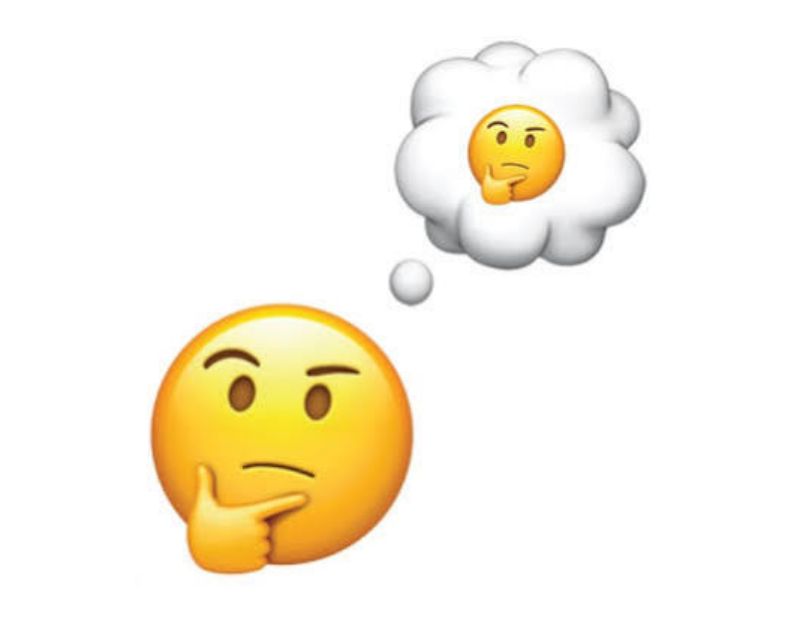
The 💭 is a real emoji, not just a decorative symbol. It belongs to the Smileys & Emotion group in the Unicode standard. That means it is treated as a color graphic on most devices and can sit inside a line of text.
Code Reference for Developers
If you build websites or apps, you can insert the symbol without pasting it.
| Language or Format | Code |
|---|---|
| HTML (decimal) | 💭 |
| HTML (hex) | 💭 |
| CSS content property | content: “\1F4AD”; |
| JavaScript | “\u{1F4AD}” |
| Python | “\U0001F4AD” or “\N{THOUGHT BALLOON}” |
| Unicode notation | U+1F4AD |
Make sure your page uses UTF-8 encoding. Without it, the symbol may show as a broken box.
Why 💭 Looks Different on Each Device?
Unicode only defines the character and its name. Each company draws its own artwork. Apple’s version tends to look soft and detailed, with a gentle shadow. Google’s is flatter and cleaner. Samsung and Microsoft use their own styles with different outlines and shading.
This matters for design. A 💭 that looks calm on an iPhone may look more cartoonish on another phone. If tone is important, check how it appears on the platforms your readers use most.
Thought Balloon Symbol on iPhone
Using the symbol on an iPhone takes only a few seconds.
Method 1: The Emoji Keyboard
- Open any app with a text field, such as Messages or Notes.
- Tap the smiley face or globe icon at the bottom left of the keyboard.
- Type “thought” in the search bar at the top of the emoji keyboard, or scroll to the Smileys & People section.
- Tap 💭 to insert it.
Method 2: Text Replacement Shortcut
You can create your own shortcut so a short word turns into 💭 automatically.
- Open Settings.
- Tap General, then Keyboard, then Text Replacement.
- Tap the plus sign.
- Paste 💭 into the Phrase box.
- Type a shortcut such as “thnk” and tap Save.
Now typing “thnk” will suggest the symbol every time. This is handy if you use it often.
Method 3: Copy and Paste
Copy the symbol from this page and paste it into any iPhone app. This works in Safari, Notes, Instagram, WhatsApp, and more.
Thought Balloon on Android
On Android, open your keyboard, tap the emoji icon, and search for “thought”. Gboard and Samsung Keyboard both support emoji search. The same text shortcut idea also works through your keyboard’s dictionary settings.
Thought Balloon on Windows and Mac
- Windows 10 and 11: Press the Windows key plus the period key to open the emoji panel. Search “thought” and select 💭.
- Mac: Press Control + Command + Space to open the character viewer. Search “thought balloon” and double click the result.
- Linux: Many desktops let you press Ctrl + Shift + U, type 1f4ad, and press Enter.
Thought Balloon Symbol on Social Media
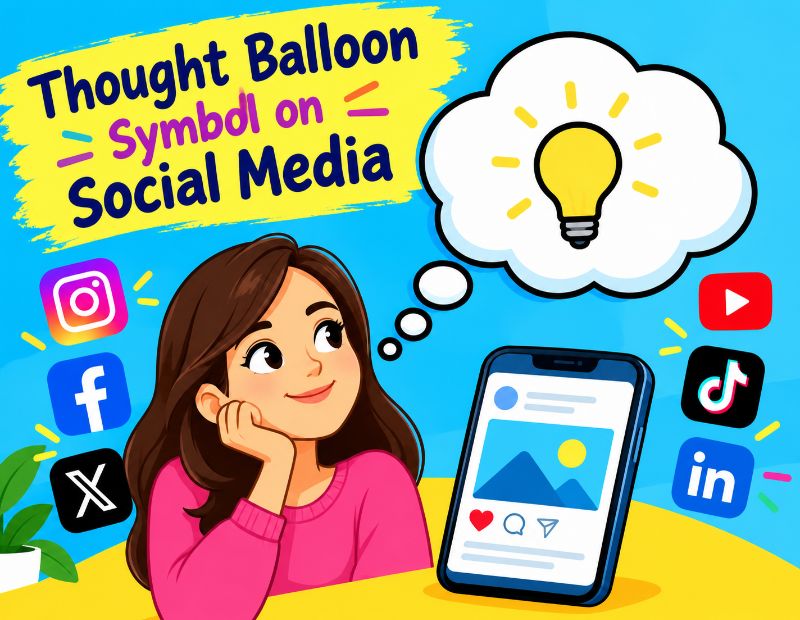
The 💭 shows up almost everywhere. Different platforms lean on it in slightly different ways.
On Instagram, people place 💭 in captions to introduce a reflective or personal line. It also works well in Stories, where a single cloud over a photo can hint at a mood. Creators use it in bios for “thoughts and ideas” or “overthinker” style identities.
TikTok
On TikTok, the symbol often appears in comments and captions to show a mind wandering. It also sits next to trending audio about daydreams, crushes, or late night thinking. A comment with only 💭 can mean “this made me think.”
X (Twitter)
On X, users add 💭 before a short opinion or “shower thought”. It signals that the post is casual and not a formal statement. It is also common in threads that start with “random thoughts”.
Facebook and WhatsApp
On Facebook and WhatsApp, the symbol is used in status updates and chats to soften a message. Saying “Missing home 💭” feels lighter than saying it plainly.
Snapchat
Snapchat users drop 💭 on photos and captions to share a mood or a question. It pairs well with sticker text that reads like an inner voice.
LinkedIn and Professional Use
On LinkedIn, the symbol is less common but still works. It can open a reflective post, such as “💭 Something I learned this quarter.” Use it sparingly in professional settings and keep the tone clear.
Pinterest and Tumblr
Writers and artists use 💭 on Pinterest boards and Tumblr posts for quotes, prompts, and journaling ideas. It signals a creative or dreamy collection.
Best Ways to Use the Thought Balloon Symbol
Knowing the meaning is only half the job. Good use depends on timing and pairing.
Tips for Better Use
- Place it where a short pause would happen in speech.
- Pair it with one other emoji, not five.
- Match it to the mood of your words.
- Avoid using it to dodge a direct answer in serious talks.
- Keep it consistent in branded posts so readers recognize your style.
Example Captions
- “Coffee, rain, and a quiet mind 💭”
- “💭 What if I just tried?”
- “Some days feel like a movie in my head 💭🎬”
- “Writing it down so I stop overthinking 💭📝”
- “Sunday plans: do nothing and daydream 💭☁️”
Pairing Ideas
| Pair With | Resulting Mood |
|---|---|
| 💭❤️ | Longing or crush |
| 💭🌙 | Late night reflection |
| 💭☕ | Slow, thoughtful morning |
| 💭📚 | Study or learning mode |
| 💭🎨 | Creative brainstorming |
| 💭😅 | Awkward or funny overthinking |
| 💭✨ | Hopeful idea |
| 💭🌧️ | Moody or nostalgic |
Thought Balloon vs Speech Balloon vs Similar Symbols
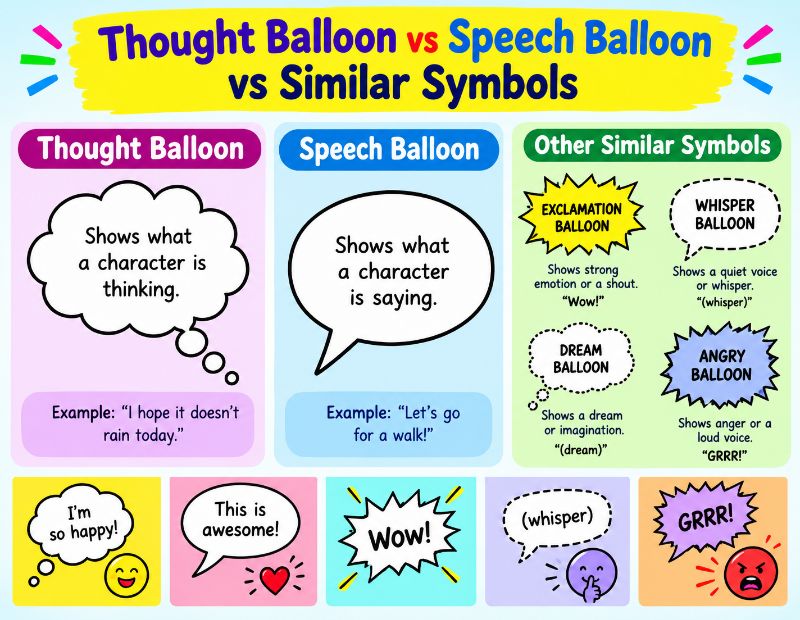
People often mix up the thought balloon with other chat symbols. They look alike but carry different ideas.
| Symbol | Name | Unicode | Main Meaning |
|---|---|---|---|
| 💭 | Thought Balloon | U+1F4AD | Thinking, dreaming, private thoughts |
| 💬 | Speech Balloon | U+1F4AC | Spoken words, chat, conversation |
| 🗨️ | Left Speech Bubble | U+1F5E8 | Someone speaking or commenting |
| 🗯️ | Right Anger Bubble | U+1F5EF | Shouting or strong emotion |
| 🤔 | Thinking Face | U+1F914 | Doubt, curiosity, questioning |
| 💤 | Zzz | U+1F4A4 | Sleep or boredom |
| ☁️ | Cloud | U+2601 | Weather, sky, calm |
The easiest way to remember: a speech balloon is for words people say, and a thought balloon is for words people think. If you want to show a thinking face with the thought, combine them: 🤔💭.
Where Else Is the Thought Balloon Used?
Beyond chat, the idea behind 💭 appears in many fields.
- Comics and graphic novels: The original home of the thought balloon. Artists use it to reveal inner voices.
- Animation and film: Cartoons often show dreams and wishes inside a bubble.
- Education: Teachers use thought bubble worksheets to help students describe what a character feels.
- Psychology and therapy: Thought bubbles help people separate thoughts from facts in cognitive exercises.
- Marketing: Brands use the cloud shape to ask questions or share bold ideas.
- Design and UX: Interface designers use it as an icon for notes, comments, or ideas.
- Journaling and planning apps: It often marks reflection prompts.
Interesting Facts About the Thought Balloon Symbol
- Its Unicode code point, U+1F4AD, sits in the Miscellaneous Symbols and Pictographs block.
- It was added to Unicode a few years before it became a standard emoji on phones.
- The same shape is used as a favicon and icon by developers who want a thoughtful, creative feel.
- It has no official skin tone or gender variations, so it looks the same for everyone.
- Search keywords tied to it include bubble, cloud, comic, dream, and thought.
- It has been part of mainstream keyboards since the mid 2010s.
- Designers often rotate or enlarge it in graphics to create a dreamy background effect.
- It pairs naturally with text overlays in photos and short videos.
How to Use the Thought Balloon Symbol in Design and Web Content?
If you manage a website, blog, or brand page, the symbol can add personality in small doses.
In headings: A single 💭 can make a section on ideas or reflection feel friendly.
In meta descriptions: Some publishers add an emoji to catch the eye in search results. Use it rarely, and only if it fits your voice. Search engines may or may not display it.
In social images: Draw or place a cloud shape over a character or object to hint at an inner voice.
As a favicon: The cloud icon works for blogs about ideas, writing, or personal growth.
In email subject lines: A 💭 can signal a reflective or “just thinking” message. Test it against a plain subject line to see what your audience prefers.
Accessibility Tips
Screen readers read emoji out loud using their official names. A 💭 is usually read as “thought balloon”. If you add many of them in a row, the reader will repeat the name each time, which can be tiring.
To keep your content friendly for everyone:
- Use one or two per post, not long strings.
- Put the meaning in words as well, so the emoji is a bonus.
- Avoid replacing important words with emoji.
Common Mistakes to Avoid
- Using it as a replacement for speech. If you mean to say something out loud, use words or a speech balloon.
- Overusing it. Too many clouds make a message look cluttered.
- Ignoring the platform design. Check how it looks where your audience will see it.
- Mixing it with unrelated emoji. Keep the combination logical.
- Using it in serious or formal notices. A cloud may feel out of place in legal or urgent messages.
Frequently Asked Questions
What does the thought balloon symbol mean?
Thought Balloon Symbol means thinking, daydreaming, or an unspoken thought. It borrows its look from comic book thought bubbles.
What is the Unicode for the thought balloon symbol?
The Unicode code point is U+1F4AD. Its official name is Thought Balloon.
How do I copy and paste the thought balloon symbol?
Select 💭, copy it with Ctrl + C or Command + C, then paste it with Ctrl + V or Command + V. On a phone, long press and choose Copy or Paste.
Is the thought balloon an emoji or a symbol?
It is both. It is a Unicode symbol that displays as an emoji on modern devices.
How do I get the thought balloon emoji on iPhone?
Open the emoji keyboard, search “thought”, and tap 💭. You can also set a Text Replacement shortcut in Settings.
Is there a thought balloon symbol emoji on Android?
Yes. Open your keyboard, tap the emoji icon, and search “thought” to find it.
How do I type the thought balloon symbol on a Windows PC?
Press Windows key plus the period key, search “thought”, and select the symbol.
How do I type thought balloon symbol on a Mac?
Press Control + Command + Space, search “thought balloon”, and double click it.
What is the difference between a thought balloon symbol and a speech balloon?
A thought balloon symbol 💭 shows private thoughts, while a speech balloon 💬 shows spoken words.
Does the thought balloon symbol look the same on every device?
No. Each company designs its own artwork, so the style changes between Apple, Google, Samsung, and others.
Can I use the thought balloon symbol in Instagram bios and captions?
Yes. It works in captions, bios, comments, and Stories without any restrictions.
What is the shortcode for the thought balloon symbol emoji?
The common shortcode is :thought_balloon:, which works on many chat apps.
When was the thought balloon symbol emoji added to Unicode?
It was approved in Unicode 6.0 in 2010 and became part of Emoji 1.0 in 2015.
What emoji go well with the thought balloon symbol?
Popular pairings include ❤️, 🌙, ☕, 📚, ✨, and 🤔. The best one depends on the mood you want.
Is the thought balloon symbol safe to use in professional messages?
Yes, in moderation. Thought balloon symbol suits reflective posts and friendly updates but not formal or urgent notices.
Conclusion
The thought balloon symbol 💭 is a small but expressive tool. It tells your reader that a thought is in progress, whether that thought is a dream, a question, or a feeling you are not ready to say out loud. Its roots in comic art make it instantly familiar, and its place in Unicode makes it available on almost every device.
Now you know what it means, how to copy and paste it, and how to type it on an iPhone, Android phone, Windows PC, or Mac. You also know how to use it on social media without overdoing it. Use it with care, pair it with the right words, and it will add warmth and personality to your messages.
